

UPSC Mapping
- Prelims: Polity & Judiciary
- Mains: GS Paper 2 (Judiciary & Constitutional Bodies)
Quick Facts
| Judge | Discovery | Outcome |
|---|---|---|
| Justice Yashwant Varma | Burnt currency at official residence | Resigned in April 2026 |
What is Judicial Accountability Varma?
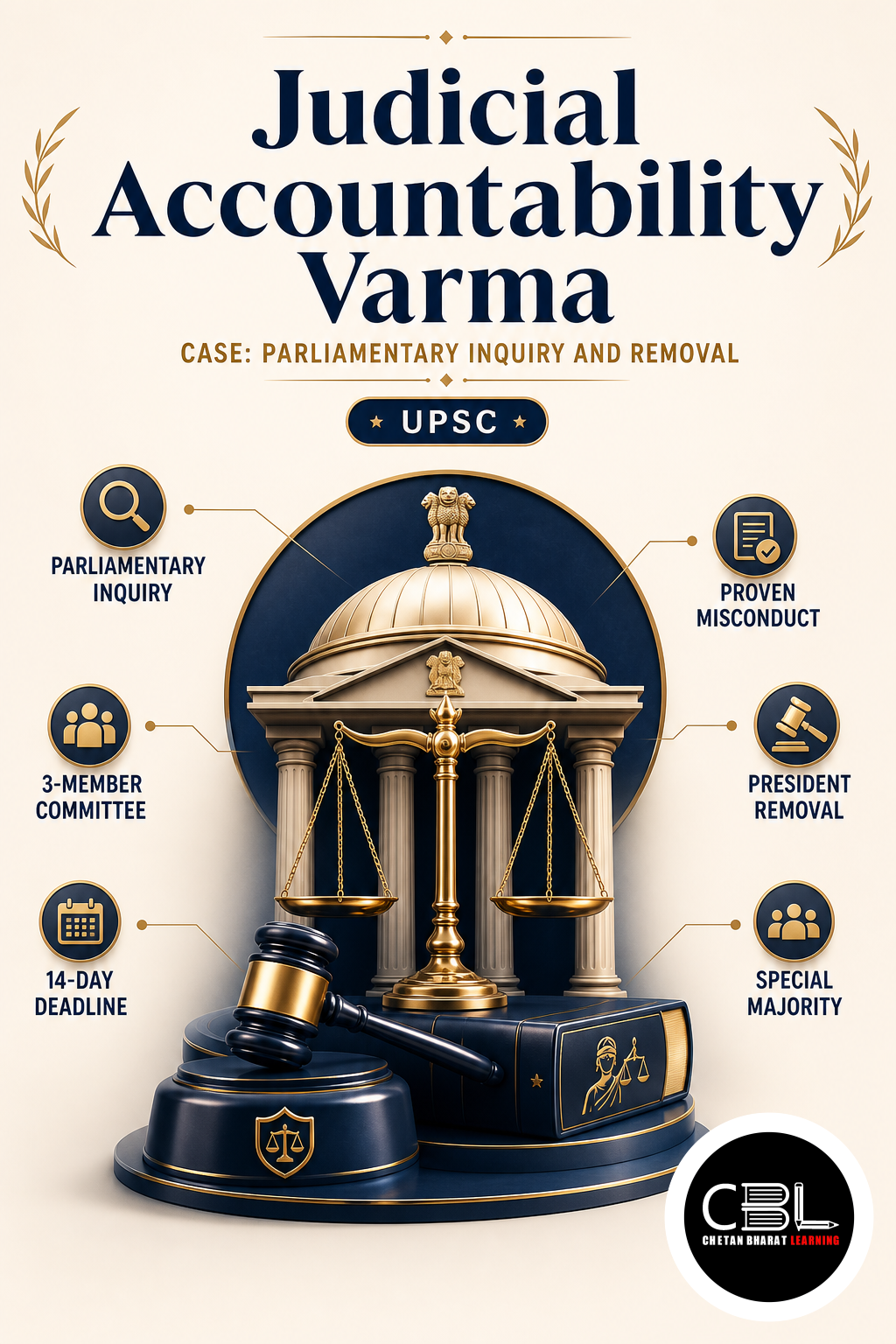
Judicial Accountability Varma refers to the case involving Justice Yashwant Varma, a judge of the Delhi High Court, whose official residence was found to contain a “huge quantity” of burnt and partially destroyed ₹500 currency notes in March 2025. A parliamentary inquiry committee later found him unable to explain the presence, source, or ownership of the cash.
The committee framed three articles of charge: possession of unexplained currency, interference with material evidence, and furnishing evasive explanations. All three charges were proved. Justice Varma resigned in April 2026, and the inquiry report was tabled in Lok Sabha in August 2026.
Why is Judicial Accountability Varma in News?
The case has been in the news because the parliamentary inquiry report was tabled in Lok Sabha, raising constitutional questions about whether Parliament can proceed with a removal motion against a judge who has already resigned. Jurists differ in their interpretations—some argue impeachment can proceed post-resignation.
It has also highlighted the broader issue of judicial accountability: how to hold judges responsible without compromising judicial independence. The findings have sparked debates on the need for a stronger judicial ethics framework and an independent complaints mechanism.
Key Features of the Case
- Discovery of Cash: Wads of burnt and partially destroyed ₹500 notes found in a storeroom.
- Parliamentary Inquiry: Three articles of charge—unexplained cash, interference with evidence, misleading explanations.
- Mutually Corroborative Testimony: Eight security officials testified to seeing bundles of notes.
- Circumstantial Evidence: Call records and staff movements linked the judge to the disappearance.
- Resignation: Justice Varma resigned before conclusion of the inquiry.
Challenges Highlighted
- Resignation Dilemma: No clear provision on impeaching a judge post-resignation.
- Self-Regulation: Accountability limited if judges police themselves.
- Political Pressure: Parliament’s role may affect judicial independence.
- Procedural Gaps: Lack of time-bound inquiry mechanism delays justice.
- Public Trust: Misconduct erodes confidence in the judiciary.
Way Forward
India needs a robust judicial ethics framework with clear codes of conduct and an independent complaints mechanism that operates outside the judiciary but includes judicial input. Transparency in inquiries—time-bound proceedings and public disclosure of findings—can enhance accountability. Clarifying the status of impeachment after resignation will address constitutional ambiguities.
Prelims Practice Corner
-
Q1. What was found at Justice Varma’s official residence?
- Unaccounted gold
- Burnt and partially destroyed currency notes
- Classified documents
- Illegal firearms
Answer: (b) Wads of burnt and partially destroyed ₹500 notes were found.
-
Q2. How many articles of charge were framed?
- 1
- 2
- 3
- 4
Answer: (c) Three articles of charge were framed.
-
Q3. When did Justice Varma resign?
- March 2025
- April 2026
- August 2026
- Not resigned
Answer: (b) He resigned in April 2026.
-
Q4. Which committee conducted the inquiry?
- Supreme Court collegium
- Parliamentary inquiry committee
- CBI
- National Judicial Appointments Commission
Answer: (b) A parliamentary inquiry committee conducted the inquiry.
-
Q5. What constitutional question does the case raise?
- Can a judge be impeached after resignation?
- Can the President remove a judge?
- Is the Supreme Court’s decision final?
- Can Parliament override judicial decisions?
Answer: (a) The case raises the question of whether impeachment can proceed after a judge’s resignation.
Mains Practice Questions
-
Q1. Discuss the constitutional mechanisms for judicial accountability in India, with reference to the Justice Varma case. (250 words, 15 marks)
Answer Structure:
- Intro: Frame the Justice Varma case as a test of accountability mechanisms.
- Body: Removal under the Constitution, role of parliamentary inquiry, balance between independence and accountability, findings and constitutional questions.
- Conclusion: Recommend strengthening judicial ethics and independent complaints mechanism.
-
Q2. What is the procedure for the removal of a Supreme Court or High Court judge in India? What are the challenges in this process? (150 words, 10 marks)
Answer Structure:
- Intro: Constitutional provision for judicial removal.
- Body: Impeachment motion, parliamentary inquiry, special majority; challenges—high threshold, political pressure, self-regulation, resignation dilemma.
- Conclusion: Need for reform to ensure accountability without compromising independence.
FAQs on Judicial Accountability Varma
What was the Justice Varma case about?
It involved the discovery of burnt currency at a Delhi High Court judge’s official residence, leading to a parliamentary inquiry that found the judge guilty of misconduct.
What is the procedure for judicial removal?
A judge can be removed through impeachment—a motion passed by both Houses of Parliament with a special majority, on grounds of proven misbehaviour or incapacity.
Why does judicial accountability matter?
Judicial accountability is essential to maintain public trust in the judiciary and the rule of law, ensuring judges are responsible for their conduct without compromising judicial independence.
Related Current Affairs
Preparing for UPSC, PCS or HCS?
Talk to a mentor at Chetan Bharat Learning, Chandigarh. Free guidance on choosing the right exam and building a study plan.
Chat on WhatsAppCall 97793 53345UPSC / IAS / PCS coaching in Chandigarh · Trusted by aspirants across Punjab & Haryana
Leave a Reply
You must be logged in to post a comment.