
UPSC Syllabus Mapping
GS Paper: GS-II
Subject: International Relations – India and Regional Groupings
What is Free Open Indo-Pacific?
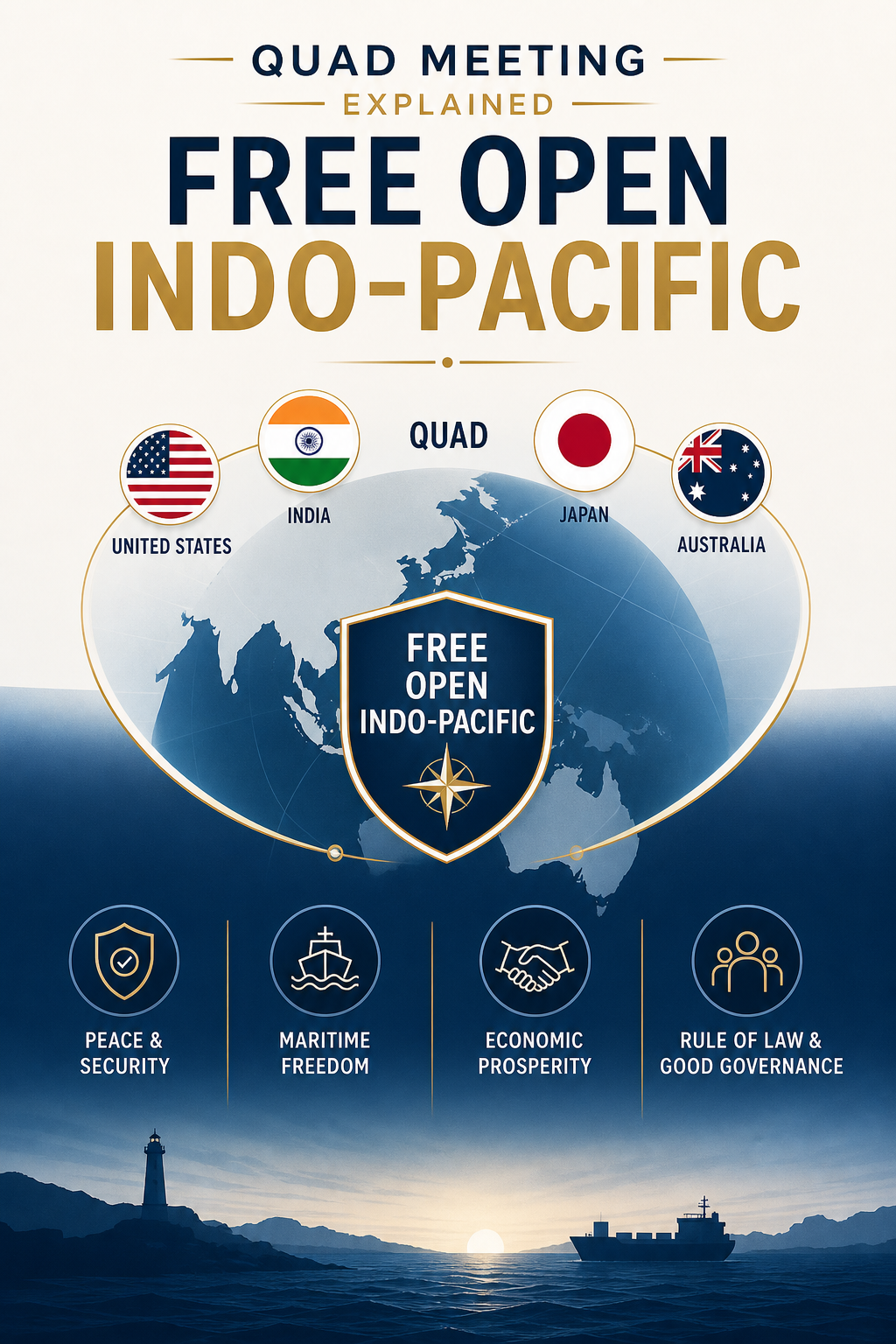
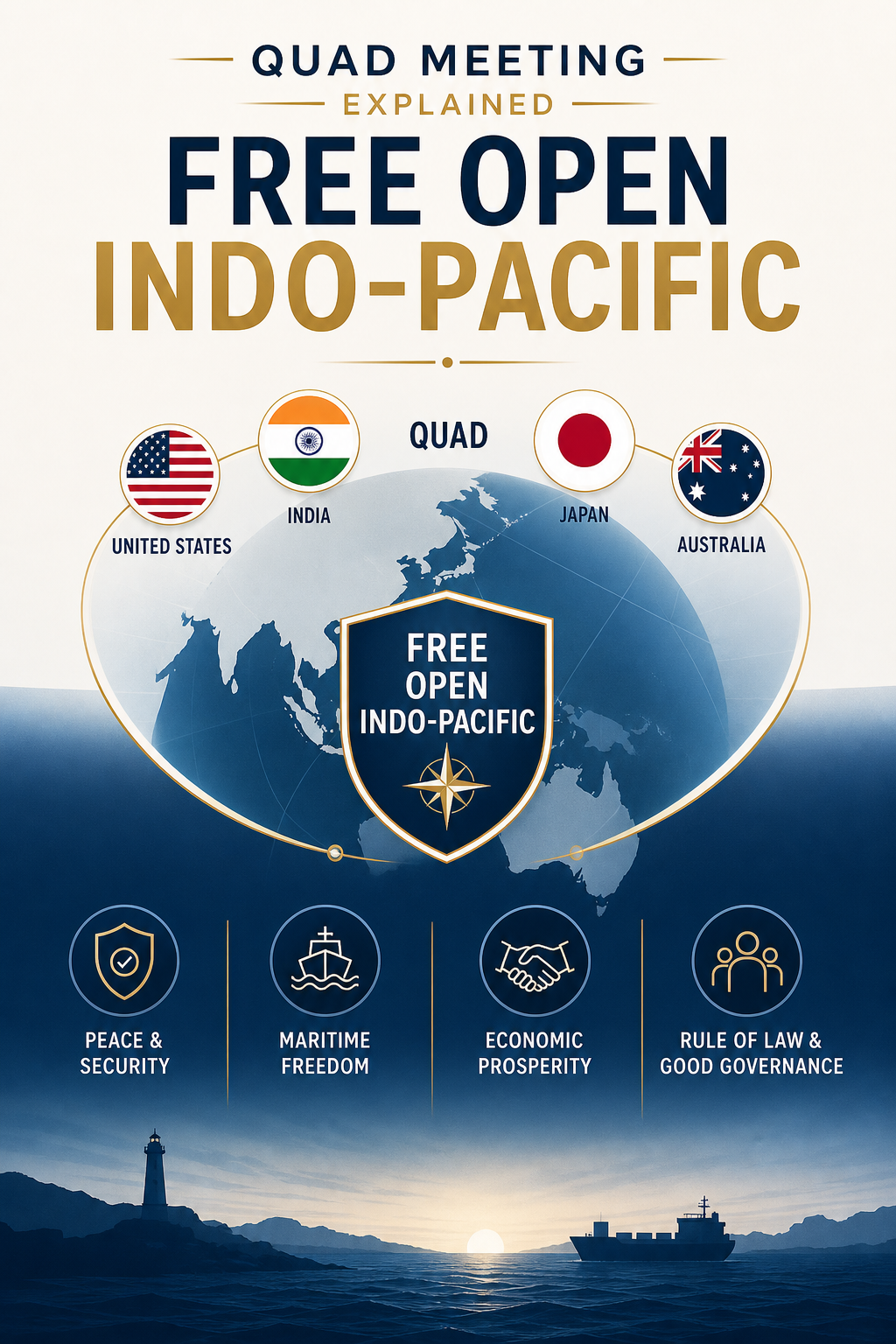
Free Open Indo-Pacific is a strategic vision that promotes a region where international law, freedom of navigation, sovereignty, territorial integrity and peaceful dispute resolution are respected. It encourages open sea lanes, transparent connectivity, inclusive economic growth and regional cooperation.
For India, the Indo-Pacific stretches from the eastern coast of Africa to the western Pacific Ocean and represents a vital maritime space through which a substantial share of India’s trade and energy imports passes.
Why is Free Open Indo-Pacific in News?
The Quad Foreign Ministers of India, the United States, Japan and Australia met in Manila and reaffirmed their shared commitment to strengthening a Free Open Indo-Pacific. The joint statement stressed respect for international law, maritime security, ASEAN centrality and opposition to unilateral actions that threaten regional stability.
Although the Quad officially states that it is not directed against any country, its discussions frequently focus on challenges such as maritime coercion, freedom of navigation and the rules-based international order. Official updates are available at Ministry of External Affairs.
Key Features of Free Open Indo-Pacific
- Supports freedom of navigation and overflight.
- Promotes respect for international law, including UNCLOS.
- Encourages peaceful settlement of disputes.
- Strengthens maritime security and regional connectivity.
- Recognises ASEAN centrality in regional architecture.
- Supports transparent infrastructure and sustainable economic cooperation.
- India follows an inclusive and non-alliance based Indo-Pacific approach.
Challenges Related to Free Open Indo-Pacific
The Indo-Pacific faces challenges including maritime disputes in the South China Sea, strategic competition among major powers, supply chain vulnerabilities, piracy and growing geopolitical rivalry. Balancing deterrence with dialogue remains a major diplomatic challenge.
For more international relations topics, visit the UPSC current affairs library.
Way Forward for Free Open Indo-Pacific
India should continue strengthening maritime capabilities, deepen cooperation with Quad partners, reinforce ASEAN-led regional mechanisms and promote a rules-based international order while maintaining strategic autonomy. Greater connectivity, resilient supply chains and adherence to international law will remain essential for regional peace and prosperity.
Additional policy resources are available through PIB Official Release.
Prelims Practice Corner
- Which countries are members of the Quad?
- What does UNCLOS stand for?
- Which organisation is recognised as central to the Indo-Pacific regional architecture?
- The South China Sea is strategically important primarily because of?
- Which GS Paper covers India’s relations with international groupings?
Mains Practice Questions
Q1. Explain the significance of the Free Open Indo-Pacific for India’s strategic and economic interests.
Answer Outline: Maritime security, trade, energy security, ASEAN, Quad, strategic autonomy.
Q2. Discuss the role of the Quad in promoting a rules-based order in the Indo-Pacific.
Answer Outline: Objectives, cooperation areas, opportunities, concerns, India’s approach.
FAQs on Free Open Indo-Pacific
What is the Free Open Indo-Pacific?
It is a strategic vision promoting a free, open, inclusive and rules-based Indo-Pacific region.
What is the Quad?
The Quad is an informal strategic grouping comprising India, the United States, Japan and Australia.
Why is the Indo-Pacific important for India?
It is critical for India’s trade, energy security, maritime connectivity, regional stability and strategic interests.
Related Current Affairs
Preparing for UPSC, PCS or HCS?
Talk to a mentor at Chetan Bharat Learning, Chandigarh. Free guidance on choosing the right exam and building a study plan.
Chat on WhatsAppCall 97793 53345UPSC / IAS / PCS coaching in Chandigarh · Trusted by aspirants across Punjab & Haryana
Leave a Reply
You must be logged in to post a comment.