

UPSC Mapping
| Prelims | Tribal Communities, Human Geography, Anthropology |
|---|---|
| Mains | GS Paper I – Society and Human Geography |
| Region | Andaman Sea |
|---|---|
| Countries | Thailand and Myanmar |
| Language Family | Austronesian |
| Lifestyle | Sea Nomadic |
Article
What are Moken People?
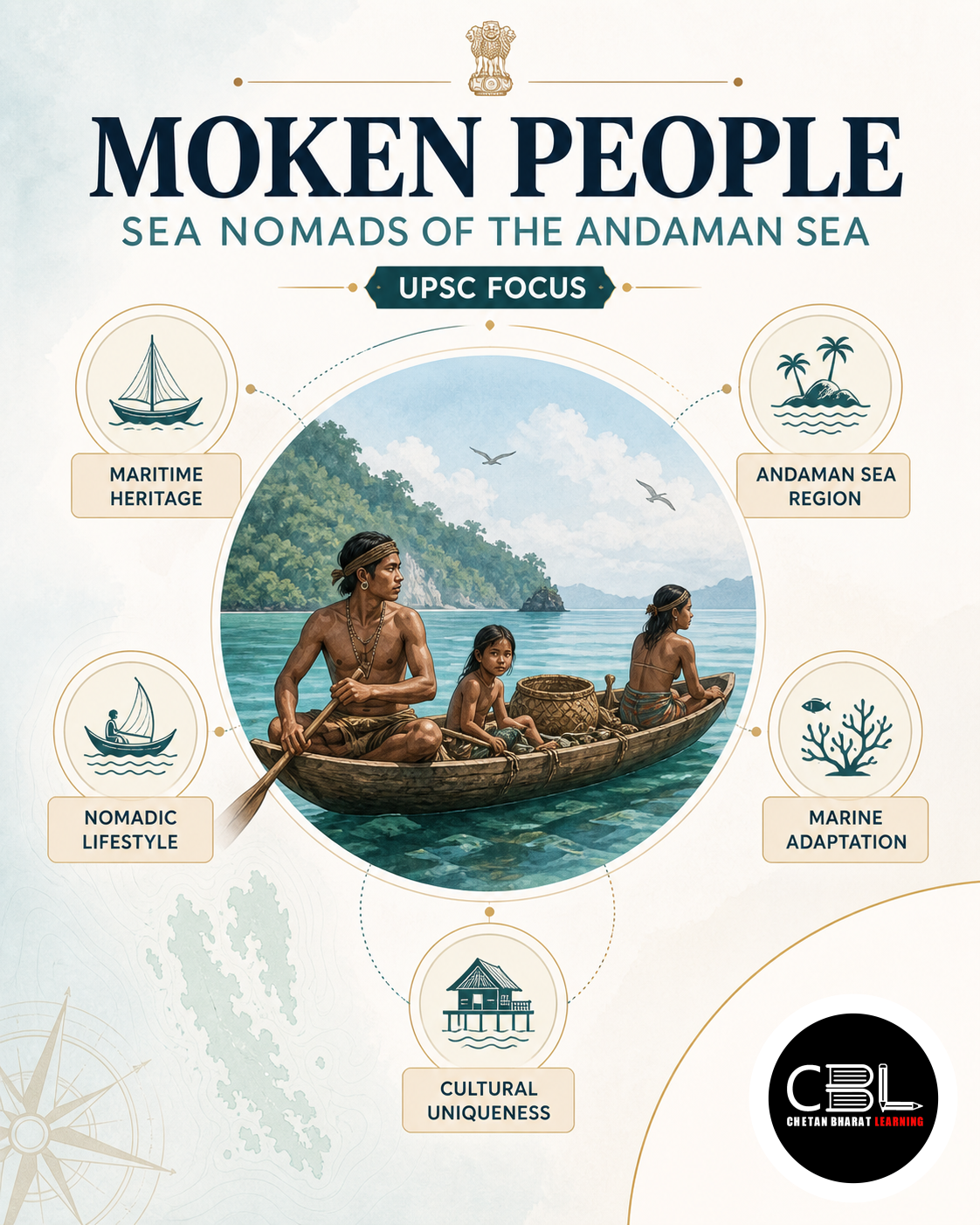
Moken People, often referred to as sea nomads or sea gypsies, are an indigenous maritime community that has lived for centuries along the Andaman Sea, mainly off the coasts of Thailand and Myanmar. Their name in the Moken language means ‘sea drowned’, reflecting their deep cultural connection with the ocean.
They are regarded as one of the world’s last remaining sea nomadic communities. Traditionally, they migrate seasonally across nearly 800 islands using handcrafted wooden boats called kabang, relying almost entirely on marine resources for survival.
Why are Moken People in News?
Scientists recently confirmed that Moken children possess exceptional underwater vision, enabling them to focus underwater with nearly twice the clarity of most children. Years of free diving and continuous interaction with the marine environment allow them to constrict their pupils and adapt their eyesight with remarkable precision.
The study has attracted scientific interest because it demonstrates how environmental adaptation and lifelong practice can significantly influence human abilities.
Key Features of Moken People
- Sea-based livelihood: Fishing, shellfish gathering and free diving form the foundation of their traditional economy.
- Kabang boats: Seasonal migration takes place using handcrafted wooden boats adapted to the Andaman Sea.
- Exceptional diving skills: Children begin swimming and diving from an early age, developing extraordinary underwater vision.
- Traditional ecological knowledge: They possess detailed understanding of reefs, tides, fish behaviour and coastal ecosystems.
- Austronesian language: The Moken speak a language belonging to the Austronesian language family found across Southeast Asia and Oceania.
Challenges Faced by Moken People
- Statelessness: Many Moken lack citizenship in both Thailand and Myanmar, limiting access to education, healthcare and legal rights.
- Loss of traditional lifestyle: Coastal development and tourism reduce access to customary fishing grounds.
- Environmental degradation: Coral reef damage and declining marine biodiversity threaten their livelihoods.
- Climate change: Rising sea levels and changing weather patterns increase vulnerability.
- Cultural erosion: Younger generations face pressure to abandon traditional knowledge and practices.
Traditional Knowledge and the 2004 Indian Ocean Tsunami
The Moken gained international recognition following the 2004 Indian Ocean tsunami. Community elders reportedly interpreted unusual natural signs, including the sudden retreat of seawater, as an indication of danger and moved to safer locations before the waves arrived.
This experience highlighted the importance of indigenous ecological knowledge in disaster preparedness and climate resilience. It also demonstrated the value of integrating traditional knowledge with modern scientific approaches.
Way Forward
Protecting the cultural identity of the Moken requires recognition of their traditional rights, improved access to education and healthcare, and conservation of marine ecosystems. Policies should respect their unique relationship with the sea while ensuring sustainable development.
Governments, researchers and international organisations should promote participatory conservation and preserve indigenous knowledge systems that contribute to biodiversity conservation and disaster risk reduction.
Prelims Practice Corner
Q1. The Moken People are primarily associated with which water body?
- (a) South China Sea
- (b) Arabian Sea
- (c) Andaman Sea
- (d) Red Sea
Answer: (c) The Moken inhabit islands in the Andaman Sea.
Q2. The traditional boats of the Moken are called:
- (a) Dhoni
- (b) Kabang
- (c) Junk
- (d) Canoe
Answer: (b) Kabang.
Q3. The Moken language belongs to which language family?
- (a) Indo-European
- (b) Dravidian
- (c) Austronesian
- (d) Sino-Tibetan
Answer: (c) Austronesian.
Q4. Why did the Moken gain global attention in 2004?
- (a) Discovery of oil
- (b) Coral reef restoration
- (c) Tsunami survival through traditional knowledge
- (d) Deep-sea mining
Answer: (c) Their traditional understanding of nature helped them avoid the tsunami.
Q5. Many Moken are stateless because:
- (a) They reject all governments
- (b) Their nomadic lifestyle has prevented formal citizenship
- (c) They migrated recently
- (d) They lost citizenship after war
Answer: (b) Their traditional mobility has left many without citizenship.
Mains Practice Questions
Q1. Discuss the significance of indigenous knowledge systems in disaster risk reduction and environmental conservation. (10 marks)
- Intro: Define indigenous knowledge.
- Body: Ecological understanding, disaster preparedness, biodiversity conservation, policy integration.
- Conclusion: Promote inclusive conservation strategies.
Q2. Examine the challenges faced by nomadic indigenous communities in the modern world. (15 marks)
- Intro: Explain nomadic indigenous communities.
- Body: Statelessness, livelihood issues, environmental pressures, cultural preservation and governance.
- Conclusion: Emphasise sustainable and rights-based development.
FAQs on Moken People
Who are the Moken People?
The Moken are indigenous sea nomads who traditionally live around the Andaman Sea along the coasts of Thailand and Myanmar.
Why can Moken children see better underwater?
Continuous diving from an early age enables them to adapt their vision underwater by constricting their pupils more effectively than most children.
Why are the Moken important for UPSC?
The topic is relevant for anthropology, human geography, indigenous communities, disaster management and GS Paper I.
Related Current Affairs
Preparing for UPSC, PCS or HCS?
Talk to a mentor at Chetan Bharat Learning, Chandigarh. Free guidance on choosing the right exam and building a study plan.
Chat on WhatsAppCall 97793 53345UPSC / IAS / PCS coaching in Chandigarh · Trusted by aspirants across Punjab & Haryana
Leave a Reply
You must be logged in to post a comment.