

UPSC Mapping
| Prelims | Harappan Civilisation, Palynology, 4.2 ka Event, AMS Radiocarbon Dating |
|---|---|
| Mains | GS Paper I: Indian Heritage and Ancient History |
Article
What is Harappan Civilisation Decline?
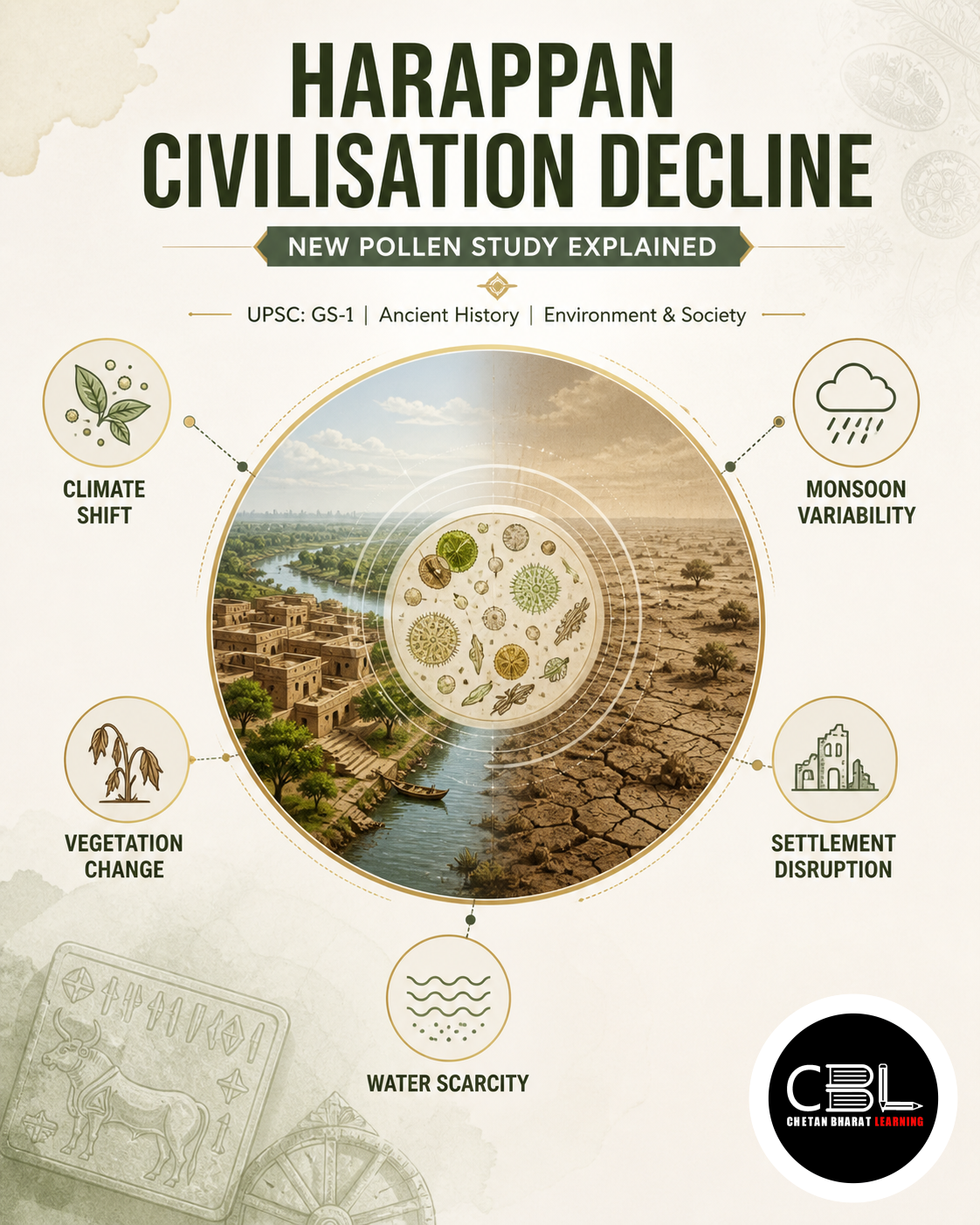
Harappan Civilisation Decline refers to the gradual de-urbanisation of the Indus Valley Civilisation around 1900 BCE. Instead of a sudden collapse, archaeological evidence indicates that major urban centres gradually declined as populations migrated towards smaller settlements, particularly in the eastern regions.
A recent scientific investigation has strengthened the climatic explanation by analysing pollen preserved in lake sediments. Researchers dated the Deoria Tal sediment layers using Accelerator Mass Spectrometry (AMS) radiocarbon dating of Trapa (water chestnut) seed cases and reconstructed past climate using Oak-to-Pine pollen ratios.
Why is Harappan Civilisation Decline in News?
A study published with support highlighted through PIB found evidence that a major weakening of the Indian Summer Monsoon around 4,200 years ago, known as the 4.2 ka climatic event, reduced river discharge in the Indus and Ghaggar-Hakra systems. The resulting drought likely triggered eastward migration and the gradual decline of Harappan urban centres.
Official scientific updates are available through the Press Information Bureau.
Key Features
The study provides new insights into both climate reconstruction and Harappan history.
- Palynology: The study of pollen grains and spores preserved in lake sediments helps reconstruct ancient climatic conditions because pollen walls remain intact for thousands of years.
- Climate indicators: Higher oak pollen represents warm and humid monsoon conditions, whereas increasing pine pollen indicates cooler, drier and more arid environments.
- Scientific dating: Researchers used AMS radiocarbon dating of Trapa seed remains to establish an accurate chronological sequence.
- Harappan characteristics: The civilisation is known for planned cities, grid-pattern streets, standardised burnt bricks, advanced drainage systems and inspection manholes.
- Economic achievements: Harappans cultivated cotton, maintained maritime trade with Mesopotamia and used standardised weights based on binary and decimal systems.
Challenges
Understanding the causes of the Harappan decline remains a complex archaeological question.
- Multiple hypotheses: Climate change, river shifts, ecological stress and socio-economic changes may have acted together rather than independently.
- Limited written records: The undeciphered Harappan script restricts direct understanding of political and social developments.
- Regional variations: Different Harappan settlements experienced varying environmental and cultural conditions.
- Interpretation of evidence: Archaeological, geological and palaeoclimatic data require careful interdisciplinary analysis.
- Preservation issues: Ancient sites continue to face threats from urbanisation, erosion and environmental degradation.
Way Forward
Future research combining archaeology, palaeoclimatology, remote sensing and geochemistry can improve understanding of ancient civilisations and long-term climate variability. Such interdisciplinary studies also provide valuable lessons on environmental resilience.
Protecting archaeological sites and expanding scientific investigations across the Indus basin will deepen knowledge of India’s ancient heritage and its interaction with climate. Official heritage information is available through the Archaeological Survey of India.
Prelims Practice Corner
Q1. Palynology is the scientific study of:
- (a) Fossils
- (b) Pollen and spores
- (c) Rocks
- (d) Metals
Answer: (b) Palynology studies pollen grains and spores preserved in sediments.
Q2. The recent climate study on the Harappan Civilisation analysed sediments from:
- (a) Sambhar Lake
- (b) Chilika Lake
- (c) Deoria Tal
- (d) Loktak Lake
Answer: (c) Researchers analysed lake sediments from Deoria Tal in Uttarakhand.
Q3. The 4.2 ka event refers to:
- (a) Volcanic eruption
- (b) Major weakening of the monsoon around 4,200 years ago
- (c) Earthquake
- (d) Sea-level rise
Answer: (b) It denotes a significant climatic drying event around 4,200 years ago.
Q4. Which feature is associated with the Harappan Civilisation?
- (a) Rock-cut temples
- (b) Planned cities with covered drainage
- (c) Ashokan pillars
- (d) Iron smelting
Answer: (b) Harappan cities were known for planned layouts and advanced drainage systems.
Q5. Harappans maintained maritime trade primarily with:
- (a) Egypt
- (b) Rome
- (c) Mesopotamia
- (d) China
Answer: (c) Archaeological evidence confirms extensive trade with Mesopotamia.
Mains Practice Questions
Q1. Examine the role of climate change in the decline of the Harappan Civilisation. Discuss recent scientific evidence. (10 marks)
Answer Structure:
- Intro: Briefly introduce the Harappan Civilisation.
- Body: Explain the 4.2 ka event, pollen evidence, river changes and migration patterns.
- Conclusion: Highlight the importance of interdisciplinary research in understanding ancient societies.
Q2. Discuss the significance of palynology in reconstructing past climates and interpreting archaeological history. (15 marks)
Answer Structure:
- Intro: Define palynology.
- Body: Explain pollen analysis, climate reconstruction, archaeological applications and limitations.
- Conclusion: Emphasise its contribution to understanding environmental history.
FAQs on Harappan Civilisation Decline
What is the 4.2 ka climatic event?
The 4.2 ka event refers to a major episode of global climatic drying about 4,200 years ago, marked in the Indian subcontinent by a weakening of the summer monsoon.
How does pollen help reconstruct ancient climates?
Pollen grains preserved in lake sediments remain intact for thousands of years. Scientists analyse their types and abundance to infer past temperature, rainfall and vegetation.
Why is the Harappan Civilisation important for UPSC?
The Harappan Civilisation is a core Ancient History topic covering urban planning, trade, agriculture, archaeology and recent scientific discoveries related to climate and environmental change.
Related Current Affairs
Preparing for UPSC, PCS or HCS?
Talk to a mentor at Chetan Bharat Learning, Chandigarh. Free guidance on choosing the right exam and building a study plan.
Chat on WhatsAppCall 97793 53345UPSC / IAS / PCS coaching in Chandigarh · Trusted by aspirants across Punjab & Haryana
Leave a Reply
You must be logged in to post a comment.