
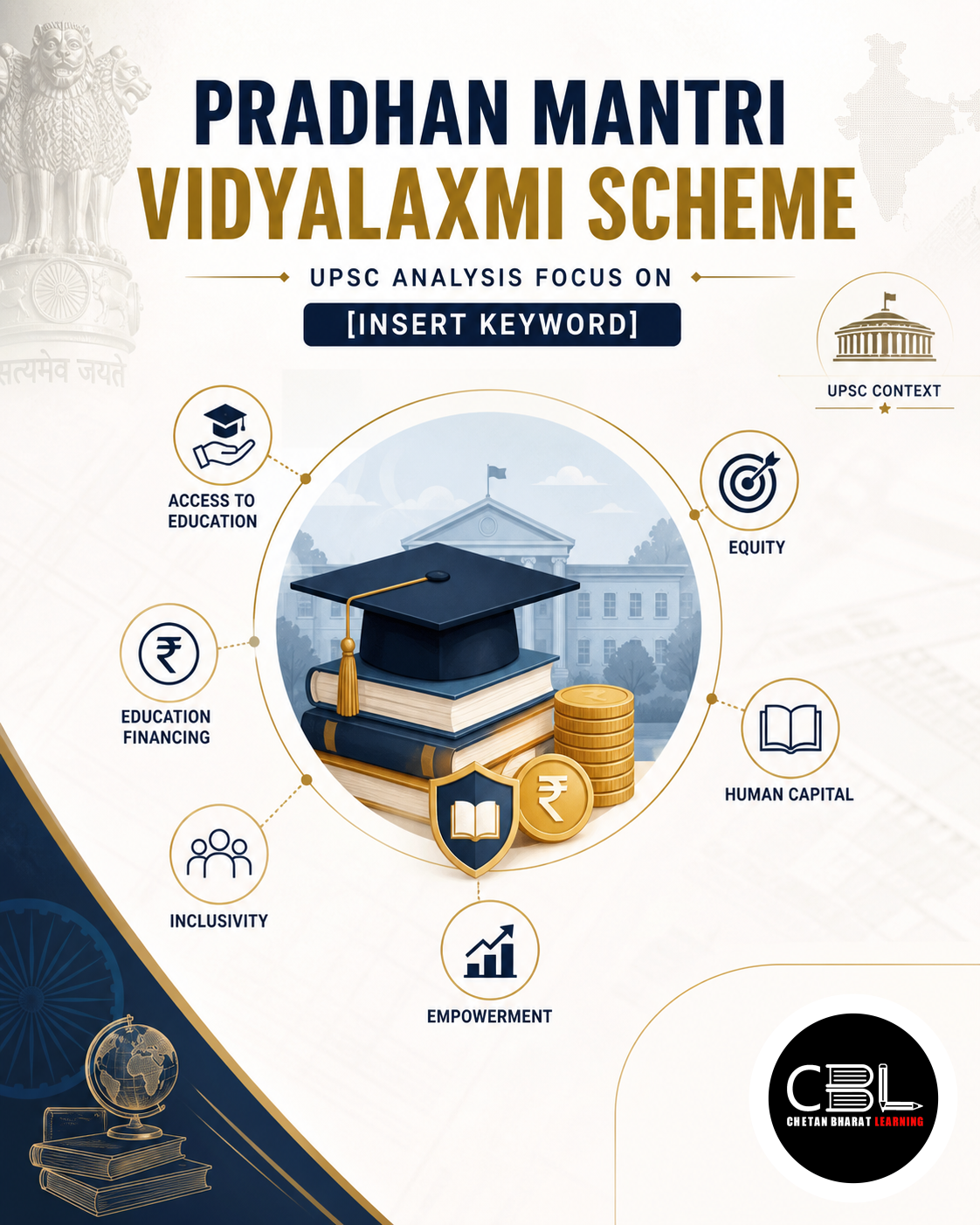

UPSC Mapping
| Mapping | Details |
|---|---|
| Prelims | Education Schemes, Ministry of Education, NEP 2020, SDGs |
| Mains | GS Paper II – Education, Human Resource Development & Welfare Schemes |
| Nodal Ministry | Ministry of Education |
| Coverage | Degree & Diploma Courses |
| Interest Benefit | 3% Interest Subvention (Eligible Students) |
| Credit Guarantee | 75% up to ₹7.5 lakh |
Article
What is Pradhan Mantri Vidyalaxmi Scheme?
Pradhan Mantri Vidyalaxmi Scheme is a flagship initiative of the Ministry of Education that aims to make quality higher education accessible to deserving students facing financial constraints. The scheme provides education loans for eligible students pursuing degree and diploma programmes in recognised Quality Higher Education Institutions (QHEIs).
It complements the vision of NEP 2020 by reducing financial barriers to higher education while promoting equitable access to quality institutions. The scheme also contributes towards achieving SDG 4, which focuses on inclusive and equitable quality education.
Why is Pradhan Mantri Vidyalaxmi Scheme in News?
The scheme has recently been recognised for supporting the objectives of Sustainable Development Goal 4 and the National Education Policy 2020 by expanding access to higher education through affordable institutional finance.
Its emphasis on credit guarantee, interest subvention and support for meritorious students reflects the Government’s broader efforts to improve the Gross Enrolment Ratio in higher education. Official details are available through the PIB release.
Key Features of Pradhan Mantri Vidyalaxmi Scheme
The scheme provides financial support through a structured education loan framework.
- Student eligibility: Available to students securing merit-based admission through competitive examinations in designated Quality Higher Education Institutions.
- Institution eligibility: Covers the top 100 NIRF-ranked institutions, top 200 State or Union Territory government institutions and all remaining institutions under the Government of India.
- Education loans: Covers eligible degree and diploma programmes through Scheduled Banks, Regional Rural Banks and Cooperative Banks participating in the scheme.
- Affordable interest: Interest rates are capped at the participating bank’s Externally Benchmarked Lending Rate (EBLR) + 0.5%.
- Loan repayment: Repayment period extends up to 15 years, excluding the moratorium period consisting of the course duration plus one year.
Financial Support under the Scheme
The scheme incorporates multiple financial safeguards to make higher education more affordable.
- Credit guarantee: Education loans up to ₹7.5 lakh receive a 75% credit guarantee from the Government of India.
- Interest subvention: Students with annual family income up to ₹8 lakh receive a 3% interest subvention on education loans up to ₹10 lakh.
- Additional benefit: The provision supplements the existing full interest subvention available for students with annual family income up to ₹4.5 lakh.
- One-time benefit: Interest subvention and credit guarantee benefits are available only once for undergraduate, postgraduate or integrated courses.
- Financial inclusion: The scheme aims to reduce dependence on informal sources of education finance.
Significance
- Supports NEP 2020: Encourages equitable access to higher education.
- Advances SDG 4: Promotes inclusive and quality education.
- Improves affordability: Reduces the financial burden on students through interest support and credit guarantees.
- Encourages merit: Rewards students admitted through merit-based competitive processes.
- Strengthens human capital: Enhances access to skilled education for long-term economic development.
Challenges
- Limited awareness: Many eligible students may remain unaware of available benefits.
- Access disparities: Students outside recognised institutions are not covered.
- Administrative coordination: Timely processing requires close coordination between institutions and banks.
- Financial literacy: Students need better understanding of education loans and repayment obligations.
- Monitoring: Continuous evaluation is essential to ensure equitable implementation.
Way Forward
Greater awareness campaigns, streamlined digital application systems and stronger coordination among educational institutions and financial institutions can improve the scheme’s effectiveness. Expanding financial literacy among students will also enhance responsible borrowing.
Continuous review of institutional coverage and financial support mechanisms can further strengthen inclusive higher education while supporting India’s demographic dividend.
Prelims Practice Corner
-
Q1. Which ministry is the nodal ministry for the Pradhan Mantri Vidyalaxmi Scheme?
- (a) Ministry of Finance
- (b) Ministry of Education
- (c) Ministry of Skill Development
- (d) Ministry of Social Justice
Answer: (b) The scheme is implemented by the Ministry of Education.
-
Q2. Under the scheme, education loans up to ₹7.5 lakh receive what percentage of Government credit guarantee?
- (a) 50%
- (b) 60%
- (c) 75%
- (d) 100%
Answer: (c) Loans up to ₹7.5 lakh receive a 75% Government credit guarantee.
-
Q3. Eligible students with annual family income up to ₹8 lakh receive:
- (a) 1% interest subvention
- (b) 2% interest subvention
- (c) 3% interest subvention
- (d) 5% interest subvention
Answer: (c) Eligible students receive a 3% interest subvention on loans up to ₹10 lakh.
-
Q4. The scheme supports admissions obtained through:
- (a) Direct management quota only
- (b) Merit-based admission through competitive examinations
- (c) Open admissions only
- (d) Foreign universities only
Answer: (b) The scheme covers merit-based admissions through competitive examinations.
-
Q5. The Pradhan Mantri Vidyalaxmi Scheme contributes directly to which Sustainable Development Goal?
- (a) SDG 2
- (b) SDG 4
- (c) SDG 8
- (d) SDG 13
Answer: (b) The scheme advances SDG 4 on inclusive and equitable quality education.
Mains Practice Questions
-
Q1. Discuss the significance of the Pradhan Mantri Vidyalaxmi Scheme in promoting equitable access to higher education in India. (10 marks)
Answer Structure:
- Intro: Introduce the scheme and its objective.
- Body: Discuss eligibility, financial assistance, NEP 2020 alignment, SDG 4 contribution and implementation challenges.
- Conclusion: Highlight its role in inclusive human capital development.
-
Q2. Evaluate the role of education finance in improving higher education outcomes in India. (15 marks)
Answer Structure:
- Intro: Explain the importance of affordable education finance.
- Body: Cover access, equity, loan support, credit guarantees, policy initiatives and implementation challenges.
- Conclusion: Emphasise inclusive and sustainable higher education financing.
FAQs on Pradhan Mantri Vidyalaxmi Scheme
-
Which ministry implements the Pradhan Mantri Vidyalaxmi Scheme?
The Ministry of Education is the nodal ministry responsible for implementing the Pradhan Mantri Vidyalaxmi Scheme.
-
Who is eligible under the Pradhan Mantri Vidyalaxmi Scheme?
Students securing merit-based admission through competitive examinations in eligible Quality Higher Education Institutions can avail education loans under the scheme.
-
Why is the Pradhan Mantri Vidyalaxmi Scheme important for UPSC?
The scheme is relevant because it links education reforms, financial inclusion, NEP 2020, SDG 4 and welfare governance, making it important for both UPSC Prelims and GS Paper II.
Related Current Affairs
Preparing for UPSC, PCS or HCS?
Talk to a mentor at Chetan Bharat Learning, Chandigarh. Free guidance on choosing the right exam and building a study plan.
Chat on WhatsAppCall 97793 53345UPSC / IAS / PCS coaching in Chandigarh · Trusted by aspirants across Punjab & Haryana
Leave a Reply
You must be logged in to post a comment.