

UPSC Syllabus Mapping
- GS Paper: GS-I & GS-II
- Subject: World Geography and International Relations — Europe Mapping, Black Sea Region and India-Romania Relations
What is Romania Geography?
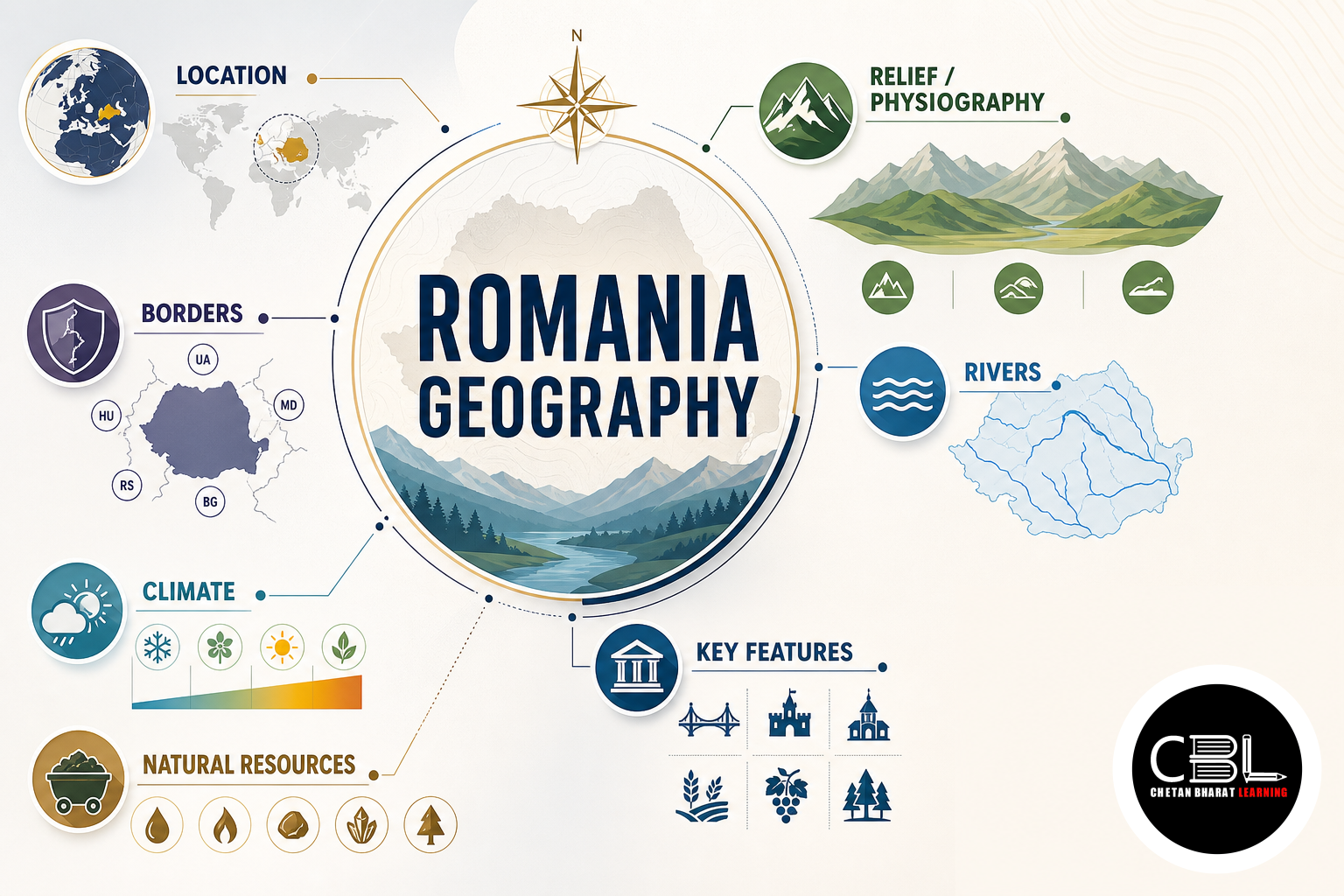
Romania is a European country whose capital and largest city is Bucharest. Its territory is organised around the Carpathian mountain system and the Transylvanian Basin, while the Danube forms an important part of its southern geographical setting before reaching the Black Sea. The country’s landscape includes mountains, hills, plateaus and extensive plains, giving it considerable physical diversity within a relatively compact territory.
Romania shares land boundaries with Ukraine to the north and east, Moldova to the east, Bulgaria to the south, Serbia to the southwest and Hungary to the west. Its southeastern side opens onto the Black Sea. This location places Romania close to Ukraine and the western Black Sea, giving its geography contemporary strategic importance in addition to its conventional physical-geography relevance.
Why is Romania Geography in News?
Romania entered Indian current affairs following the President of India’s visit as part of a European diplomatic tour. High-level engagement provides an opportunity to strengthen bilateral relations in trade, investment, technology, education, culture and other areas. Romania’s membership of both the European Union and NATO further increases its diplomatic relevance for India as New Delhi expands engagement with individual European countries alongside its wider India-EU partnership.
India and Romania have maintained diplomatic relations for decades, and contemporary cooperation spans political exchanges and economic engagement. Romania can also serve as a useful partner for understanding developments in the Black Sea and Eastern European neighbourhood. Official information about bilateral relations and high-level visits can be accessed through India’s Ministry of External Affairs.
Key Features of Romania
Romania’s physical geography is often described through the relatively balanced presence of mountains, hills and plains. The Carpathians form the country’s dominant mountain system and curve through its central regions. Within this arc lies Transylvania, a historically important region associated with the elevated Transylvanian Basin and surrounding uplands.
- Carpathian Mountains: The mountain arc crosses central Romania and includes the Eastern and Southern Carpathians as well as western mountain groups.
- Highest point: Moldoveanu Peak, located in the Southern Carpathians, is Romania’s highest mountain at 2,544 metres.
- Transylvanian Basin: This elevated interior region lies within the Carpathian arc and forms one of Romania’s most recognisable physical features.
- Danube River: The river is central to Romania’s geography, forming significant stretches of its southern boundary before flowing towards the Black Sea.
- Danube Delta: Near the river’s mouth, a complex network of channels, lakes, reed beds and wetlands forms an internationally important biodiversity region.
- Black Sea: Romania has a coastline on the western Black Sea, giving it maritime access and considerable strategic significance.
- Fertile plains: Southern and western lowlands contain productive agricultural soils, including areas of fertile chernozem associated with cereal cultivation.
The Danube Delta deserves special attention for Prelims. The Danube originates in Germany and travels across or along several European countries before reaching the Black Sea. Its delta is shared primarily between Romania and Ukraine, with the largest part lying in Romania. The wetland supports extensive bird and aquatic biodiversity and is recognised internationally for its ecological value.
Challenges Related to Romania Geography
Romania’s strategic location also exposes it to geopolitical pressures. Its border with Ukraine and Black Sea coastline place it close to a major zone of European conflict and security competition. Black Sea maritime routes have become important for grain exports, energy movements and regional logistics, while NATO’s eastern flank has acquired greater military significance. Geography therefore directly shapes Romania’s contemporary foreign and security policy.
Environmental management is another concern. The Danube Delta is a sensitive wetland ecosystem affected by pressures associated with pollution, navigation, land-use change and wider changes within the Danube basin. Effective conservation requires cooperation across borders because river-basin processes do not follow political boundaries. Similarly, sustainable development of mountain and coastal regions must balance economic activity with ecosystem protection.
For UPSC, the challenge is often conceptual rather than factual: candidates should connect places appearing in international news with physical geography. Romania should therefore be revised together with the Black Sea, Danube, Carpathians, neighbouring countries and important regional ports.
Way Forward for India-Romania Relations
India can use sustained political engagement with Romania to strengthen its wider relationship with Central and Eastern Europe. Bilateral cooperation can complement the India-EU framework while creating opportunities in sectors such as information technology, pharmaceuticals, engineering, renewable energy and manufacturing. Educational and cultural exchanges can provide an additional foundation for long-term people-to-people relations.
Romania’s maritime position is also relevant. Constanța, situated on the Black Sea, is the country’s principal seaport and an important European logistics hub. The Danube-Black Sea connection gives Romania access to inland European waterways as well as maritime trade. As India seeks diversified connectivity with Europe, developments involving Black Sea ports and continental transport corridors merit continued attention, although their commercial viability depends on wider geopolitical and logistical conditions.
Environmental cooperation can form another area of engagement, particularly around renewable energy, biodiversity and sustainable development. Romania’s experience as an EU member and its geographic position can also support dialogue on European economic and security developments. The Romanian Ministry of Foreign Affairs provides official information on the country’s external relations. Overall, deeper bilateral engagement can complement India’s increasingly diversified partnerships across Europe.
Prelims Practice Corner
-
Which of the following countries shares a land border with Romania?
Options: 1. Ukraine 2. Moldova 3. Hungary 4. SerbiaAnswer: 1, 2, 3 and 4.
-
Romania has a coastline on which sea?
Options: (a) Adriatic Sea (b) Baltic Sea (c) Black Sea (d) Caspian SeaAnswer: Black Sea.
-
Consider the following pairs:
1. Moldoveanu — Highest peak of Romania
2. Constanța — Major Black Sea port
3. Transylvania — Region within the Carpathian arc
How many pairs given above are correctly matched?Answer: All three.
-
The Danube River ultimately drains into the:
(a) Mediterranean Sea (b) Black Sea (c) North Sea (d) Baltic SeaAnswer: Black Sea.
-
Consider the following statements regarding Romania:
1. It is a member of the European Union.
2. It is a member of NATO.
3. It shares a land boundary with Bulgaria.
Which of the statements given above are correct?Answer: 1, 2 and 3.
Mains Practice Questions
-
Romania’s physical geography has significantly shaped its contemporary economic and strategic importance in Europe. Discuss. (10 marks)
Outline:
- Southeastern European location
- Carpathians and Transylvania
- Danube
- Black Sea coastline
- Constanța
- Agriculture and chernozem
- Proximity to Ukraine
- Trade and security significance
-
India’s engagement with Central and Eastern European countries can complement its broader partnership with the European Union. Examine with reference to Romania. (15 marks)
Outline:
- India-EU context
- Bilateral political relations
- Trade and investment
- IT, pharmaceuticals and manufacturing
- Black Sea connectivity
- European security developments
- Education and cultural links
- Diversified European diplomacy
FAQs on Romania Geography
Which countries border Romania?
Romania shares land borders with Ukraine, Moldova, Bulgaria, Serbia and Hungary. It also has a coastline on the Black Sea.
Why is the Danube Delta important?
The Danube Delta is a major European wetland formed near the river’s entry into the Black Sea. It supports rich biodiversity and is internationally recognised for its ecological importance.
Why is Romania strategically important?
Its location on the Black Sea, border with Ukraine, membership of NATO and the European Union, and access to the Danube transport system give Romania considerable importance for European security, trade and regional connectivity.
Related Current Affairs
Preparing for UPSC, PCS or HCS?
Talk to a mentor at Chetan Bharat Learning, Chandigarh. Free guidance on choosing the right exam and building a study plan.
Chat on WhatsAppCall 97793 53345UPSC / IAS / PCS coaching in Chandigarh · Trusted by aspirants across Punjab & Haryana
Leave a Reply
You must be logged in to post a comment.