

UPSC Mapping
| Prelims | Polity & Governance |
|---|---|
| Mains | GS Paper 2 (Parliament & State Legislatures) |
Quick Facts
| Lok Sabha Productivity | 15% |
|---|---|
| Rajya Sabha Productivity | 33% |
| Question Hour (Lok Sabha) | 1% |
What is Parliamentary Productivity Low?
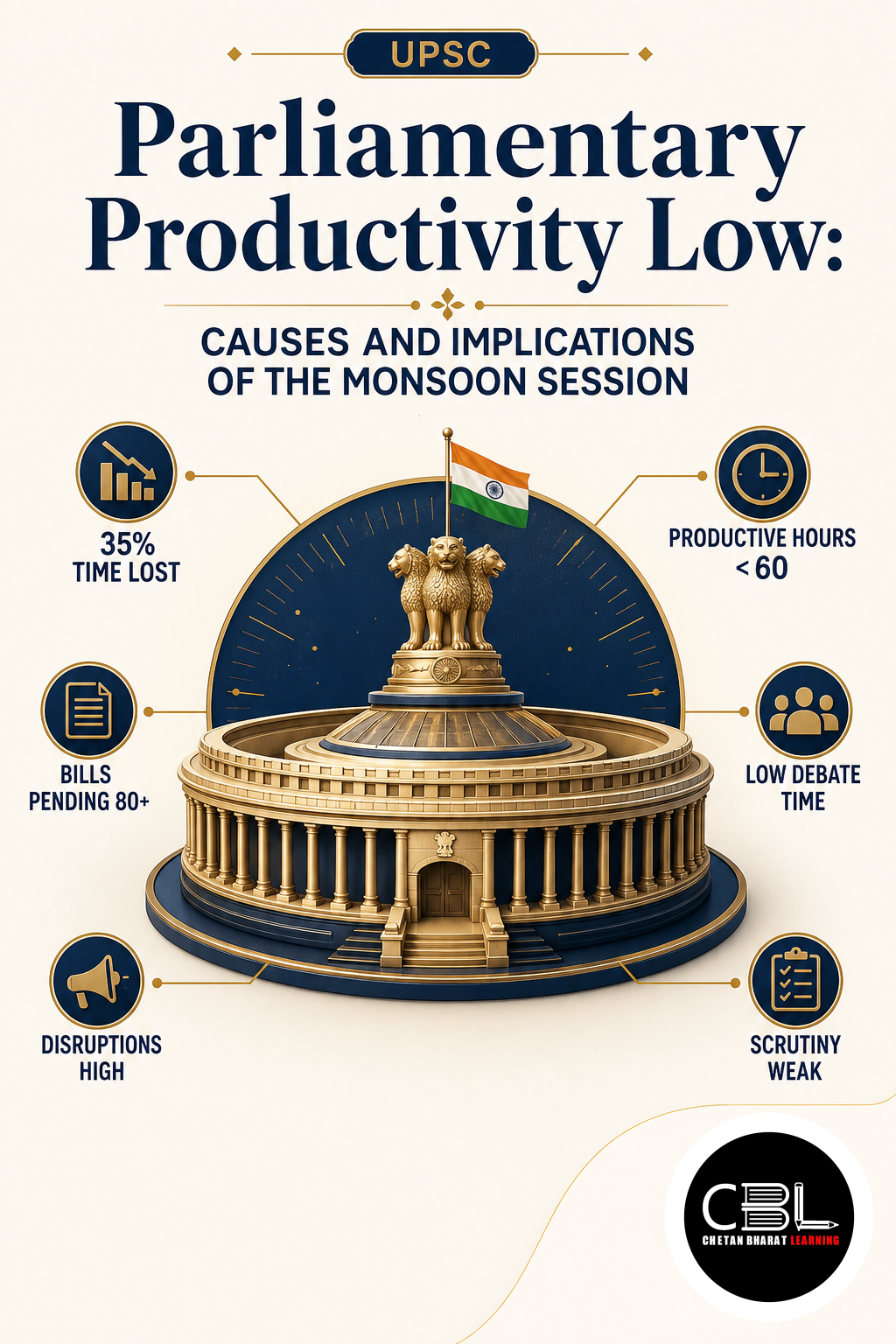
Parliamentary Productivity Low refers to the reduced functioning of Parliament relative to scheduled time, measured by the percentage of time spent on legislative business, debates, and Question Hour. The Monsoon Session 2026 recorded one of the lowest productivity rates, with Question Hour running just 1% of scheduled time in Lok Sabha and 12% in Rajya Sabha.
Productivity is not simply about the number of Bills passed—it reflects the quality of debate, scrutiny, and accountability. Low productivity indicates reduced oversight of the executive, rushed legislation, and weakening of parliamentary conventions.
Why is Parliamentary Productivity Low in News?
Parliamentary Productivity Low is in the news because the Monsoon Session 2026 saw frequent disruptions over the NEET paper leak and other contentious issues. The session saw an estimated ₹175 crore loss due to disruptions, highlighting the financial cost of low productivity.
The issue has reignited debates on the need for a fixed parliamentary calendar, minimum sitting days, and reforms to the anti-defection law to encourage constructive debate.
Key Features of Parliamentary Productivity Low
- Political Polarisation: Lack of consensus on contentious issues leads to repeated disruptions.
- Disruption as Strategy: Limited institutional space for Opposition turns disruption into a standard tactic.
- Weakening of Question Hour: Frequent adjournments reduce the primary oversight mechanism.
- Anti-Defection Law: Tenth Schedule limits legislators’ voting freedom, reducing internal debate and cross-party compromise.
- No Fixed Calendar: India lacks a fixed parliamentary calendar or minimum sitting days.
Implications of Parliamentary Productivity Low
- Accountability Vacuum: Loss of debate and Question Hour reduces executive scrutiny.
- Executive Overreach: Reduced legislative engagement increases dependence on ordinances and delegated legislation.
- Legitimacy Erosion: Passing legislation without adequate scrutiny undermines law quality and public trust.
- Judicial Burden: Hastily passed laws create ambiguities, leading to judicial challenges.
- Financial Loss: Disruptions waste taxpayer-funded resources—₹175 crore lost in Monsoon 2026.
Way Forward for Parliamentary Productivity
To address Parliamentary Productivity Low, India should consider a fixed parliamentary calendar with a minimum number of sitting days. Reforming the anti-defection law to allow conscience voting on non-confidence motions can encourage constructive debate.
Strengthening parliamentary committees to scrutinise legislation in detail can compensate for lost floor time. Ensuring Question Hour is protected from disruptions is essential for accountability. A consensual approach between the government and opposition can restore public trust.
Prelims Practice Corner
- Q1. What was the productivity of the Lok Sabha in the Monsoon Session 2026?
(a) 10% (b) 15% (c) 25% (d) 33%
Answer: (b) The Lok Sabha functioned for 15% of scheduled time. - Q2. What percentage of Question Hour was utilised in Lok Sabha?
(a) 1% (b) 5% (c) 10% (d) 12%
Answer: (a) Question Hour ran just 1% of scheduled time. - Q3. What is the estimated financial loss of the Monsoon Session 2026?
(a) ₹50 crore (b) ₹100 crore (c) ₹175 crore (d) ₹250 crore
Answer: (c) The session faced an estimated ₹175 crore loss. - Q4. Which Schedule of the Constitution contains the anti-defection law?
(a) Eighth Schedule (b) Ninth Schedule (c) Tenth Schedule (d) Twelfth Schedule
Answer: (c) The Tenth Schedule contains the anti-defection provisions. - Q5. Under which Article are parliamentary privileges protected?
(a) Article 85 (b) Article 105 (c) Article 122 (d) Article 124
Answer: (b) Article 105 protects freedom of speech and parliamentary privileges.
Mains Practice Questions
- Q1. Analyse the causes and implications of declining parliamentary productivity in India. What reforms are needed to strengthen Parliament’s functioning? (250 words, 15 marks)
Answer Structure:- Intro: Introduce the low productivity in the Monsoon Session 2026.
- Body: Discuss causes: political polarisation, disruption strategy, weak Question Hour, anti-defection law. Analyse implications: accountability vacuum, executive overreach, legitimacy erosion, financial loss. Suggest reforms: fixed calendar, minimum sitting days, committee strengthening.
- Conclusion: Emphasise the need for a consensual approach to restore public trust.
- Q2. What is the significance of Question Hour in India’s parliamentary democracy, and why is its disruption a cause for concern? (150 words, 10 marks)
Answer Structure:- Intro: Define Question Hour as a primary oversight mechanism.
- Body: Explain its role in holding the executive accountable through questioning. Disruption reduces scrutiny, weakens democratic accountability, and undermines public trust.
- Conclusion: Conclude that preserving Question Hour is essential for parliamentary democracy.
FAQs on Parliamentary Productivity Low
- What is parliamentary productivity? It is the ratio of actual parliamentary work completed compared to the scheduled time available.
- What caused the low productivity in Monsoon 2026? Political polarisation, disruptions over the NEET paper leak, and the weakening of Question Hour.
- What reforms can improve parliamentary productivity? A fixed parliamentary calendar, minimum sitting days, anti-defection law reforms, and stronger committees.
Related Current Affairs
Preparing for UPSC, PCS or HCS?
Talk to a mentor at Chetan Bharat Learning, Chandigarh. Free guidance on choosing the right exam and building a study plan.
Chat on WhatsAppCall 97793 53345UPSC / IAS / PCS coaching in Chandigarh · Trusted by aspirants across Punjab & Haryana
Leave a Reply
You must be logged in to post a comment.