
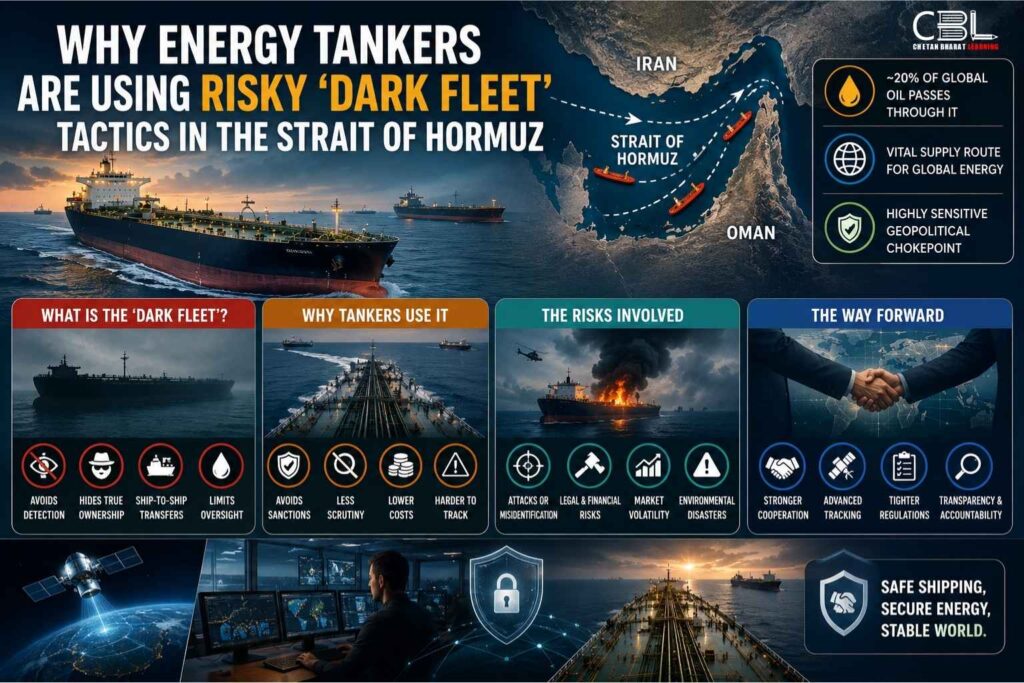
The Strait of Hormuz, one of the world’s most important maritime chokepoints, has witnessed a sharp rise in the use of “dark fleet” tactics by energy tankers. Amid rising geopolitical tensions in West Asia and security concerns in the Gulf region, many vessels are switching off their Automatic Identification System (AIS) transponders while crossing the strait.
This practice, commonly known as “going dark,” makes ships difficult to track and has raised serious concerns regarding maritime safety, global trade, and energy security. For India, which relies heavily on oil and LNG imports through the Strait of Hormuz, these developments carry significant strategic and economic implications.
Students preparing through UPSC Coaching in Chandigarh and IAS Coaching in Chandigarh should understand this issue because it connects international relations, maritime security, global trade, and energy security.
What Is the ‘Dark Fleet’?
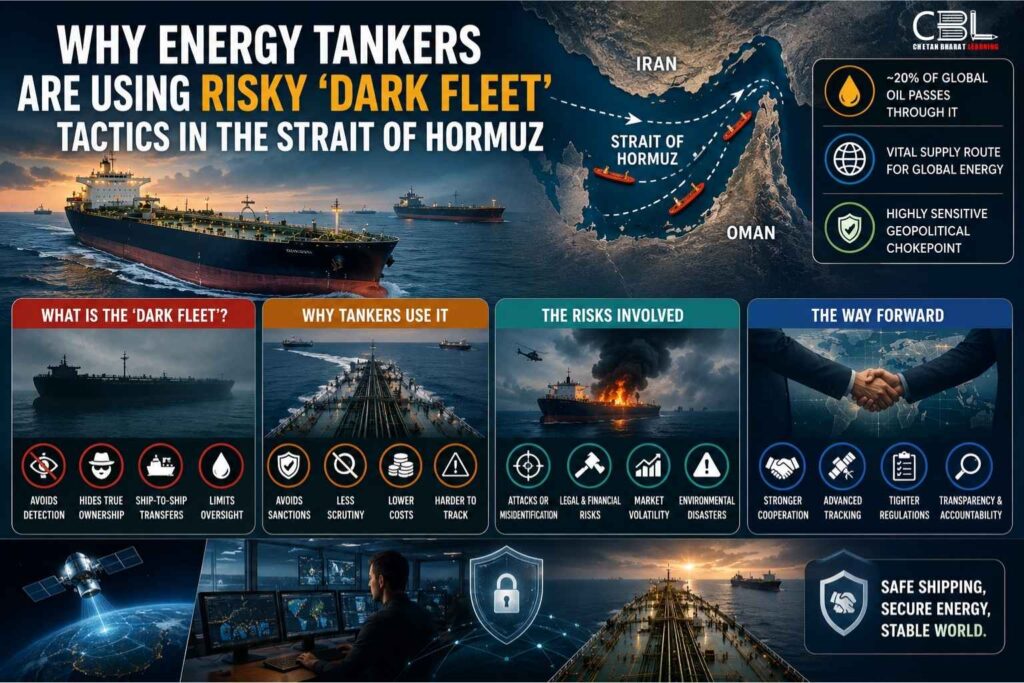
The term “dark fleet” refers to ships that deliberately switch off their AIS tracking systems to avoid detection.
Under normal circumstances, AIS transponders help authorities and nearby vessels identify a ship’s location, speed, and route. However, vessels involved in sanctions-related trade, conflict zones, or high-risk routes sometimes disable these systems to reduce visibility.
While this practice may improve operational security in some situations, it significantly increases the risk of accidents and reduces transparency in maritime trade.
Why Are Tankers Going Dark in Hormuz?
The recent increase in dark fleet operations is closely linked to growing instability in West Asia.
As military tensions and regional conflicts intensify, commercial shipping companies face greater security risks. Tanker operators fear potential attacks, surveillance, and disruptions while navigating through the narrow Strait of Hormuz.
To minimise exposure, many vessels switch off tracking systems during transit, making them harder to monitor.
According to maritime tracking data, dark transits through the Strait of Hormuz have increased significantly in recent months, reflecting growing concerns among shipping operators.
Strategic Importance of the Strait of Hormuz
The Strait of Hormuz connects the Persian Gulf with the Arabian Sea and serves as one of the most critical energy corridors in the world.
A substantial share of global crude oil and liquefied natural gas (LNG) exports passes through this narrow waterway every day.
The strait is particularly important for major energy exporters such as:
- Saudi Arabia
- United Arab Emirates
- Qatar
- Kuwait
- Iraq
Any disruption in this route can immediately affect global energy prices and international trade.
Why Is Hormuz Important for India?
India remains one of the largest energy importers in the world.
More than 40% of India’s crude oil imports, nearly 60% of LNG imports, and a major portion of LPG imports move through the Strait of Hormuz.
This heavy dependence makes India highly vulnerable to disruptions in the region.
Any prolonged instability can result in:
- Higher crude oil prices
- Increased transportation costs
- Inflationary pressures
- Supply chain disruptions
- Wider economic challenges
This is why Energy Security remains a critical concern for India’s economic and strategic planning.
Risks Associated with Dark Fleet Operations
While shipping companies may view dark operations as a security measure, the practice creates several risks.
Maritime Safety Risks
Without AIS signals, ships become harder to detect, increasing the chances of collisions in one of the world’s busiest shipping lanes.
Reduced Transparency
Authorities and maritime agencies face difficulties tracking vessel movements, making enforcement and monitoring more challenging.
Security Concerns
Dark operations can be exploited for illicit trade, sanctions evasion, and unauthorised shipping activities.
Insurance Challenges
Higher uncertainty increases insurance premiums and operational costs for shipping companies.
Impact on Global Energy Markets
The rise in dark fleet operations reflects broader instability in global energy markets.
Any disruption in the flow of oil and gas through the Strait of Hormuz can trigger sharp increases in energy prices worldwide.
Countries dependent on imported energy, including India, are particularly vulnerable to such shocks.
Higher oil prices increase production costs, transportation expenses, and inflation, affecting both households and businesses.
As a result, developments in Hormuz are closely monitored by governments, investors, and energy companies across the world.
Implications for India
India faces multiple challenges arising from these developments.
First, rising energy costs can affect economic growth and inflation management.
Second, supply disruptions may impact industrial production and transportation sectors.
Third, strategic energy planning becomes increasingly important in an uncertain geopolitical environment.
To reduce vulnerability, India has been focusing on:
- Diversifying energy import sources
- Expanding strategic petroleum reserves
- Promoting renewable energy
- Strengthening maritime security cooperation
These measures aim to improve resilience against external shocks.
The Way Forward
The increasing use of dark fleet tactics highlights the need for stronger international cooperation in maritime security.
Regional stability, diplomatic engagement, and adherence to international maritime regulations remain essential for ensuring safe navigation through critical sea routes.
Countries must work together to maintain freedom of navigation, improve surveillance mechanisms, and strengthen maritime safety standards.
For India, enhancing energy security and reducing excessive dependence on vulnerable supply routes will remain long-term strategic priorities.
Significance for UPSC Aspirants
UPSC Prelims
- Strait of Hormuz
- AIS (Automatic Identification System)
- Maritime Security
- Energy Security
GS Paper II
- International Relations
- West Asia
- India’s Foreign Policy
GS Paper III
- Energy Security
- Infrastructure and Logistics
- Economic Implications of Geopolitical Conflicts
Essay Topics
- Energy Security and National Development
- Maritime Security in the 21st Century
- Geopolitics and Global Trade
Students enrolled in UPSC Coaching in Chandigarh can use the Strait of Hormuz case as a contemporary example in answers related to energy security and international relations. Similarly, aspirants studying through IAS Coaching in Chandigarh can apply these developments while discussing geopolitical risks and economic resilience.
FAQs
What is a dark fleet?
A dark fleet refers to ships that switch off their AIS tracking systems to avoid detection during transit.
What is AIS?
AIS (Automatic Identification System) is a tracking system that provides information about a ship’s location, speed, and route.
Why is the Strait of Hormuz important?
It is one of the world’s most important energy corridors through which a significant share of global oil and gas trade passes.
Why is Hormuz important for India?
India imports a large portion of its crude oil, LNG, and LPG through the Strait of Hormuz.
Why is this topic important for UPSC?
The issue covers international relations, maritime security, energy security, and global trade, making it highly relevant for both Prelims and Mains.
Conclusion
The growing use of dark fleet tactics in the Strait of Hormuz reflects rising geopolitical uncertainty and increasing security concerns in West Asia. While shipping companies may see these measures as necessary for protection, they also create serious challenges related to maritime safety, transparency, and global energy security.
For India, the issue highlights the importance of strengthening energy security, diversifying import routes, and maintaining stable maritime trade networks. As global tensions continue to influence energy markets, developments in the Strait of Hormuz will remain a key area of strategic and economic significance.
Related Current Affairs
Preparing for UPSC, PCS or HCS?
Talk to a mentor at Chetan Bharat Learning, Chandigarh. Free guidance on choosing the right exam and building a study plan.
Chat on WhatsAppCall 97793 53345UPSC / IAS / PCS coaching in Chandigarh · Trusted by aspirants across Punjab & Haryana
Leave a Reply
You must be logged in to post a comment.