
Why Cloud Sovereignty Has Become a Strategic Issue
In the digital era, countries are increasingly dependent on cloud infrastructure to run businesses, government services, financial systems, and critical industries.
However, this growing dependence has raised an important question: Who controls the digital infrastructure that powers a nation’s economy?
The issue gained attention when reports suggested that Nayara Energy faced uncertainty regarding cloud services due to international sanctions linked to its Russian shareholder. Although operations were not ultimately disrupted, the episode highlighted a broader concern.
It demonstrated how geopolitical developments can affect digital infrastructure and business continuity.
As a result, policymakers around the world are paying greater attention to cloud sovereignty and digital self-reliance.
Students preparing through UPSC Coaching in Chandigarh and IAS Coaching in Chandigarh should closely follow developments related to digital governance, cyber security, and technology policy because these topics are highly relevant for GS Paper 2, GS Paper 3, Essay, and UPSC Interview preparation.
What Is Cloud Sovereignty?
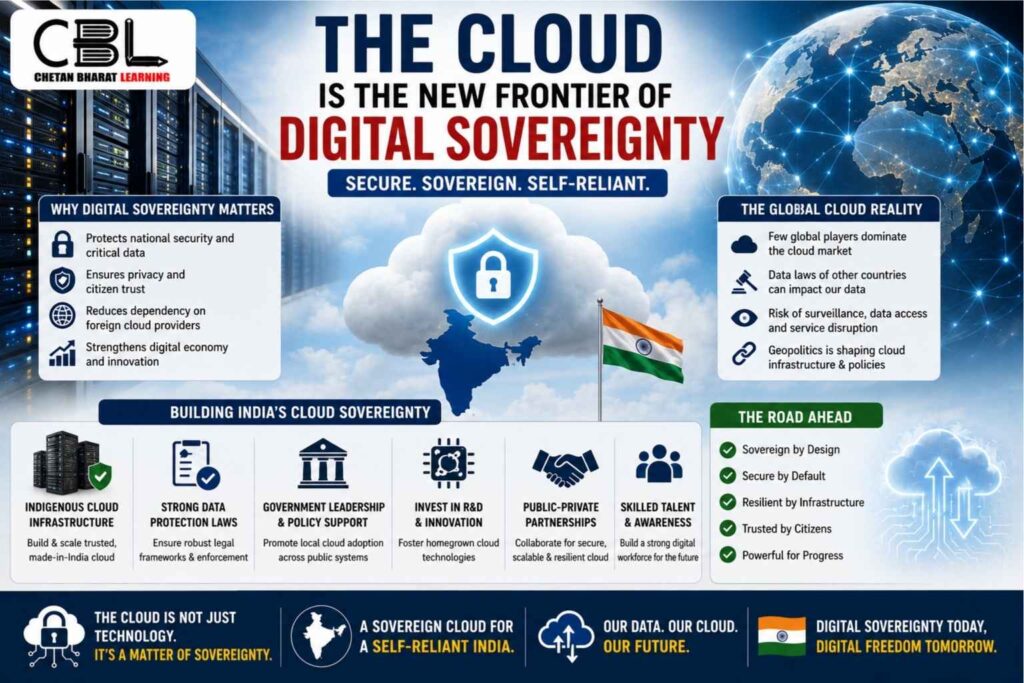
Cloud sovereignty refers to a country’s ability to exercise control over its digital infrastructure, data, and cloud services.
In simple terms, it means ensuring that critical digital assets remain protected from external legal, political, or economic pressures.
Cloud sovereignty involves:
- Data control
- Digital infrastructure security
- Regulatory oversight
- National technological capability
The objective is to reduce vulnerabilities arising from excessive dependence on foreign-controlled platforms.
Why Does Cloud Sovereignty Matter?
Today, cloud services support a wide range of activities.
These include:
- Banking operations
- Government services
- Healthcare systems
- Energy infrastructure
- Business operations
If access to cloud services is disrupted, critical functions can be affected.
Therefore, cloud infrastructure has become as important as physical infrastructure in the modern economy.
Geopolitics and Technology
Technology and geopolitics are becoming increasingly interconnected.
In recent years, several countries have used:
- Economic sanctions
- Technology restrictions
- Export controls
- Data regulations
as tools of foreign policy.
As a result, countries are becoming more conscious of their dependence on foreign technology providers.
The debate is no longer limited to data storage. It now includes strategic control over digital infrastructure.
What Is Digital Sovereignty?
Digital sovereignty is the broader concept under which cloud sovereignty operates.
It refers to a nation’s ability to independently govern:
- Data
- Digital platforms
- Technology infrastructure
- Cyber ecosystems
A digitally sovereign nation can make policy decisions without excessive dependence on external actors.
India’s Growing Digital Infrastructure
India has emerged as one of the world’s largest digital economies.
The country has built several major digital platforms, including:
- Aadhaar
- UPI
- DigiLocker
- CoWIN
- Digital Public Infrastructure (DPI)
These systems support millions of users every day.
Consequently, protecting digital infrastructure has become a strategic priority.
Challenges Facing India
Despite significant progress, several challenges remain.
Dependence on Global Cloud Providers
A large share of cloud services used by businesses worldwide is controlled by a few global technology companies.
This concentration creates concerns regarding:
- Operational dependence
- Data security
- Regulatory control
Data Governance Issues
As digital transactions increase, the volume of sensitive data also grows.
Governments must therefore ensure:
✔ Data protection
✔ Privacy safeguards
✔ Secure storage
✔ Regulatory compliance
Cyber Security Risks
Cyber attacks are becoming more sophisticated.
Critical digital infrastructure can become a target for:
- State-sponsored attacks
- Cyber criminals
- Ransomware groups
Therefore, cyber resilience remains a key component of digital sovereignty.
India’s Response
India has taken several steps to strengthen digital resilience.
These include:
- Expanding domestic data centres
- Promoting data protection frameworks
- Strengthening cyber security systems
- Supporting digital public infrastructure
Such measures aim to reduce vulnerabilities and improve long-term technological resilience.
Balancing Global Integration and Strategic Autonomy
India cannot completely isolate itself from global technology networks.
At the same time, excessive dependence on external infrastructure can create strategic risks.
Therefore, policymakers must strike a balance between:
- Global integration
- Innovation
- Security
- Strategic autonomy
Finding this balance will be crucial for India’s digital future.
Why Cloud Sovereignty Matters for Businesses
Businesses increasingly rely on cloud platforms for daily operations.
A secure and resilient cloud ecosystem can provide:
✔ Business continuity
✔ Operational stability
✔ Better data protection
✔ Reduced geopolitical risks
As digitalisation expands, cloud sovereignty will become even more important for economic growth.
Prelims Pointers
Important Concepts
- Cloud Computing
- Cloud Sovereignty
- Digital Sovereignty
- Data Localisation
Related Areas
- Cyber Security
- Data Governance
- Digital Infrastructure
Mains Perspective
Possible Question
“Digital sovereignty is becoming as important as territorial sovereignty in the 21st century.” Discuss in the context of cloud infrastructure and national security.
Key Dimensions
- Digital infrastructure
- Data governance
- Cyber security
- Strategic autonomy
- Technology dependence
- National security
Frequently Asked Questions (FAQ)
What is cloud sovereignty?
Cloud sovereignty refers to a country’s ability to maintain control over its digital infrastructure, cloud services, and data.
Why is cloud sovereignty important?
It helps reduce dependence on foreign-controlled infrastructure and improves national digital security.
What is the difference between cloud sovereignty and digital sovereignty?
Cloud sovereignty focuses on cloud infrastructure and data control, while digital sovereignty covers the broader digital ecosystem.
Why is cloud infrastructure considered strategic?
Because critical services such as banking, governance, healthcare, and business operations increasingly depend on cloud platforms.
Conclusion: The New Dimension of National Power
In the digital age, sovereignty is no longer limited to land, sea, air, and space. Control over data and digital infrastructure is emerging as a new dimension of national power.
As economies become increasingly digital, countries must ensure that critical infrastructure remains secure, resilient, and strategically autonomous.
For India, strengthening cloud sovereignty will be essential not only for economic growth but also for national security and technological self-reliance.
“In the 21st century, control over data and digital infrastructure may become as important as control over physical territory.”
Related Current Affairs
Preparing for UPSC, PCS or HCS?
Talk to a mentor at Chetan Bharat Learning, Chandigarh. Free guidance on choosing the right exam and building a study plan.
Chat on WhatsAppCall 97793 53345UPSC / IAS / PCS coaching in Chandigarh · Trusted by aspirants across Punjab & Haryana
Leave a Reply
You must be logged in to post a comment.