
Why the Monsoon Matters
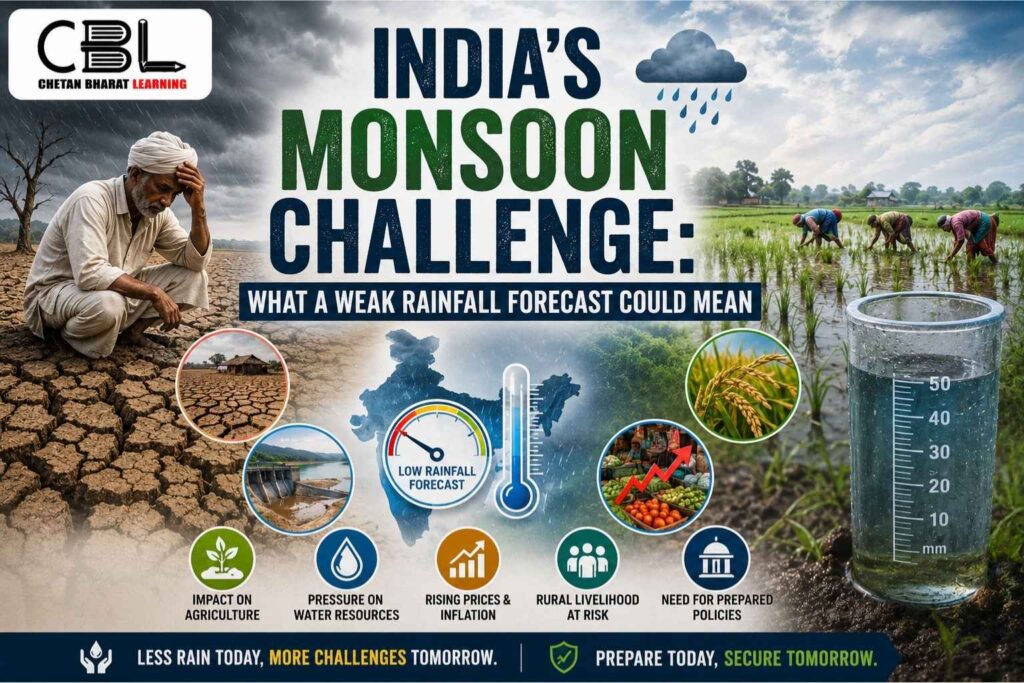
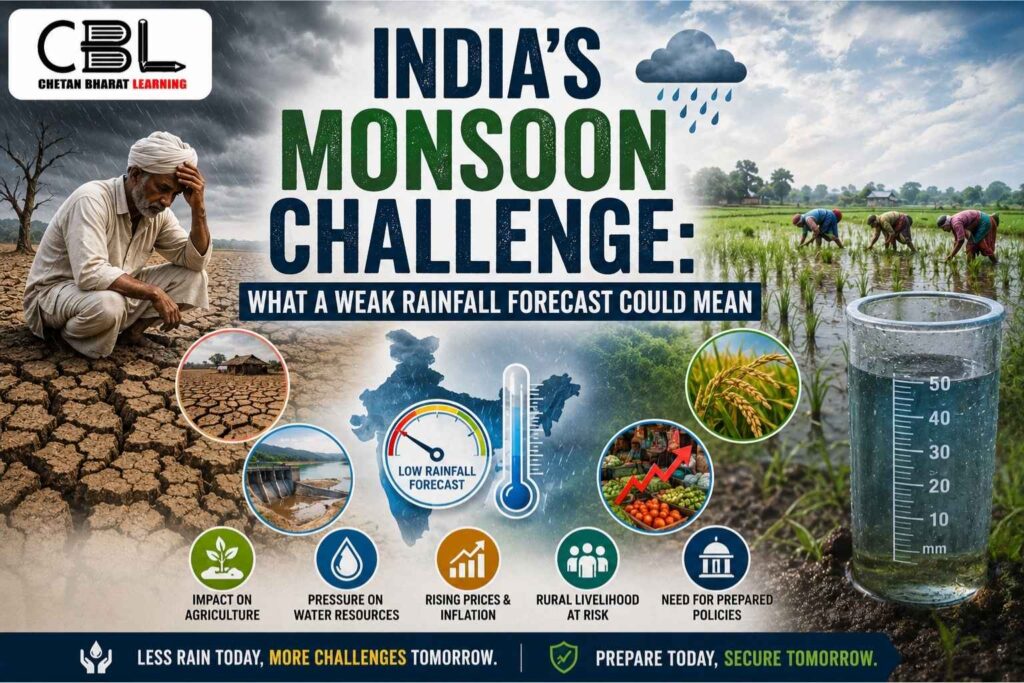
The southwest monsoon is often described as the lifeline of the Indian economy. Despite rapid urbanisation and economic diversification, agriculture, water resources, food security, and rural livelihoods continue to depend heavily on seasonal rainfall.
Recent forecasts indicating that rainfall may fall to around 90% of the 50-year average have raised concerns about the possibility of one of the weakest monsoons in a decade.
A below-normal monsoon does not simply affect agriculture. It can influence inflation, energy production, water availability, and overall economic growth.
Students preparing through UPSC Coaching in Chandigarh and IAS Coaching in Chandigarh should closely follow topics like monsoon systems, climate variability, food security, and water management because these themes are highly important for GS Paper 1, GS Paper 3, Essay, and UPSC Interview preparation.
Understanding the Indian Monsoon System
The Indian monsoon is a seasonal wind system that brings rainfall to large parts of the country between June and September.
Its development depends on several factors:
- Differential heating of land and sea
- Inter-Tropical Convergence Zone (ITCZ)
- El Niño and La Niña conditions
- Indian Ocean Dipole (IOD)
- Jet streams and atmospheric circulation
Even small variations in these factors can significantly affect rainfall distribution.
What Does 90% of the Long Period Average Mean?
The India Meteorological Department (IMD) uses the Long Period Average (LPA) as a benchmark for monsoon assessment.
Generally:
- 96–104% of LPA = Normal rainfall
- Below 96% = Below-normal rainfall
- Above 104% = Above-normal rainfall
A forecast of around 90% of LPA suggests a significant rainfall deficiency compared to normal conditions.
Why a Weak Monsoon Is a Concern
1. Impact on Agriculture
A large share of India’s agricultural land remains dependent on rainfall.
Lower rainfall can lead to:
- Reduced crop sowing
- Lower agricultural productivity
- Crop stress
- Reduced farmer incomes
Rain-fed agriculture is particularly vulnerable.
2. Food Inflation Risks
Agricultural production directly affects food supply.
Poor rainfall may result in:
- Lower crop output
- Reduced vegetable production
- Higher food prices
- Increased inflationary pressure
Food inflation can affect both rural and urban households.
3. Water Security Challenges
Monsoon rainfall replenishes:
- Reservoirs
- Rivers
- Lakes
- Groundwater systems
A deficient monsoon may reduce water availability for:
- Agriculture
- Domestic consumption
- Industrial use
This increases pressure on already stressed water resources.
4. Hydropower Generation
Hydropower projects depend on adequate water availability.
Lower rainfall may reduce:
- Reservoir levels
- Electricity generation capacity
- Energy reliability in certain regions
This can increase dependence on conventional energy sources.
Climate Change and Monsoon Variability
Scientists increasingly argue that climate change is altering rainfall patterns across South Asia.
Emerging trends include:
- More extreme rainfall events
- Longer dry spells
- Uneven rainfall distribution
- Increased climate uncertainty
As a result, monsoon forecasting and climate adaptation have become more important than ever.
Can India Manage a Weak Monsoon Better Today?
Compared to previous decades, India possesses stronger institutional mechanisms to manage rainfall shocks.
These include:
✔ Improved weather forecasting
✔ Better food grain stocks
✔ Expanded irrigation infrastructure
✔ Crop insurance schemes
✔ Disaster management systems
While challenges remain, resilience has improved considerably.
Government Measures to Reduce Monsoon Dependence
India has increasingly focused on:
- Micro-irrigation
- Watershed development
- Crop diversification
- Groundwater management
- Climate-resilient agriculture
The objective is to reduce excessive dependence on monsoon variability.
The Economic Dimension
A weak monsoon can affect:
- Rural consumption
- Agricultural exports
- Food inflation
- GDP growth
However, the impact today may be lower than in previous decades because services and manufacturing now contribute a larger share to the economy.
Nevertheless, agriculture remains crucial for employment and rural livelihoods.
Prelims Pointers
Important Terms
- Long Period Average (LPA)
- El Niño
- La Niña
- Indian Ocean Dipole (IOD)
Important Institution
- India Meteorological Department (IMD)
Mains Perspective
Possible Question
“Climate variability is increasing the economic and environmental risks associated with the Indian monsoon.” Discuss.
Key Dimensions to Include
- Agriculture
- Food security
- Water management
- Climate change
- Disaster preparedness
- Rural economy
Frequently Asked Questions (FAQ)
What is the Long Period Average (LPA)?
LPA is the average rainfall recorded over a long historical period and serves as a benchmark for monsoon assessment.
Why is the monsoon important for India?
The monsoon supports agriculture, water resources, hydropower generation, and rural livelihoods.
How does climate change affect the monsoon?
Climate change can alter rainfall patterns, increase extreme weather events, and create greater uncertainty in seasonal rainfall.
Can India reduce dependence on the monsoon?
Yes. Investments in irrigation, water management, climate-resilient agriculture, and forecasting systems can improve resilience.
Conclusion: Beyond Rainfall, a Test of Resilience
A weak monsoon forecast is not merely a weather event—it is a test of India’s economic, agricultural, and environmental resilience.
While modern forecasting systems and policy interventions have improved preparedness, the long-term solution lies in strengthening water security, climate adaptation, and sustainable agricultural practices.
The challenge is not only to predict rainfall more accurately but also to build systems capable of thriving despite climatic uncertainty.
“The future of monsoon management lies not in controlling the rain, but in improving resilience to its variability.”
Related Current Affairs
Preparing for UPSC, PCS or HCS?
Talk to a mentor at Chetan Bharat Learning, Chandigarh. Free guidance on choosing the right exam and building a study plan.
Chat on WhatsAppCall 97793 53345UPSC / IAS / PCS coaching in Chandigarh · Trusted by aspirants across Punjab & Haryana
Leave a Reply
You must be logged in to post a comment.