
Why the Subsidy Debate Matters
Agriculture remains the backbone of rural livelihoods in India. To support farmers and ensure food security, governments have traditionally provided various subsidies and financial assistance.
These include:
- Fertilizer subsidies
- Electricity subsidies
- Irrigation support
- Minimum Support Price (MSP) mechanisms
- Loan waivers
While these measures have played an important role in protecting farmers, questions are increasingly being raised about their long-term sustainability and effectiveness.
The debate is no longer about whether farmers should be supported. Instead, it focuses on how support can be delivered more efficiently while ensuring fiscal sustainability and agricultural productivity.
Students preparing through UPSC Coaching in Chandigarh and IAS Coaching in Chandigarh should closely follow topics like agricultural reforms, rural development, food security, and fiscal policy because these themes are highly important for GS Paper 3, Essay, and UPSC Interview preparation.
Why Agricultural Subsidies Were Introduced
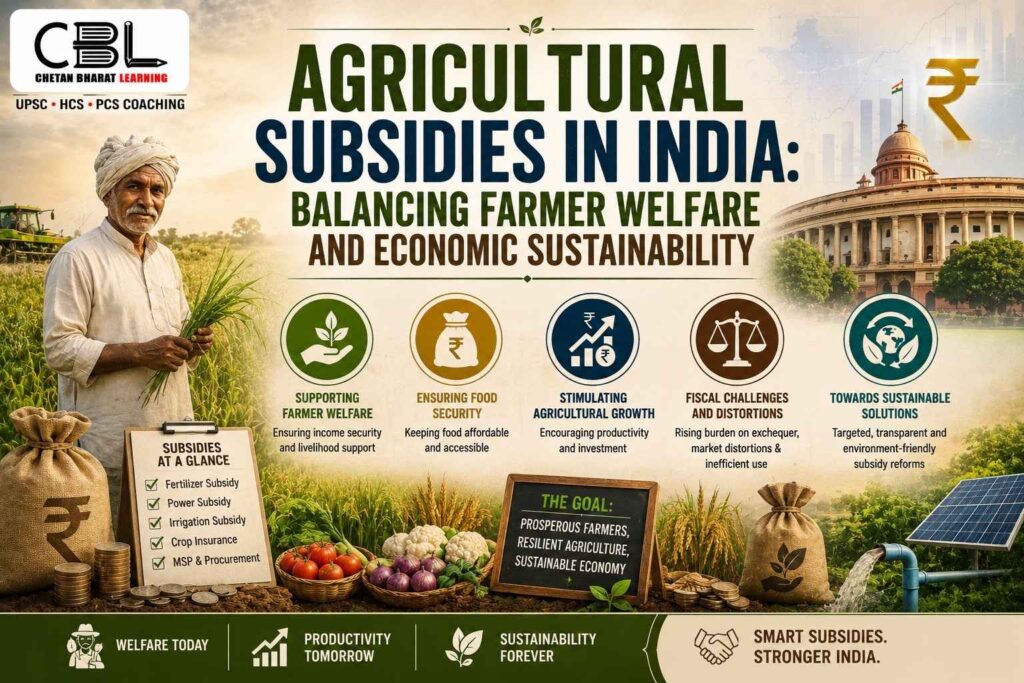
Agricultural subsidies were introduced to address several structural challenges faced by farmers.
The key objectives include:
✔ Reducing input costs
✔ Improving food production
✔ Supporting farmer incomes
✔ Enhancing food security
✔ Stabilizing agricultural markets
Subsidies became especially important after the Green Revolution, which transformed India’s agricultural landscape.
Major Agricultural Subsidies in India
1. Fertilizer Subsidies
Fertilizer subsidies help farmers purchase nutrients such as:
- Urea
- DAP (Di-Ammonium Phosphate)
- Potash-based fertilizers
The government bears a significant portion of the cost to make fertilizers affordable.
Benefits
- Lower cultivation costs
- Improved productivity
- Enhanced food production
Concerns
- Overuse of chemical fertilizers
- Soil degradation
- Fiscal burden on government finances
2. Electricity Subsidies
Many states provide heavily subsidized or free electricity for agricultural activities.
Benefits
- Lower irrigation costs
- Support for groundwater extraction
- Reduced operational expenses
Challenges
- Excessive groundwater depletion
- Energy inefficiency
- Financial stress on power utilities
3. MSP and Procurement Support
The Minimum Support Price (MSP) system protects farmers against sharp price fluctuations.
Government procurement:
- Ensures assured markets
- Supports food security programs
- Provides income stability
However, critics argue that excessive dependence on MSP can distort cropping patterns and market signals.
The Growing Fiscal Challenge
Agricultural subsidies constitute a significant expenditure for governments.
Large subsidy commitments can:
- Increase fiscal pressures
- Reduce resources for capital investment
- Limit spending on infrastructure and innovation
As public expenditure requirements continue to rise, policymakers face difficult choices regarding subsidy allocation.
The Problem of Resource Misallocation
One major criticism of subsidy-driven agriculture is that it sometimes encourages inefficient resource use.
Examples include:
- Excessive groundwater extraction
- Overuse of fertilizers
- Cultivation of water-intensive crops in unsuitable regions
Such patterns can create environmental and economic challenges over time.
Should Subsidies Be Removed?
The debate is not about eliminating support for farmers.
Most experts argue for:
✔ Smarter subsidies
✔ Targeted support mechanisms
✔ Direct income transfers
✔ Better market access
✔ Agricultural modernization
The goal is to improve outcomes while reducing inefficiencies.
Alternative Approaches to Farmer Support
Direct Benefit Transfers (DBT)
Instead of subsidizing inputs, governments can provide direct financial assistance to farmers.
Benefits include:
- Greater transparency
- Reduced leakages
- Better targeting
Investment in Agricultural Infrastructure
Long-term productivity improvements require investment in:
- Irrigation systems
- Storage facilities
- Rural roads
- Agricultural research
Such investments may generate more sustainable benefits than untargeted subsidies.
Technology and Innovation
Modern agriculture increasingly depends on:
- Precision farming
- Climate-smart agriculture
- Digital advisory services
- Improved seed varieties
Investment in innovation can improve productivity while reducing resource stress.
Agriculture, Politics and Public Policy
Agricultural subsidies are not only economic instruments; they are also politically sensitive issues.
Farmers represent a significant segment of India’s population, making agricultural policy an important electoral and governance issue.
As a result, reforms often require balancing:
- Economic efficiency
- Farmer welfare
- Political feasibility
- Social equity
Prelims Pointers
Important Subsidies
- Fertilizer subsidy
- Power subsidy
- Irrigation subsidy
Key Concepts
- MSP
- DBT
- Food Security
- Fiscal Deficit
Mains Perspective
Possible Question
“Agricultural subsidies have contributed to food security and farmer welfare but have also created fiscal and environmental challenges.” Critically examine.
Key Dimensions to Include
- Farmer welfare
- Fiscal sustainability
- Resource efficiency
- Agricultural productivity
- Environmental concerns
- Reform options
Frequently Asked Questions (FAQ)
Why does India provide agricultural subsidies?
Subsidies help reduce input costs, support farmer incomes, and strengthen food security.
What are the major concerns regarding subsidies?
Concerns include fiscal burden, resource misallocation, environmental degradation, and inefficiencies.
What is MSP?
Minimum Support Price (MSP) is a government-announced price that protects farmers from sharp market fluctuations.
Can subsidies be replaced entirely?
Most experts recommend reforming and targeting subsidies rather than eliminating them completely.
Conclusion: From Subsidies to Sustainable Support
India’s agricultural subsidy system has played a vital role in supporting farmers and ensuring food security. However, changing economic realities, environmental pressures, and fiscal constraints require a re-evaluation of how support is delivered.
The future may lie in shifting from broad-based subsidies toward:
- Targeted assistance
- Direct income support
- Agricultural innovation
- Infrastructure development
Such an approach can strengthen farmer welfare while ensuring long-term sustainability.
“The challenge is not whether to support farmers, but how to support them in a way that is economically sustainable, environmentally responsible, and socially inclusive.”
Related Current Affairs
Preparing for UPSC, PCS or HCS?
Talk to a mentor at Chetan Bharat Learning, Chandigarh. Free guidance on choosing the right exam and building a study plan.
Chat on WhatsAppCall 97793 53345UPSC / IAS / PCS coaching in Chandigarh · Trusted by aspirants across Punjab & Haryana
Leave a Reply
You must be logged in to post a comment.