
Why the Sahel Region Matters Globally
The Sahel region of Africa has emerged as one of the world’s most unstable geopolitical zones. Stretching across countries such as Mali, Burkina Faso, Niger, and parts of Chad, the region is increasingly witnessing:
- Islamist insurgencies
- Military coups
- Ethnic conflicts
- Weak governance structures
- Foreign power competition
At the center of this growing instability is Jama’at Nusrat al-Islam wal-Muslimin (JNIM), an Al-Qaeda-linked militant group that is expanding its influence across the Sahel.
The organisation is attempting to establish Islamist rule based on strict interpretations of Sharia law while weakening state authority and foreign military presence.
Students preparing through UPSC Coaching in Chandigarh and IAS Coaching in Chandigarh should closely follow topics like terrorism, regional instability, military coups, proxy conflicts, and geopolitical competition because these themes are highly important for GS Paper 2, GS Paper 3, Essay, and UPSC Interview preparation.
What Is JNIM?
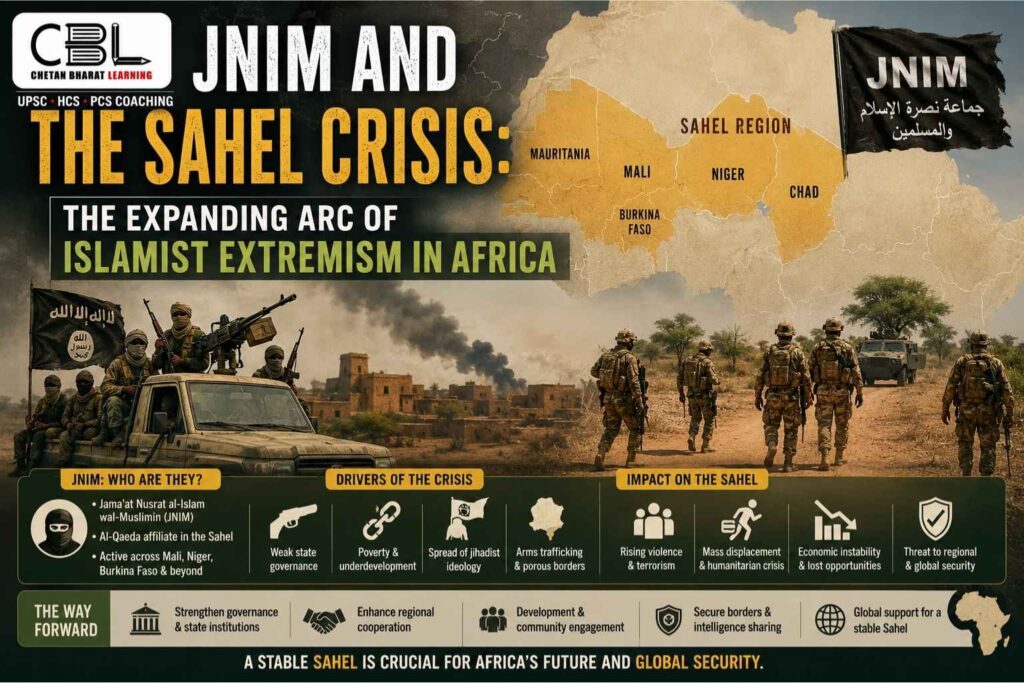
JNIM is a coalition of multiple Islamist militant groups operating primarily in West Africa.
The organisation was formed in 2017 and maintains ideological and operational links with:
- Al-Qaeda
- Regional jihadist networks
JNIM seeks to:
✔ Expand Islamist governance
✔ Remove foreign military influence
✔ Undermine state institutions
✔ Establish territorial control
The group operates heavily in:
- Mali
- Burkina Faso
- Niger
Why the Sahel Has Become a Conflict Zone
1. Weak Governance and Fragile States
Several Sahel countries suffer from:
- Political instability
- Weak state institutions
- Poor governance
- Limited economic opportunities
This creates fertile conditions for extremist recruitment.
2. Military Coups and Political Uncertainty
In recent years, Mali, Burkina Faso, and Niger have experienced military coups.
Frequent regime changes weaken:
- Democratic institutions
- Security coordination
- Regional cooperation
Political instability often creates security vacuums that militant organisations exploit.
3. Poverty and Youth Vulnerability
The Sahel region faces:
- High unemployment
- Food insecurity
- Climate stress
- Limited education access
Extremist groups often exploit socio-economic grievances to recruit young populations.
4. Climate Change and Resource Conflict
Climate variability has intensified:
- Desertification
- Water scarcity
- Land conflicts
- Migration pressures
Competition over shrinking natural resources contributes to local conflicts and social fragmentation.
The Expanding Influence of JNIM
JNIM has significantly expanded beyond northern Mali into broader areas of the Sahel region.
The group increasingly uses:
- Guerrilla warfare
- Cross-border attacks
- Local alliances
- Community infiltration
Rather than relying only on military force, JNIM often attempts to gain local legitimacy by:
- Providing dispute resolution
- Offering protection
- Exploiting weak governance systems
This makes counterinsurgency operations far more difficult.
Foreign Powers and the Sahel Crisis
France’s Declining Influence
France historically maintained a strong military presence in the Sahel through operations such as:
- Operation Barkhane
However, rising anti-French sentiment and political tensions forced France to reduce its military footprint in several countries.
The Wagner Group and Russia’s Growing Presence
Russia-linked Wagner Group forces have increased their influence in parts of the Sahel.
Their presence reflects:
- Expanding Russian geopolitical interests
- Competition with Western influence
- Security partnerships with military-led governments
This has transformed the Sahel into a space of broader geopolitical rivalry.
Why the Sahel Crisis Matters for the World
The Sahel crisis has global implications because it affects:
✔ Regional stability
✔ International terrorism networks
✔ Migration flows
✔ Global security cooperation
✔ Resource security
The region’s instability also increases the risk of extremist spillover into neighboring regions.
Counterterrorism Challenges
Despite multiple military operations, extremist groups continue to adapt rapidly.
Major challenges include:
- Difficult terrain
- Cross-border militant mobility
- Weak state capacity
- Civilian distrust
- Humanitarian crises
Purely military solutions have struggled to deliver long-term stability.
The Humanitarian Dimension
Millions of people across the Sahel face:
- Displacement
- Food shortages
- Humanitarian emergencies
- Lack of healthcare
- Educational disruption
Conflict and climate stress together are worsening human security conditions.
Prelims Pointers
Important Facts
- JNIM is linked to Al-Qaeda
- Active mainly in Mali, Burkina Faso, and Niger
- Sahel region stretches across North and Sub-Saharan Africa
Key Terms
- Sahel
- Islamist extremism
- Counterinsurgency
- Wagner Group
- Military coups
Mains Perspective
Possible Question
“The Sahel crisis reflects the intersection of terrorism, weak governance, climate stress, and geopolitical competition.” Discuss.
Key Dimensions to Include
- Fragile states
- Terrorism
- Climate insecurity
- Foreign intervention
- Proxy competition
- Humanitarian crisis
Frequently Asked Questions (FAQ)
What is JNIM?
JNIM is an Al-Qaeda-affiliated Islamist militant coalition operating mainly in the Sahel region of Africa.
Why is the Sahel region unstable?
The region faces weak governance, military coups, poverty, climate stress, and expanding extremist violence.
Why is Russia increasing its presence in the Sahel?
Russia seeks strategic influence, security partnerships, and geopolitical leverage in Africa through groups like Wagner.
Why is the Sahel important in International Relations?
The region affects global security, terrorism networks, migration, and geopolitical competition among major powers.
Conclusion: A Crisis Beyond Borders
The Sahel crisis is no longer a localized regional conflict. It has evolved into a multidimensional challenge involving:
- Terrorism
- Governance failures
- Climate insecurity
- Geopolitical competition
- Humanitarian instability
The rise of JNIM demonstrates how extremist organisations can exploit fragile governance structures and social vulnerabilities to expand influence across borders.
As the global order becomes increasingly fragmented, the Sahel may continue to emerge as one of the most strategically important security theatres of the 21st century.
“The Sahel crisis is not only a battle against extremism — it is also a struggle over governance, legitimacy, and the future balance of power in Africa.”
Related Current Affairs
Preparing for UPSC, PCS or HCS?
Talk to a mentor at Chetan Bharat Learning, Chandigarh. Free guidance on choosing the right exam and building a study plan.
Chat on WhatsAppCall 97793 53345UPSC / IAS / PCS coaching in Chandigarh · Trusted by aspirants across Punjab & Haryana
Leave a Reply
You must be logged in to post a comment.