
India’s AI Moment in 2026: From Talent Hub to Strategic AI Power
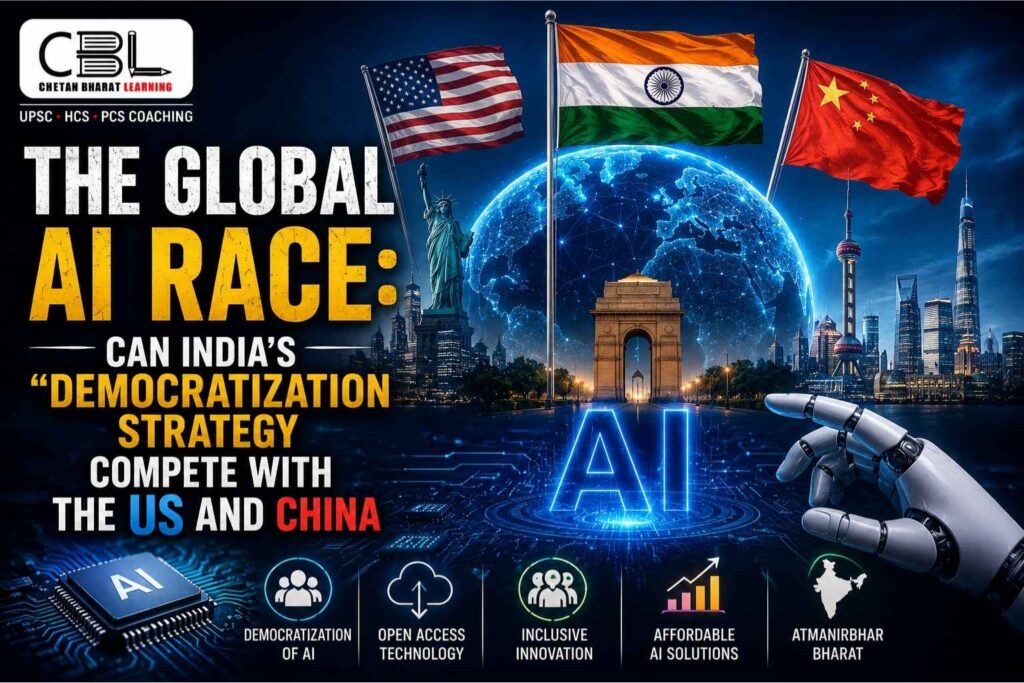
The global race for Artificial Intelligence (AI) is no longer limited to algorithms or chatbots. In 2026, the competition has expanded into a much larger strategic battle involving:
- Control over AI infrastructure
- Leadership in global AI standards
- Integration of AI into daily governance and economic systems
- Ensuring AI benefits society at scale
According to the Global AI Brain Race Report 2026, India currently ranks 6th globally in AI readiness. While India possesses one of the world’s largest technology talent pools, the ranking highlights an important reality:
Talent alone is not enough to dominate the AI era.
Countries leading the AI race are building complete AI ecosystems that include:
- Compute infrastructure
- Semiconductor access
- Research capability
- Governance frameworks
- Public digital systems
- Strategic capital investment
While the United States and China continue to dominate through massive R&D spending and computational strength, India is following a different path focused on AI democratization, sovereign capability, and inclusive innovation.
Why India Ranks 6th in the Global AI Race
The Global AI Brain Race Report 2026 evaluates countries across four major pillars:
- Research & Development (R&D)
- Infrastructure
- Talent
- Governance
The Global Leaders in AI
United States: The Compute and Innovation Giant
The United States remains the leading AI power because of its:
- Frontier AI research
- Access to advanced GPUs
- Strong semiconductor ecosystem
- Dominance of Big Tech companies
- Massive private investment
American firms continue to lead the development of large-scale Frontier Models.
China: AI at National Scale
China ranks second due to:
- Heavy state-backed AI investments
- Large-scale AI education programs
- Integrated industrial policy
- Strong hardware manufacturing capability
- Centralized data ecosystems
China’s model combines state planning with rapid implementation capacity.
India’s Strength: Talent and Digital Scale
India performs strongly in:
- Software engineering talent
- AI workforce size
- Startup ecosystem growth
- Digital public infrastructure
India’s large population and rapidly digitizing economy create strong conditions for scaling AI-based solutions.
India’s Biggest Weaknesses: Compute and Governance
Despite its talent advantage, India still faces major structural challenges.
1. Limited Access to High-End Compute
Modern AI development increasingly depends on:
- GPUs
- High-performance computing clusters
- Data centers
- Semiconductor ecosystems
India currently lacks sufficient domestic access to advanced compute infrastructure.
2. Evolving Governance Frameworks
India is still developing:
- AI regulation systems
- Data governance frameworks
- Ethical AI safeguards
- Privacy protections
- AI accountability mechanisms
The report emphasizes that future AI leaders will be nations capable of balancing innovation with governance stability.
India’s AI Strategy: Democratization Instead of “Brute Force”
Unlike Silicon Valley’s race to build increasingly larger Frontier Models, India’s AI strategy focuses on building public AI infrastructure.
This vision is reflected in the IndiaAI Mission.
India’s objective is not only to create massive AI companies but also to ensure AI becomes:
- Affordable
- Inclusive
- Linguistically diverse
- Accessible to startups and researchers
- Useful for public welfare
1. Sovereign AI: Building AI for India’s Needs
India is investing in Sovereign AI systems designed around:
- Indian languages
- Local governance realities
- Rural applications
- Healthcare delivery
- Agriculture
- Indian legal and cultural contexts
This approach differs significantly from Western AI systems that are primarily trained on English-language and Western datasets.
Why Sovereign AI Matters
India does not want to rely entirely on foreign AI platforms that may:
- Ignore Indian languages
- Reflect external biases
- Operate under foreign regulatory systems
- Lack sensitivity toward local social realities
Therefore, Sovereign AI is closely linked with:
- Technological independence
- Cultural representation
- Strategic autonomy
2. Public Compute Infrastructure: India’s “AI Rails”
One of the most ambitious goals of the IndiaAI Mission is the creation of a public compute utility.
India’s GPU Push
The government has already onboarded:
- Over 58,000 GPUs
- Shared compute access systems
- Subsidized AI infrastructure for startups and researchers
This approach treats compute power as a public utility similar to roads, electricity, or digital infrastructure.
Why This Model Is Different
Unlike the US and China, which rely heavily on private tech giants or centralized state capacity, India’s strategy focuses on:
- Building open AI rails
- Democratizing access
- Lowering entry barriers
- Encouraging startup innovation
This enables smaller Indian firms to compete without requiring billions of dollars in capital investment.
3. AIKosh: India’s Public Dataset Ecosystem
AIKosh is another major pillar of India’s AI ecosystem.
What AIKosh Does
AIKosh provides:
- 9,500+ datasets
- Multi-sectoral public data
- Ready-to-train AI resources
This reduces the time startups spend:
- Cleaning data
- Organizing datasets
- Building training pipelines
As a result, developers can focus more directly on innovation and practical AI applications.
The 2026 Turning Point: AI Impact Summit in New Delhi
India’s AI ambitions received global visibility during the AI Impact Summit (February 2026) hosted in New Delhi.
The summit symbolized India’s transition from:
AI consumer → AI rule-shaper and global standard-setter
The “7 Chakras & 3 Sutras” Framework
India introduced a new AI governance framework supported by 92 countries.
The framework emphasized:
- Human-centric AI
- Energy-efficient systems
- Ethical deployment
- Inclusive digital growth
- Responsible innovation
This reflected India’s effort to promote a more democratic and globally inclusive AI order.
Global AI Commitments
During the summit:
- 13 major AI developers signed the New Delhi Frontier AI Impact Commitments
The commitments focused on:
- Ethical deployment
- Responsible AI systems
- Transparency standards
- Market accountability
This significantly strengthened India’s role in global AI governance debates.
Why India’s AI Model Is Different From Silicon Valley
Frontier Models vs Sovereign AI
Frontier Models
These are:
- Massive general-purpose AI systems
- Highly compute-intensive
- Trained with extremely large budgets
- Dominated mainly by US and Chinese firms
Examples include:
- GPT-4
- Claude
Sovereign AI
Sovereign AI focuses on:
- National priorities
- Local language capability
- Domestic governance
- Public accessibility
- Strategic independence
India’s strategy is less about winning the Frontier Model race and more about ensuring AI supports developmental goals.
Can India Lead Without Semiconductor Dominance?
One of the biggest strategic questions facing India is:
Can India become an AI leader without controlling advanced semiconductor manufacturing?
Currently:
- The US dominates AI software ecosystems
- Taiwan and South Korea dominate chip fabrication
- China dominates scale manufacturing
India still lacks world-leading semiconductor fabrication capability.
However, India is attempting a different approach through:
- AI infrastructure sharing
- Public compute systems
- Open innovation models
- Integration with Digital Public Infrastructure (DPI)
This model may allow India to become a leader in AI deployment even without dominating chip manufacturing.
AI and Digital Public Infrastructure (DPI)
India’s greatest comparative advantage may be its existing Digital Public Infrastructure ecosystem.
India already possesses:
- Aadhaar
- UPI
- DigiLocker
- Account Aggregator systems
The next step involves integrating AI directly into these digital public rails.
This could enable:
- AI-driven public services
- Inclusive digital governance
- Rural AI accessibility
- Affordable AI applications at population scale
Prelims Pointers
IndiaAI Mission
Allocation: ₹10,300 crore
Focus Areas
- Compute infrastructure
- Skill development
- AI startups
- Public datasets
India’s Global AI Ranking
- 6th globally (Global AI Brain Race 2026)
Important National Projects
- AIRAWAT
- PARAM Siddhi-AI
- National Supercomputing Mission
Mains Perspective
“India’s AI strategy represents a departure from the global market-led AI model.” Discuss.
Key Themes to Cover
- AI democratization
- Public compute infrastructure
- Digital Public Infrastructure integration
- Sovereign AI
- Ethical governance
- Inclusive growth
- Strategic autonomy
Conclusion: India’s AI Bet Is About Inclusion, Not Just Scale
India’s AI strategy is fundamentally different from the brute-force competition shaping the US-China AI rivalry.
Instead of focusing only on:
- Bigger models
- Higher compute power
- Corporate monopolies
India is trying to build:
- Public AI rails
- Affordable compute access
- Inclusive innovation ecosystems
- Sovereign AI capabilities
The success of this model will depend on whether India can overcome:
- GPU shortages
- Funding gaps
- Governance challenges
- Deep-tech research limitations
Still, India’s broader vision is becoming increasingly clear:
The future of AI should not belong only to nations with the biggest servers, but also to societies capable of using AI to empower billions of people.
“India is transforming from a provider of AI labor into a designer of AI systems, betting that democratic access will matter more than sheer algorithmic dominance.”
“In the AI era, the true strength of a nation will be measured not only by the power of its machines, but by the inclusiveness of the society those machines serve.”
Related Current Affairs
Preparing for UPSC, PCS or HCS?
Talk to a mentor at Chetan Bharat Learning, Chandigarh. Free guidance on choosing the right exam and building a study plan.
Chat on WhatsAppCall 97793 53345UPSC / IAS / PCS coaching in Chandigarh · Trusted by aspirants across Punjab & Haryana
Leave a Reply
You must be logged in to post a comment.