
UPSC Syllabus Mapping
| GS Paper | GS-III |
|---|---|
| Subject | Environment, Biodiversity and Conservation |
What is Hedychium zubeengargianum?
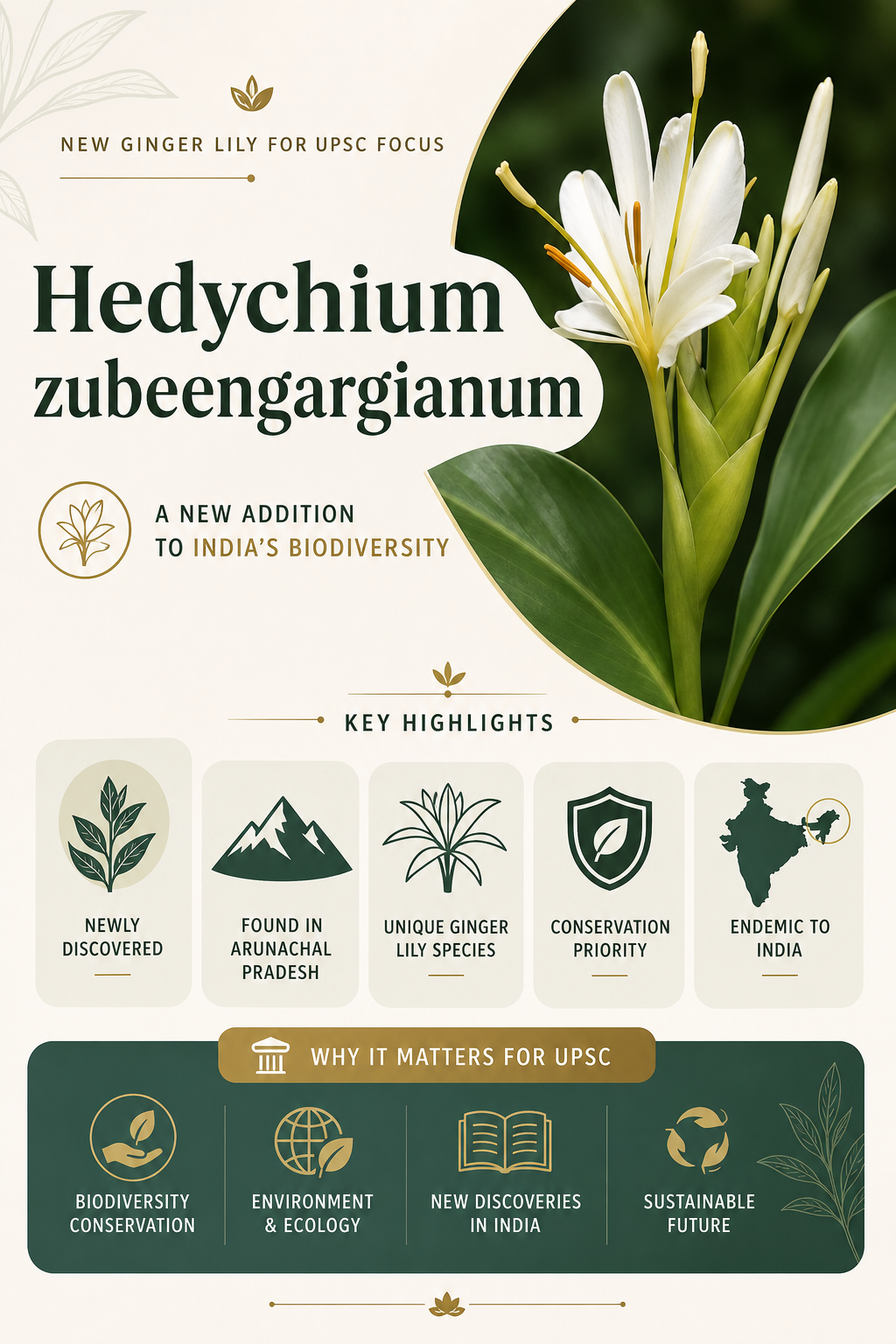
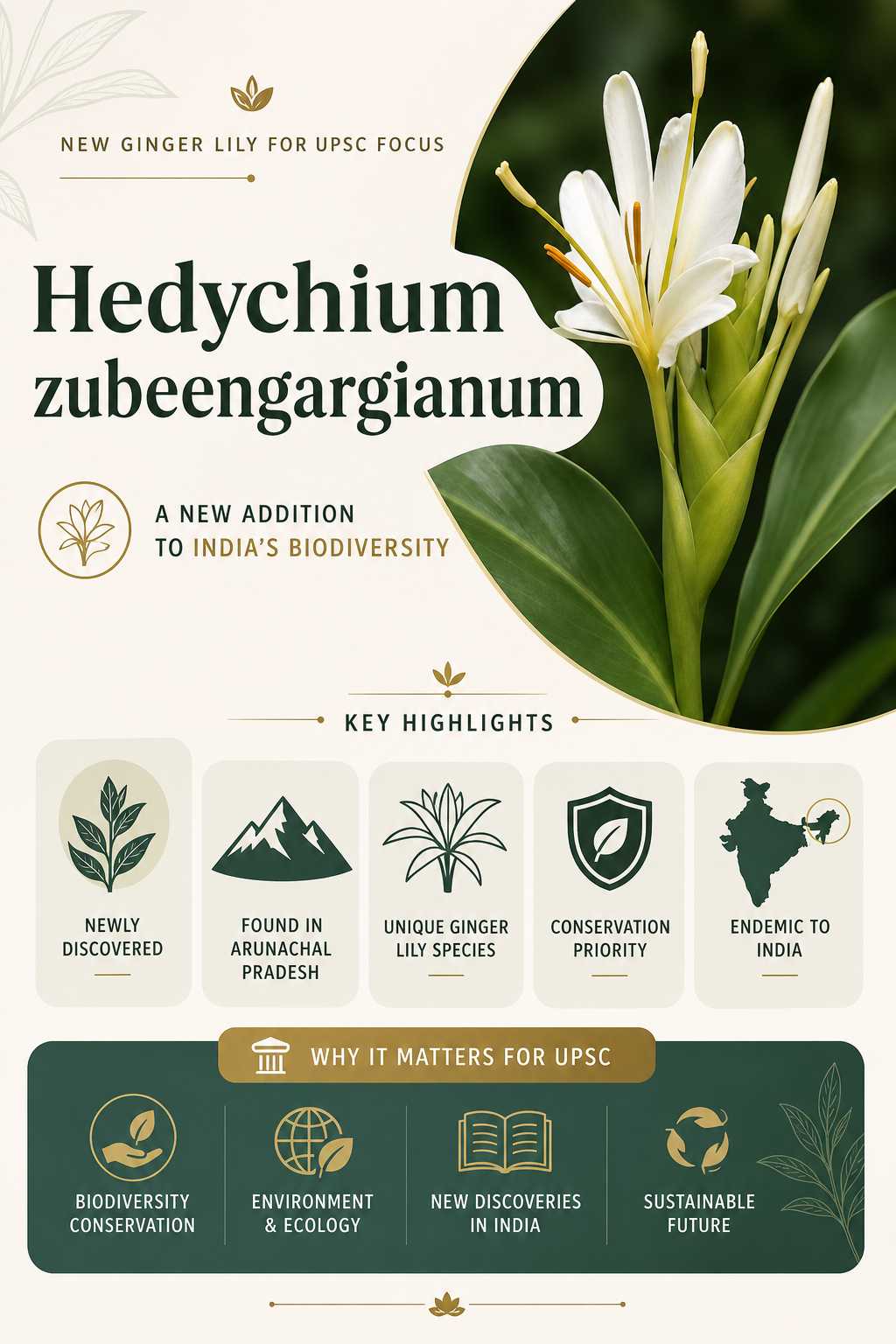
The plant is a newly identified species belonging to the genus Hedychium, whose members are popularly called ginger lilies. The genus belongs to the ginger family, Zingiberaceae. Ginger lilies are notable flowering plants, and several members of the genus occur in biodiversity-rich parts of India, particularly the Northeast and Western Ghats. For Prelims, candidates should distinguish the botanical genus from culinary ginger and remember that the news concerns taxonomic identification of a flowering plant.
The species has creamy-white fragrant flowers, yellow anthers and a densely hairy flowering stalk. Its flowering period is reported to occur during April and May. These characteristics help distinguish it from the closely related Hedychium gracile. Such morphological differences are important in plant taxonomy because botanists compare observable structures, reproductive features and other evidence while determining whether a specimen represents a distinct species.
Why is Hedychium zubeengargianum in News?
The species entered current affairs after botanists at the Botanical Survey of India, Eastern Regional Centre, Shillong, identified it following study of an unusual plant growing in the institute’s botanical garden. The plant had reportedly been growing there since at least 2018. However, its original source could not be traced because collection records were unavailable. This makes careful scientific documentation particularly important when botanical material is collected, cultivated and subsequently examined.
The species was named after Meghalaya-born Assamese musician Zubeen Garg. Beyond the naming aspect, the development highlights the continuing role of taxonomic research in documenting India’s biological diversity. The Botanical Survey of India is a key institution concerned with exploration and documentation of the country’s plant resources. Aspirants can consult Botanical Survey of India for authoritative institutional information on India’s plant diversity and botanical research.
Key Features of the New Ginger Lily
The identification provides several factual points relevant for Prelims. The plant belongs to the genus Hedychium and the family Zingiberaceae. Its conspicuous creamy-white and fragrant flowers, yellow anthers and densely hairy flowering stalk are important diagnostic characteristics. The reported flowering season from April to May is another distinguishing feature when it is compared with related species.
- Plant group: Ginger lily and flowering plant of the ginger family.
- Institution: Botanical Survey of India, Eastern Regional Centre, Shillong.
- Flower: Creamy-white and fragrant, with yellow anthers.
- Flowering period: April to May.
- Close relative: Hedychium gracile.
- Geographical context: The discovery is associated with Shillong in Meghalaya, within biodiversity-rich Northeast India.
India is reported to have about 41 taxa of Hedychium, with many occurring in the Northeast and Western Ghats. Both regions are important centres of biological richness. The news therefore provides a useful bridge between species-based current affairs and broader UPSC concepts such as biodiversity hotspots, endemism, taxonomy, floristic surveys and conservation planning.
Challenges Related to Botanical Documentation
The case illustrates a practical challenge in biodiversity science: a living specimen may survive in a botanical collection even when information about its original collection site is incomplete. Missing provenance records can restrict understanding of a species’ natural distribution, habitat preferences and population status. Without reliable field-location data, scientists may also find it difficult to assess ecological threats or determine whether the plant has a narrow natural range.
Taxonomy itself requires sustained expertise, specimen comparison, field surveys and well-maintained collections. Accurate species identification forms the foundation for biodiversity assessment because conservation decisions depend on knowing which organisms exist and where they occur. This is particularly significant in ecologically diverse regions where habitat change may affect poorly documented species. Aspirants can connect such developments with biodiversity and conservation themes through the UPSC current affairs library.
Way Forward for Biodiversity Research
The identification of Hedychium zubeengargianum underlines the value of strengthening field taxonomy, herbarium collections, botanical gardens and digital biodiversity records. Precise collection information, including locality and habitat details, improves the scientific value of specimens. Continued floristic surveys in Northeast India can also help researchers document lesser-known plant diversity and establish clearer information about distribution and ecological requirements.
Conservation policy benefits when taxonomy is integrated with habitat research and long-term ecological monitoring. Institutions can strengthen collaboration among field botanists, taxonomists, universities and conservation agencies while ensuring that specimens and associated records are systematically preserved. At the national level, the Ministry of Environment, Forest and Climate Change provides the wider institutional context for biodiversity conservation policy. For UPSC, the larger lesson is that species discovery is not merely a naming exercise; it expands the scientific knowledge required to understand and conserve biological diversity.
Prelims Practice Corner
Q1. The recently reported Hedychium zubeengargianum is a species of:
- (a) Orchid
- (b) Ginger lily
- (c) Mangrove
- (d) Fern
Answer: (b) Ginger lily. It belongs to the genus Hedychium.
Q2. Which institution was associated with identification of the species?
- (a) Zoological Survey of India
- (b) Forest Survey of India
- (c) Botanical Survey of India
- (d) Wildlife Institute of India
Answer: (c) Botanical Survey of India, Eastern Regional Centre, Shillong.
Q3. Which feature is associated with the newly identified species?
- (a) Blue flowers
- (b) Creamy-white fragrant flowers
- (c) Red anthers
- (d) Aquatic habitat
Answer: (b) It has creamy-white fragrant flowers and yellow anthers.
Q4. The genus Hedychium belongs to which family?
- (a) Poaceae
- (b) Fabaceae
- (c) Zingiberaceae
- (d) Asteraceae
Answer: (c) Zingiberaceae, the ginger family.
Q5. The Eastern Regional Centre involved in the identification is located in:
- (a) Shillong
- (b) Gangtok
- (c) Guwahati
- (d) Kohima
Answer: (a) Shillong, Meghalaya.
Mains Practice Questions
Q1. Taxonomic research is an essential but often overlooked component of biodiversity conservation. Discuss. (10 marks)
Outline: Define taxonomy; explain species identification and documentation; connect taxonomy with distribution mapping and conservation assessment; discuss field surveys, herbaria and botanical gardens; conclude with the need for stronger scientific documentation.
Q2. Examine the significance of documenting plant diversity in Northeast India for biodiversity conservation. (15 marks)
Outline: Introduce the region’s biological richness; discuss species documentation, endemism and habitat knowledge; explain challenges such as incomplete records and habitat pressures; highlight institutional research and ecological monitoring; conclude with science-based conservation.
FAQs on the New Ginger Lily
What is Hedychium zubeengargianum?
It is a newly identified species of ginger lily belonging to the genus Hedychium and the family Zingiberaceae.
Which organisation identified the species?
Botanists associated with the Botanical Survey of India’s Eastern Regional Centre in Shillong identified the species after studying the unusual plant.
Why is this discovery important for UPSC preparation?
It provides factual Prelims material on species and institutions while linking dynamically with static topics such as taxonomy, Northeast Indian biodiversity, botanical surveys and biodiversity conservation.
Related Current Affairs
Preparing for UPSC, PCS or HCS?
Talk to a mentor at Chetan Bharat Learning, Chandigarh. Free guidance on choosing the right exam and building a study plan.
Chat on WhatsAppCall 97793 53345UPSC / IAS / PCS coaching in Chandigarh · Trusted by aspirants across Punjab & Haryana
Leave a Reply
You must be logged in to post a comment.