
UPSC Syllabus Mapping
GS Paper: GS-II and GS-III
Subject: Government Initiatives, Agriculture, Food Processing, Northeast Development and Intellectual Property Rights
Article
What is Mission Golden Spice?
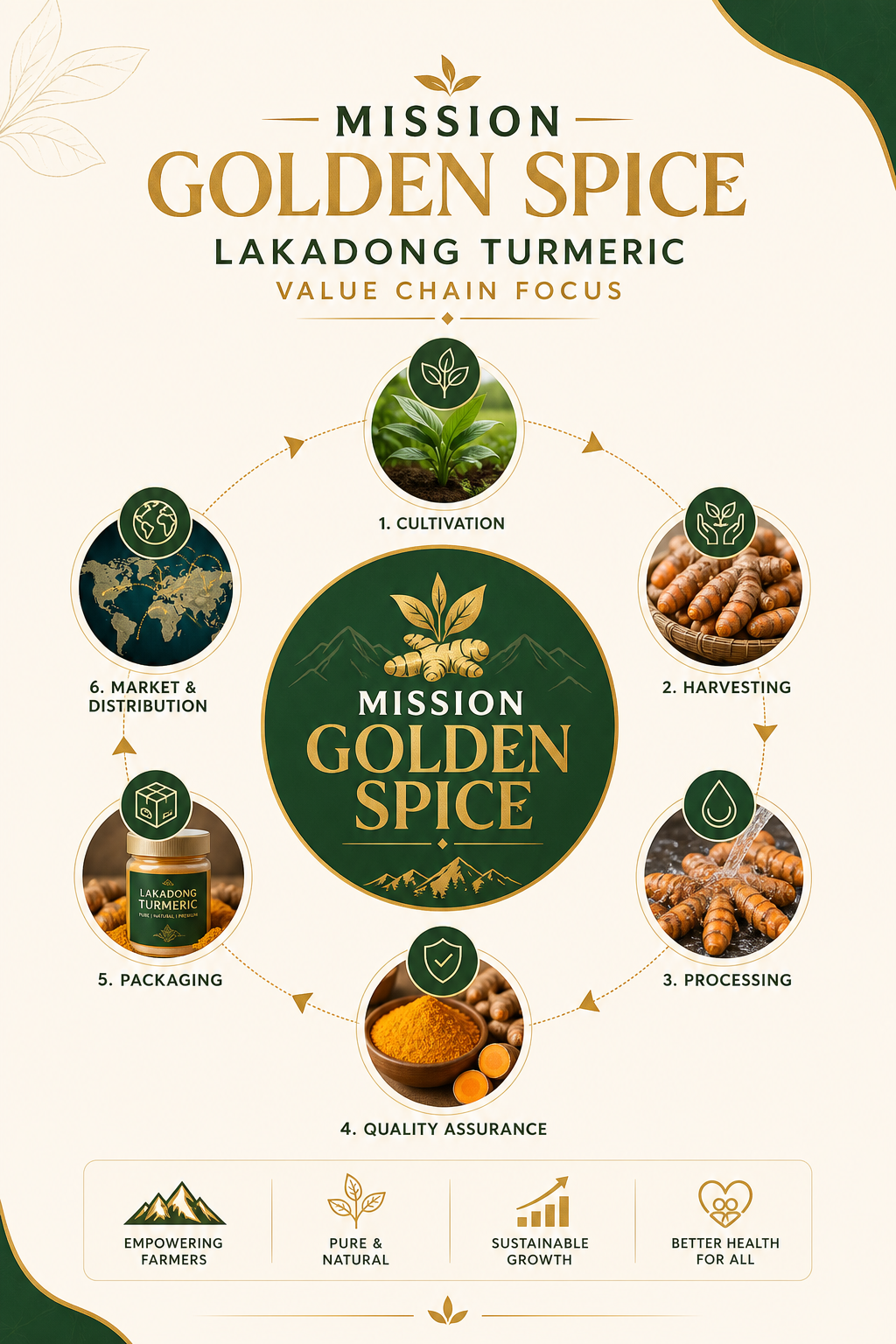
Officially called the Integrated Lakadong Turmeric Value Chain Enhancement Project, the initiative is designed for implementation from 2025 to 2030. It seeks to transform the economic ecosystem surrounding Lakadong turmeric by linking cultivation with aggregation, processing, value addition, quality assurance, branding and access to domestic and overseas markets. The Ministry of Development of North Eastern Region and the North Eastern Council are important anchor institutions, while the Government of Meghalaya has a central implementation role.
Lakadong turmeric is associated particularly with Meghalaya’s Jaintia Hills and is valued for its quality characteristics, including high curcumin content. It has received Geographical Indication protection. A GI identifies goods whose particular quality, reputation or other characteristic is essentially attributable to their geographical origin. Protecting such products can allow local producers to differentiate them in markets and retain greater economic value from region-specific knowledge and agricultural characteristics.
Why is Mission Golden Spice in News?
The Union Minister for Development of North Eastern Region launched the ₹175.45-crore project to strengthen the complete value chain for Lakadong turmeric. The five-year intervention seeks to address a common challenge in Indian agriculture: producers often sell relatively low-value raw commodities while a larger share of value is generated downstream through processing, extraction, packaging, branding and marketing. Building these capabilities closer to producing regions can potentially improve farmer realisation and create local employment.
The initiative envisages expansion in cultivation and production alongside investments in processing and market development. It also seeks to connect Meghalaya’s turmeric ecosystem with premium international markets. This approach reflects a broader development strategy for the Northeast based on leveraging distinctive regional products rather than treating geographical constraints solely as disadvantages.
Key Features of the Lakadong Turmeric Project
- Five-year roadmap: Phased interventions across production, processing and marketing for 2025–2030.
- Cultivation expansion: Increase area under Lakadong turmeric and boost overall production.
- Value addition: Establish organic processing and curcumin extraction facilities to move beyond raw turmeric sales.
- Convergent financing: Funding by MDONER, NEC, the Ministry of Agriculture and Farmers’ Welfare and the Government of Meghalaya.
- Women-led participation: Emphasis on women’s roles in processing, adding a gender and livelihood dimension.
- Traceability: Digital authentication and traceability mechanisms to protect product identity and build consumer trust.
Challenges Related to Mission Golden Spice
Scaling a specialised agricultural product requires coordination between production and demand. Rapid expansion of cultivated area without sufficient market development could depress prices, while processing facilities need predictable raw material supply. Export markets impose quality, certification and traceability standards. Infrastructure and logistics challenges in the Northeast, including terrain and connectivity, must be addressed alongside environmental sustainability concerns.
Way Forward for High-Value Agricultural Exports
Producer organisations, cooperatives and women-led groups should drive implementation to ensure value-chain gains benefit farmers. Investments in processing capacity, laboratories, logistics, export certification, branding and digital traceability are essential. Mission Golden Spice can become a model for place-based development by linking a distinctive GI product with local processing, women’s livelihoods and international markets.
Prelims Practice Corner
Q1. Mission Golden Spice is primarily associated with which agricultural product?
(a) Sikkim large cardamom
(b) Lakadong turmeric
(c) Assam tea
(d) Naga tree tomato
Answer: (b) Lakadong turmeric.
Q2. Lakadong turmeric is particularly associated with which State?
(a) Meghalaya
(b) Mizoram
(c) Manipur
(d) Arunachal Pradesh
Answer: (a) Meghalaya.
Q3. A Geographical Indication primarily identifies:
(a) Goods whose qualities or reputation are linked to geographical origin
(b) Every product manufactured by a government company
(c) Only patented pharmaceutical products
(d) Imported agricultural commodities
Answer: (a) Goods whose qualities or reputation are linked to geographical origin.
Q4. Which institution is an anchor body associated with the project?
(a) North Eastern Council
(b) Finance Commission
(c) National Green Tribunal
(d) Competition Commission of India
Answer: (a) North Eastern Council.
Q5. Curcumin is most closely associated with:
(a) Turmeric
(b) Coffee
(c) Jute
(d) Rubber
Answer: (a) Turmeric.
Mains Practice Questions
Q1. How can geographical indications and agricultural value addition contribute to improving farmers’ incomes? Explain with suitable examples. (10 marks)
Outline: Define GI and value addition; explain product differentiation, premium markets and local processing; discuss farmer organisations and traceability; identify quality and marketing challenges; conclude with greater producer participation in value chains.
Q2. Place-based agricultural development can transform the economic potential of India’s Northeast. Discuss with reference to specialised crops, women-led value chains and export promotion. (15 marks)
Outline: Introduce the Northeast’s distinctive agricultural resources; discuss GI products, processing, women-led livelihoods and exports; examine infrastructure, logistics and certification constraints; suggest FPOs, value addition, traceability and market linkages; conclude with sustainable regional development.
FAQs on Lakadong Turmeric Development
What is the official name of Mission Golden Spice?
It is officially known as the Integrated Lakadong Turmeric Value Chain Enhancement Project and is designed as a five-year initiative covering 2025–2030.
Why is Lakadong turmeric economically important?
It is a distinctive GI-tagged agricultural product from Meghalaya that can potentially command premium value when its geographical identity, quality, processing and branding are effectively protected and marketed.
Why is this initiative important for UPSC?
It connects GS-II and GS-III themes involving government interventions, Northeast development, agricultural marketing, food processing, farmers’ incomes, geographical indications, women-led development and export-oriented value chains.
Related Current Affairs
Preparing for UPSC, PCS or HCS?
Talk to a mentor at Chetan Bharat Learning, Chandigarh. Free guidance on choosing the right exam and building a study plan.
Chat on WhatsAppCall 97793 53345UPSC / IAS / PCS coaching in Chandigarh · Trusted by aspirants across Punjab & Haryana
Leave a Reply
You must be logged in to post a comment.