
UPSC Mapping
| GS Paper | GS-II |
|---|---|
| Subject | Government Policies, Social Justice, Education and Welfare of Vulnerable Sections |
What is PM-YASASVI Scheme?
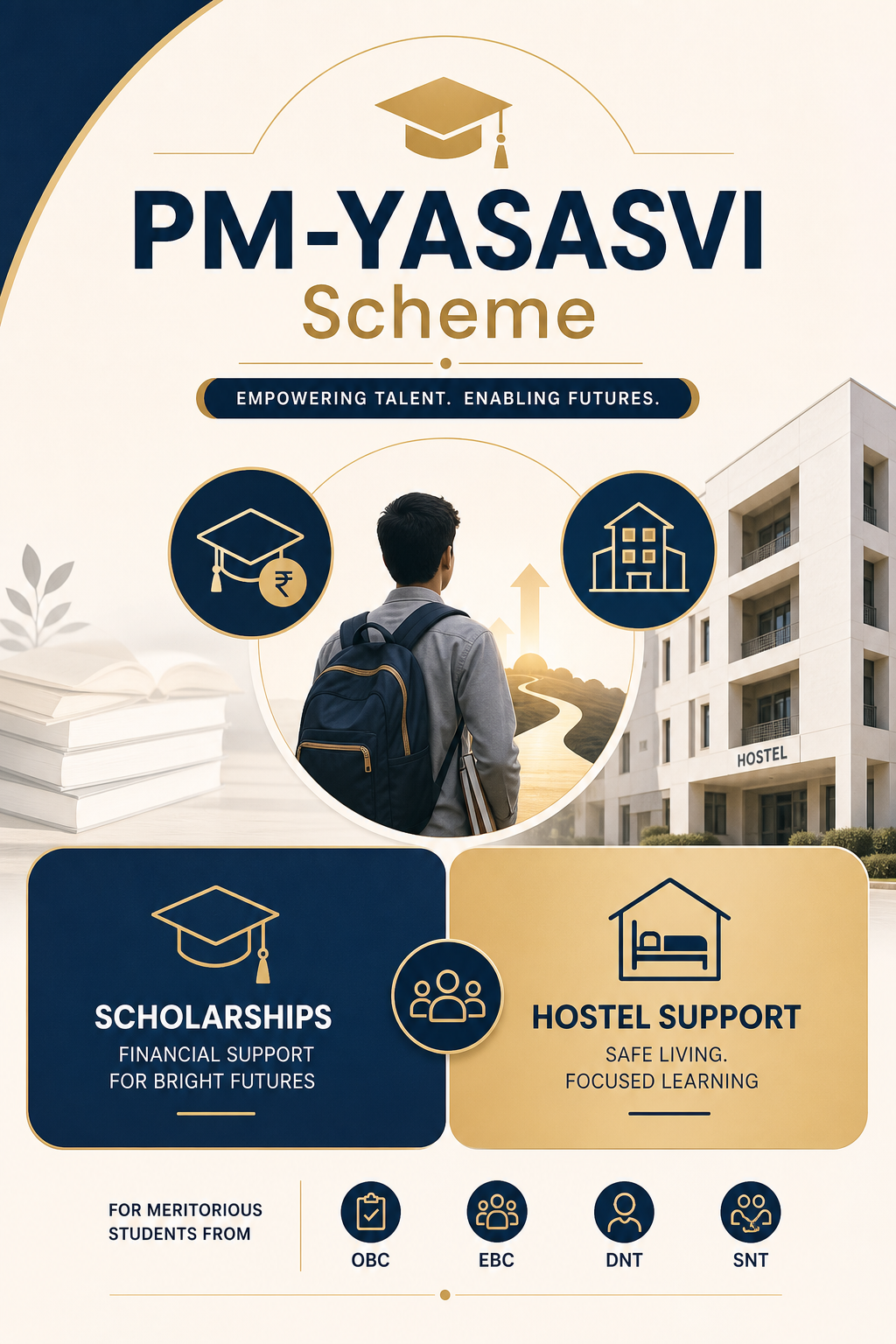
PM-YASASVI stands for Prime Minister Young Achievers Scholarship Award Scheme for Vibrant India. It is implemented by the Department of Social Justice and Empowerment under the Ministry of Social Justice and Empowerment. The umbrella framework seeks to improve educational access among eligible socially and economically disadvantaged students by reducing financial barriers at different stages of schooling and higher education.
The programme brings together multiple forms of educational assistance instead of treating scholarships and residential infrastructure as isolated interventions. Its beneficiaries include eligible students from OBC, EBC and DNT communities. This makes the scheme relevant to the constitutional objective of promoting educational advancement among disadvantaged groups and to the broader policy principle of substantive equality, under which unequal starting conditions may require targeted public support.
Why is PM-YASASVI Scheme in News?
The scheme entered current affairs after the Minister of State for Social Justice and Empowerment highlighted government efforts to expand educational opportunities for disadvantaged students through scholarship assistance and hostel facilities. The intervention is important because educational exclusion can result from both household-level financial constraints and geographical barriers, particularly where students must travel or relocate to access post-matric and higher education.
The hostel component has evolved over time, with earlier arrangements for OBC students subsequently revised and incorporated within the broader educational support architecture. The present approach combines direct assistance to students with institutional infrastructure intended to improve access to educational centres. Aspirants can consult the Ministry of Social Justice and Empowerment for official guidelines and updates concerning welfare programmes for eligible communities.
Key Features of Educational Support
A major feature is its multi-stage scholarship architecture. The umbrella framework encompasses Pre-Matric Scholarship, Post-Matric Scholarship, Top Class Education in Schools and Top Class Education in Colleges. Together, these components seek to provide continuity of assistance as eligible students move from school education towards higher education. Such continuity is important because financial vulnerability can contribute to dropout at multiple transition points rather than at only one educational stage.
- Target groups: Eligible students belonging to OBC, EBC and Denotified, Nomadic and Semi-Nomadic Tribes.
- Scholarship coverage: Assistance spans pre-matric, post-matric and selected top-class school and college education.
- Hostel infrastructure: Residential facilities seek to address geographical barriers faced by students who lack suitable educational institutions near their homes.
- Regional cost norms: Hostel construction norms provide differentiated per-seat ceilings for the North Eastern, Himalayan and other regions.
- Accessibility: The hostel framework provides for reservation of seats for students with disabilities.
- Monitoring: Fund-release and quality-control provisions seek to link expenditure with construction progress, completion and actual utilisation.
The hostel component also permits construction within suitable existing or ongoing public projects and educational campuses, reducing dependence on acquiring separate land. Timelines and staged release of grants are intended to improve implementation discipline. Independent quality inspections and impact assessment provisions can further strengthen accountability by examining whether public expenditure translates into functional facilities used by intended beneficiaries.
Challenges Related to PM-YASASVI Scheme
Effective scholarship programmes depend on awareness, accurate beneficiary identification, timely applications and predictable transfer of assistance. Students from remote or vulnerable communities may face information gaps or difficulties with documentation and digital application processes. Administrative coordination among the Union government, States, educational institutions and implementing agencies is therefore important for preventing eligible students from being excluded because of procedural barriers.
Hostel construction creates a different set of governance challenges. Building infrastructure is only the first stage; facilities must remain safe, accessible and adequately maintained after completion. Delayed projects, weak maintenance or low occupancy can reduce the developmental value of capital expenditure. Monitoring should consequently examine educational outcomes and actual utilisation alongside physical construction and financial expenditure.
Scholarships also work most effectively when combined with improvements in educational quality, mentoring, counselling and pathways into higher education and employment. Financial assistance can reduce one important barrier but cannot by itself resolve all dimensions of educational disadvantage. Aspirants can connect such welfare programmes with wider themes of social justice and human-capital development through the UPSC current affairs library.
Way Forward for Inclusive Education
Implementation can be strengthened through proactive awareness campaigns, simplified applications and convergence with educational institutions. Digital systems should reduce administrative burdens while retaining assisted channels for students who face connectivity or digital-literacy constraints. Regular monitoring of scholarship disbursement can help identify delays and ensure that assistance reaches students when educational expenses actually arise.
Residential infrastructure should be assessed through both construction quality and educational impact. Transparent occupancy data, accessibility audits, maintenance mechanisms and independent inspections can improve accountability. Locating hostels near institutions offering post-matric and higher education can also help ensure that infrastructure responds to actual geographical barriers rather than simply meeting construction targets.
The PM-YASASVI Scheme should ultimately be viewed as part of a broader strategy for equality of educational opportunity. Article 46 of the Constitution directs the State to promote with special care the educational and economic interests of weaker sections, while Article 15 enables special provisions in specified circumstances for socially and educationally backward classes. Aspirants can use PIB Official Release to track authoritative government announcements. Combining scholarships, accessible accommodation and quality education can strengthen social mobility and substantive inclusion.
Prelims Practice Corner
Q1. PM-YASASVI is implemented by which Union Ministry?
(a) Ministry of Education
(b) Ministry of Tribal Affairs
(c) Ministry of Social Justice and Empowerment
(d) Ministry of Skill Development and Entrepreneurship
Answer: (c) It is implemented through the Department of Social Justice and Empowerment under the Ministry of Social Justice and Empowerment.
Q2. Which among the following are covered among the target groups of the scheme?
1. OBCs
2. EBCs
3. Denotified Tribes
4. Nomadic and Semi-Nomadic Tribes
(a) 1 and 2 only
(b) 1, 2 and 3 only
(c) 2, 3 and 4 only
(d) 1, 2, 3 and 4
Answer: (d) The umbrella scheme covers eligible students from all these groups.
Q3. Which of the following is NOT one of the scholarship components associated with the umbrella framework?
(a) Pre-Matric Scholarship
(b) Post-Matric Scholarship
(c) Top Class Education in Colleges
(d) National Overseas Fellowship for Scientists
Answer: (d) The listed umbrella components include pre-matric, post-matric and top-class education support, not the option mentioned.
Q4. Article 46 of the Constitution directs the State to:
(a) Establish a uniform civil code
(b) Promote the educational and economic interests of weaker sections
(c) Separate the judiciary from the executive
(d) Organise village panchayats
Answer: (b) Article 46 is a Directive Principle concerning the educational and economic interests of weaker sections.
Q5. The hostel component of the programme primarily helps address which barrier?
(a) Only curriculum design
(b) Geographical access to educational institutions
(c) International student migration
(d) Teacher recruitment examinations
Answer: (b) Residential facilities can reduce geographical barriers for students who must travel or relocate for education.
Mains Practice Questions
Q1.
Targeted scholarships can promote substantive equality only when accompanied by measures addressing non-financial barriers to education. Discuss. (10 marks)
Outline: Define substantive equality; explain financial and geographical barriers; discuss scholarships, hostels, accessibility and digital inclusion; identify awareness and implementation challenges; conclude with an integrated educational-support approach.
Q2.
Examine the role of educational welfare schemes in improving social mobility among disadvantaged communities in India. Suggest measures for outcome-oriented implementation. (15 marks)
Outline: Link education with social mobility; discuss constitutional provisions; explain scholarship and residential support; examine targeting, delivery, infrastructure and maintenance challenges; propose monitoring, accessibility, mentoring and outcome evaluation; conclude with equality of opportunity.
FAQs on Educational Support for Backward Classes
What does PM-YASASVI stand for?
It stands for Prime Minister Young Achievers Scholarship Award Scheme for Vibrant India, an umbrella educational support programme administered by the Ministry of Social Justice and Empowerment.
Who can benefit from the programme?
Its components provide assistance to eligible students belonging to OBC, EBC and Denotified, Nomadic and Semi-Nomadic communities, subject to the applicable guidelines and eligibility conditions.
Why is the scheme relevant for UPSC?
It connects GS-II themes of social justice, welfare of vulnerable sections, education and government interventions with constitutional principles concerning substantive equality and advancement of disadvantaged communities.
Related Current Affairs
Preparing for UPSC, PCS or HCS?
Talk to a mentor at Chetan Bharat Learning, Chandigarh. Free guidance on choosing the right exam and building a study plan.
Chat on WhatsAppCall 97793 53345UPSC / IAS / PCS coaching in Chandigarh · Trusted by aspirants across Punjab & Haryana
Leave a Reply
You must be logged in to post a comment.