
Important for:
UPSC, Haryana HCS, Punjab PCS
Prelims: National Symbols, Prevention of Insults to National Honour Act, 1971
Mains: GS Paper 2 — Constitution, National Symbols, Freedom of Expression
Why in News?
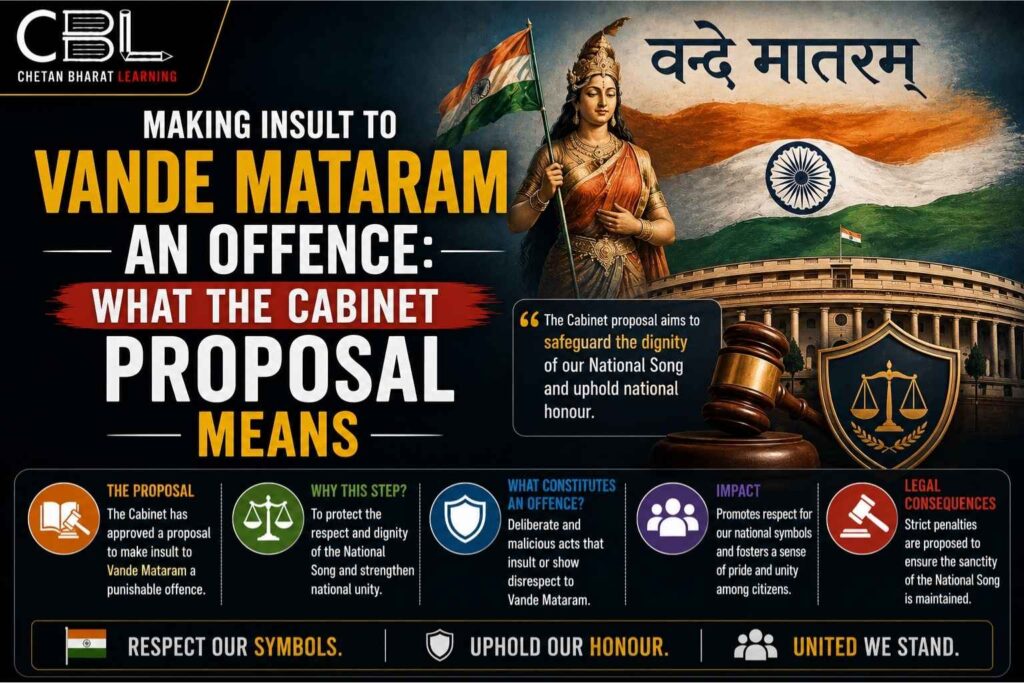
The Union Cabinet has approved amendments to the Prevention of Insults to National Honour Act, 1971 to make intentional insult or obstruction during the singing of Vande Mataram a punishable offence.
What is Vande Mataram?
➤ Vande Mataram is India’s:
✔ National Song
Written by:
→ Bankim Chandra Chattopadhyay
Originally featured in:
→ Anandamath
Current Legal Position
The:
✔ National Flag
✔ National Anthem (Jana Gana Mana)
already receive legal protection under the Prevention of Insults to National Honour Act, 1971.
The proposed amendment seeks to extend similar protection to:
→ Vande Mataram
What Will the Amendment Do?
The amendment may:
✔ Make intentional insult punishable
✔ Penalise obstruction during singing
✔ Add specific punishment clauses
About the Prevention of Insults to National Honour Act, 1971
The Act protects:
- National Flag
- Constitution of India
- National Anthem
from intentional insult or disrespect.
Why is the Issue Sensitive?
The debate involves balancing:
✔ National respect
and
✔ Freedom of expression
Questions may arise regarding:
- Mandatory participation
- Constitutional freedoms
- Scope of punishment
Constitutional Dimensions
Relevant constitutional aspects include:
Article 19(1)(a)
Freedom of speech and expression
Article 51A(a)
Fundamental duty to respect national symbols
Key Insight for UPSC
➤ Democratic constitutional systems often require balancing:
✔ Patriotism
✔ Constitutional freedoms
✔ National unity
PRELIMS PRACTICE QUESTIONS
Q1. Vande Mataram is India’s:
A. National Anthem
B. National Motto
C. National Song
D. National Emblem
⇢ Answer: C
Q2. Vande Mataram was written by:
A. Rabindranath Tagore
B. Bankim Chandra Chattopadhyay
C. Subhash Chandra Bose
D. Mahatma Gandhi
⇢ Answer: B
Q3. Prevention of Insults to National Honour Act was enacted in:
A. 1950
B. 1962
C. 1971
D. 1984
⇢ Answer: C
Q4. Article 51A relates to:
A. Directive Principles
B. Fundamental Duties
C. Emergency provisions
D. Panchayats
⇢ Answer: B
Q5. Freedom of speech is protected under:
A. Article 14
B. Article 19
C. Article 21
D. Article 32
⇢ Answer: B
CBL Mains Practice Question
“Respect for national symbols must be balanced with constitutional freedoms in a democracy.”
Discuss in the context of the proposed amendment related to Vande Mataram.
FAQs
1. What is Vande Mataram?
India’s National Song.
2. Which law is being amended?
Prevention of Insults to National Honour Act, 1971.
3. What is the purpose of the amendment?
To make intentional insult to Vande Mataram punishable.
4. Which constitutional duty is related to national symbols?
Article 51A(a).
5. Which GS paper covers this topic?
GS Paper 2.
Related Current Affairs
Preparing for UPSC, PCS or HCS?
Talk to a mentor at Chetan Bharat Learning, Chandigarh. Free guidance on choosing the right exam and building a study plan.
Chat on WhatsAppCall 97793 53345UPSC / IAS / PCS coaching in Chandigarh · Trusted by aspirants across Punjab & Haryana
Leave a Reply
You must be logged in to post a comment.