
UPSC Syllabus Mapping
- GS Paper: GS-II
- Subject: Polity & Governance
- Topic: Public Order, Criminal Justice Administration
- Prelims Relevance: BNSS, preventive powers, constitutional rights
- Mains Relevance: Balancing civil liberties with maintenance of public order
Article
Why in News
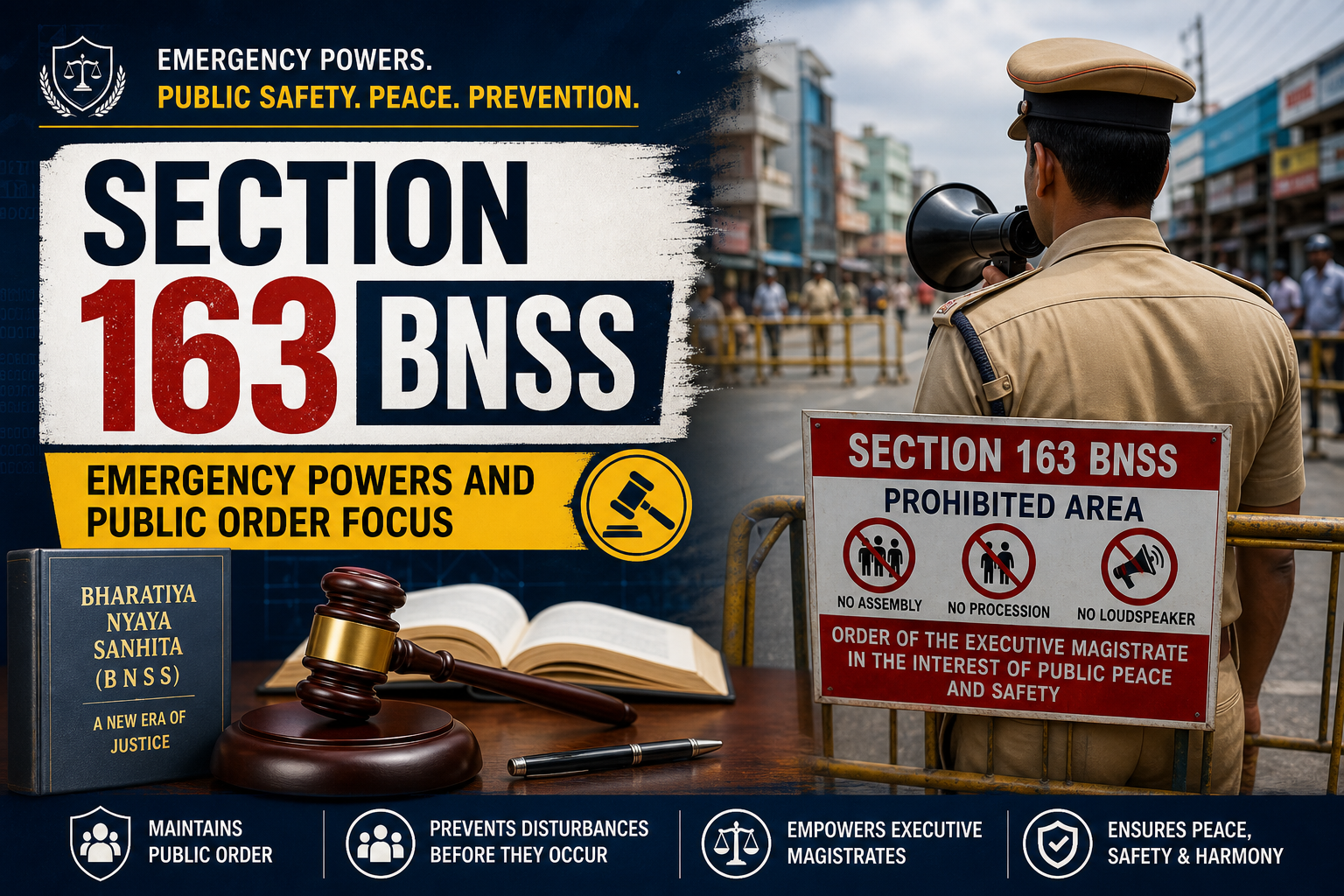
Following a protest march towards Parliament in New Delhi, authorities imposed prohibitory orders under Section 163 BNSS, bringing renewed attention to the emergency powers available to Executive Magistrates for maintaining public order.
What is Section 163 of BNSS?
Section 163 of the Bharatiya Nagarik Suraksha Sanhita (BNSS), 2023 replaces the erstwhile Section 144 of the Code of Criminal Procedure (CrPC). It empowers an Executive Magistrate to issue written orders in urgent situations where immediate prevention or speedy remedy is necessary to prevent obstruction, danger to human life, public safety, riots, affrays or disturbances to public tranquillity.
Quick Facts
| Replaces | Section 144 CrPC |
|---|---|
| Part of | Bharatiya Nagarik Suraksha Sanhita, 2023 |
| Issued by | Executive Magistrate |
| Validity | Generally valid for a maximum period prescribed under law unless extended as permitted |
| Nature | Primarily preventive, not punitive |
Purpose of the Provision
The provision is intended to address immediate threats before they escalate into violence or widespread disorder. It enables authorities to regulate assemblies, movement, carrying of weapons, and other specified activities when public safety is at risk.
Constitutional Perspective
- Article 19(1)(a): Freedom of speech may be reasonably restricted.
- Article 19(1)(b): Right to peaceful assembly subject to reasonable restrictions.
- Article 21: State must ensure due process while protecting life and liberty.
Judicial Safeguards
- Babulal Parate v. State of Maharashtra (1961): Upheld constitutional validity while emphasizing emergency use.
- Mazdoor Kisan Shakti Sangathan v. Union of India (2018): Blanket restrictions cannot become a substitute for regulating peaceful protests.
- Courts have repeatedly held that preventive powers cannot become routine administrative tools.
Issues and Concerns
- Frequent use may affect democratic freedoms.
- Possibility of repeated renewals without fresh assessment.
- Risk of disproportionate restrictions on peaceful assemblies.
- Need for transparent reasoning and judicial oversight.
Way Forward
- Strict adherence to constitutional safeguards.
- Periodic judicial review of prolonged prohibitory orders.
- Use evidence-based assessment before imposing restrictions.
- Develop transparent permission mechanisms for peaceful protests.
Prelims Practice Corner
- Q1. Section 163 of BNSS replaced which CrPC provision?
Answer: Section 144 - Q2. Which authority issues orders under Section 163?
Answer: Executive Magistrate - Q3. Which Fundamental Right is most directly affected?
Answer: Article 19(1)(b) - Q4. The primary nature of Section 163 powers is:
Answer: Preventive - Q5. Which Supreme Court judgment emphasized regulation rather than blanket prohibition of protests?
Answer: Mazdoor Kisan Shakti Sangathan v. Union of India
Mains Practice Questions
- Question (10 Marks): Discuss the significance of Section 163 of the BNSS in maintaining public order while protecting constitutional freedoms.
Answer Framework:- Introduction: Preventive powers under BNSS.
- Body: Constitutional basis, necessity, judicial safeguards, concerns of misuse.
- Conclusion: Balanced application with accountability.
- Question (15 Marks): Examine whether preventive legal powers such as Section 163 BNSS strike an appropriate balance between security and civil liberties.
Answer Framework:- Introduction.
- Arguments supporting preventive powers.
- Concerns relating to democratic rights.
- Judicial interventions.
- Way Forward.
FAQs
Q1. What replaced Section 144 CrPC?
A. Section 163 of the Bharatiya Nagarik Suraksha Sanhita, 2023.
Q2. Can peaceful protests be completely banned?
A. No. Courts have emphasized that restrictions must be reasonable, proportionate, and based on genuine public order concerns.
Q3. Why is Section 163 important for UPSC?
A. It links constitutional rights, governance, criminal justice reforms, public order, and landmark Supreme Court judgments.
Related Current Affairs
Preparing for UPSC, PCS or HCS?
Talk to a mentor at Chetan Bharat Learning, Chandigarh. Free guidance on choosing the right exam and building a study plan.
Chat on WhatsAppCall 97793 53345UPSC / IAS / PCS coaching in Chandigarh · Trusted by aspirants across Punjab & Haryana
Leave a Reply
You must be logged in to post a comment.