
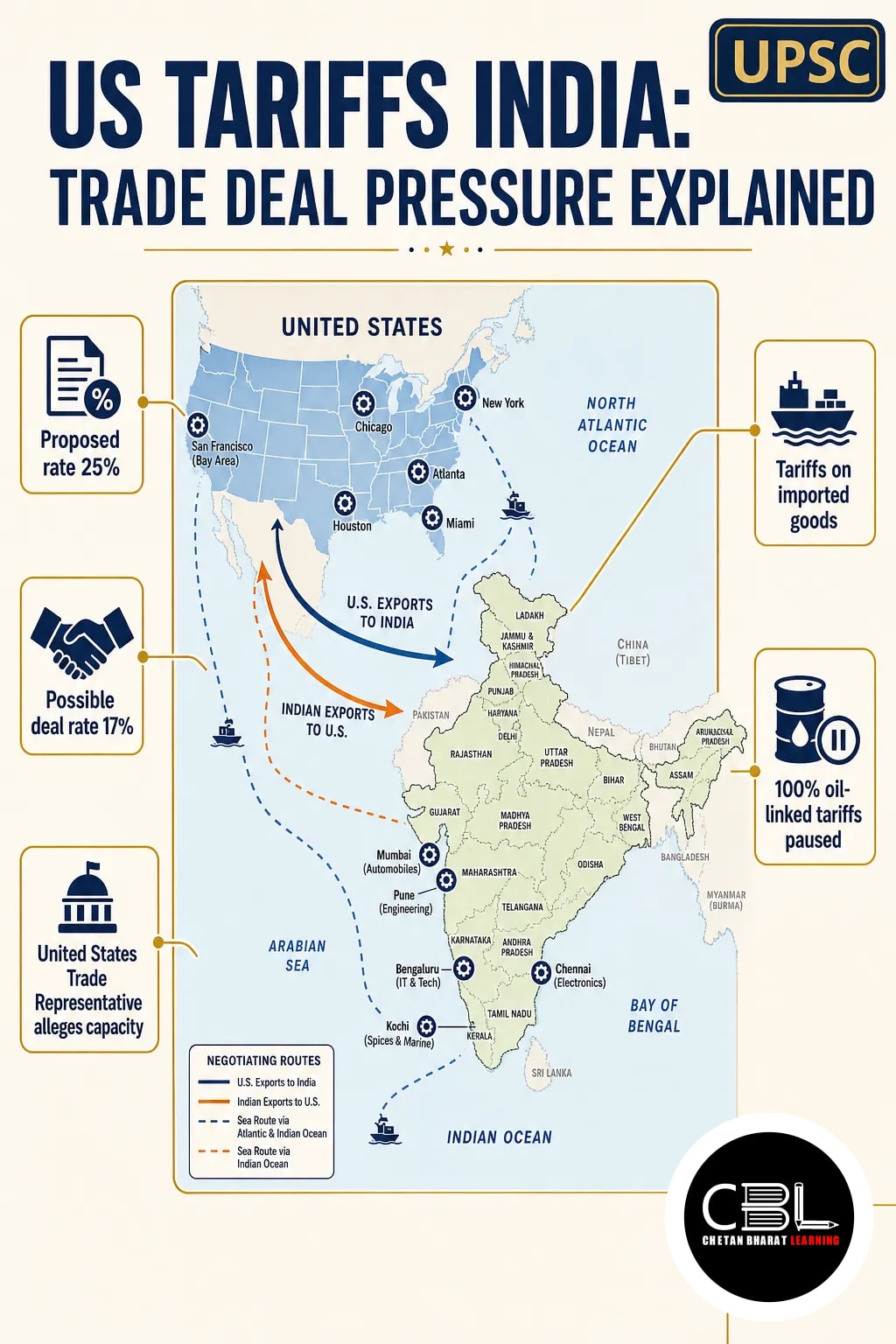
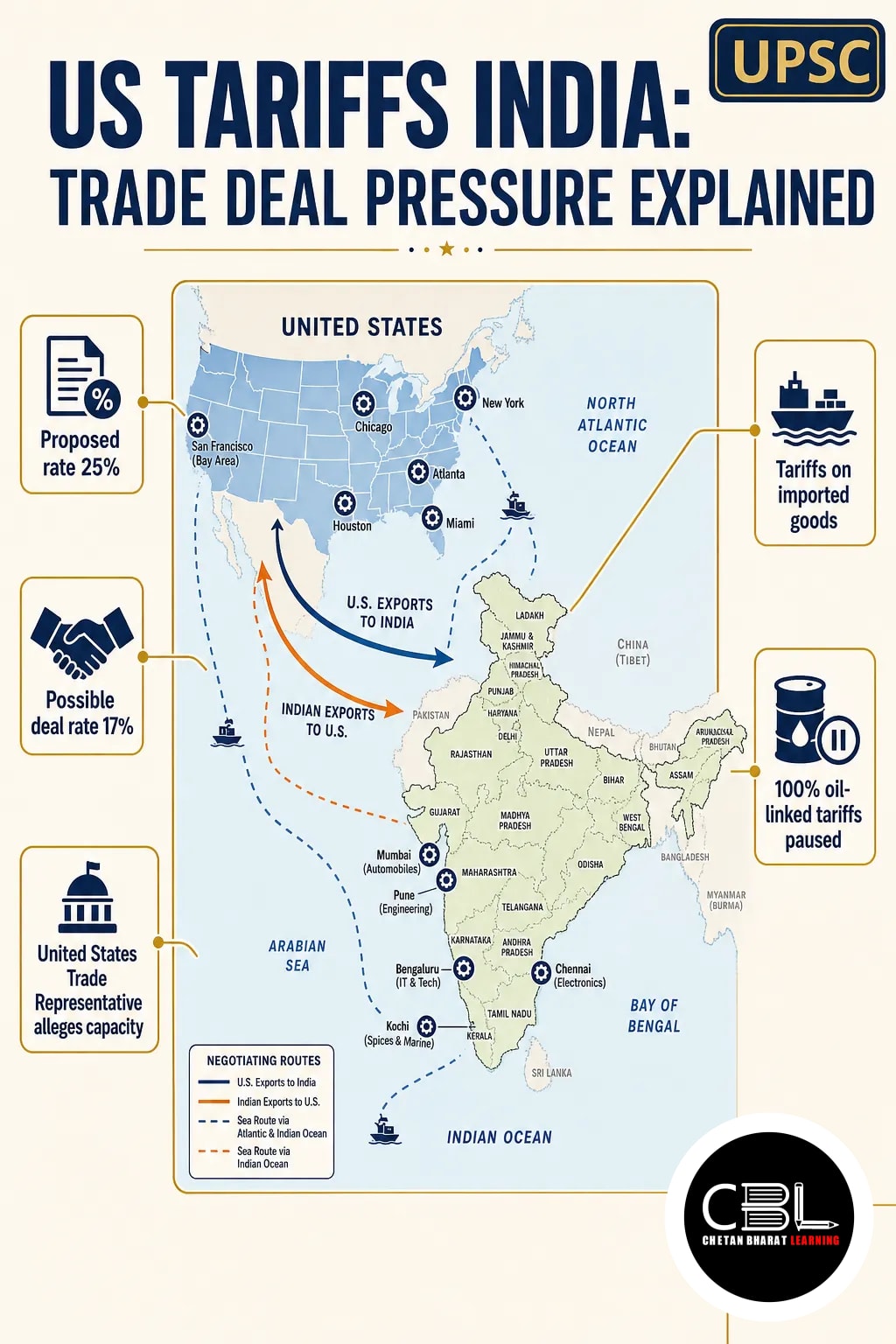
US tariffs India faces have entered a new phase: Washington has proposed a 25% rate linked to manufacturing capacity and a possible trade deal. Earlier CBL coverage examined India’s oil import shifts; the new proposal brings a separate manufacturing allegation into the trade discussion.
Quick answer: US tariffs India now faces in negotiations include a proposed 25% rate, which could fall to 17% if India signs a trade deal. The United States Trade Representative cites strategic excess manufacturing capacity. However, The Hindu editorial disputes that claim and urges India to weigh the agreement’s full costs and benefits.
What is the issue behind the tariff proposal?
The issue is whether India should accept a trade agreement under pressure from a proposed US tariff. The United States Trade Representative (USTR) alleges that India uses strategic excess manufacturing capacity to the detriment of American industry. The proposed 25% rate is net of existing tariffs.
A tariff is a duty on imported goods. It raises their cost at the importing border and can alter competition between domestic and foreign suppliers. However, the eventual burden depends on how importers, exporters and consumers adjust prices and purchases.
The editorial treats the proposed difference between 25% and 17% as negotiating leverage. Thus, the policy question is not merely the tariff rate, but also what India would give up to obtain the lower rate.
Why are US tariffs India faces back in focus?
The latest proposal follows several changes in announced or agreed rates since April 2025. Moreover, the proposed 25% rate is the second-highest among the 14 countries against which the USTR has taken action.
| Period | Trade development |
|---|---|
| April 2025 | President Donald Trump announced a 26% reciprocal tariff for India. |
| July 2025 | The US imposed a 25% tariff, followed by an additional 25% linked to Russian oil imports. |
| February 2026 | The two countries agreed on an 18% rate in a joint statement. |
| Latest proposal | The proposed 25% rate could decline to 17% if India signs a trade deal. |
The proposed deal rate is one percentage point below the 18% rate cited for competitors Indonesia and Malaysia. Meanwhile, the editorial says 100% tariffs linked to Russian oil purchases remain temporarily paused. These oil-linked measures are separate from the latest manufacturing-capacity proposal.
What is the case for considering a trade deal?
A credible deal could reduce tariff uncertainty and improve exporters’ access to the US market. However, its value would depend on its complete terms and whether promised tariff treatment lasts.
- Lower proposed rate: The difference between 25% and 17% is eight percentage points. Therefore, affected exporters could gain a price advantage relative to the higher proposed rate.
- Business planning: Clearer trade conditions could help firms plan production and contracts. However, businesses would also need clarity on product coverage and implementation.
- Competitive position: The 17% rate would be slightly below the 18% cited for Indonesia and Malaysia. Nevertheless, tariffs are only one component of competitiveness; costs, quality and reliability also matter.
The tariff saving alone does not establish that an agreement benefits India overall. For example, negotiators must compare it with any obligations and concessions in the final text.
What are the concerns about the US claim?
The editorial disputes the claim that India has strategic excess manufacturing capacity. It points to import dependence and a lower manufacturing share of gross domestic product (GDP) than a decade ago.
Excess capacity broadly means production capacity beyond what can be used profitably at prevailing demand and prices. However, the editorial’s aggregate indicators do not by themselves settle capacity conditions in every industry. A sector-level assessment would be needed to test the allegation.
- Capacity versus expertise: The USTR mentions generic pharmaceuticals, telecommunications equipment and renewable energy goods. However, the editorial argues that expertise in the first two is not proof of strategic excess capacity.
- Supply-chain adjustment: The editorial links rising US renewable energy imports from India to reduced purchases from China. Therefore, a change in sourcing should not automatically be treated as evidence of excess capacity.
- Tariff effectiveness: The editorial considers a small tariff disadvantage unlikely to substantially weaken the appeal of Indian products in the first two sectors. However, actual effects would vary across products, contracts and alternative suppliers.
Domestic manufacturing capacity also matters for policy choices. For context, CBL has examined a proposed bulk drug park in Himachal Pradesh; its significance should be assessed separately from the US allegation.
What should India’s negotiating approach be?
India should evaluate the full agreement against its economic and strategic costs, rather than respond to the tariff number alone. The editorial’s threshold is that the deal’s benefits should at least equal its costs.
- Assess sectoral evidence: Examine capacity utilisation, imports and demand in the sectors identified. Thus, negotiators can distinguish competitive production from demonstrable excess capacity.
- Calculate net gains: Compare tariff relief with proposed commitments and adjustment costs. In addition, assess how benefits and costs would be distributed across sectors.
- Reduce vulnerability: Support productivity and diversify export markets and suppliers. Consequently, firms may be less exposed to pressure from any single market.
- Protect policy space: Review the duration, product coverage and enforceability of commitments. Meanwhile, account separately for the uncertainty surrounding oil-linked tariffs.
Useful for Essay and GS IV: Sound negotiation tests immediate relief against lasting obligations, rather than treating either firmness or agreement as an end in itself.
Source: The Hindu Editorial, 27 November 2026
- India oil imports: September 2026 shift | UPSC (30 Oct 2026)
Punjab PCS and Haryana HCS may test tariffs, export competitiveness and the effects of trade policy on manufacturing. In addition, candidates should connect national trade decisions with state-level industrial and employment policy without assuming uniform effects across industries.
Prelims Practice Corner
Mains Practice Questions
Frequently Asked Questions
What is the latest proposed US tariff rate for India?
The proposed rate is 25%, net of existing tariffs. However, it could fall to 17% if India signs a trade deal.
Why does the US cite manufacturing capacity?
The USTR alleges that India uses strategic excess capacity to the detriment of American industry. However, the editorial disputes the allegation and distinguishes capacity from manufacturing expertise.
Are the proposed manufacturing tariffs the same as oil-linked tariffs?
No, because the latest proposal concerns manufacturing capacity, while other tariffs relate to Russian oil purchases. The editorial says the 100% oil-linked tariffs remain temporarily paused.
Why does the proposed 17% rate matter?
It is eight percentage points below the proposed 25% rate. Therefore, the potential reduction creates an incentive to sign a deal, although its overall value depends on the deal’s terms.
Related Current Affairs
Preparing for UPSC, PCS or HCS?
Talk to a mentor at Chetan Bharat Learning, Chandigarh. Free guidance on choosing the right exam and building a study plan.
Chat on WhatsAppCall 97793 53345UPSC / IAS / PCS coaching in Chandigarh · Trusted by aspirants across Punjab & Haryana






Leave a Reply
You must be logged in to post a comment.