
UPSC Mapping
- Prelims: SWIFT, CIPS, SPFS, CBDCs and Rupee Settlement
- Mains: GS Paper III – Economy and Financial Infrastructure
Article
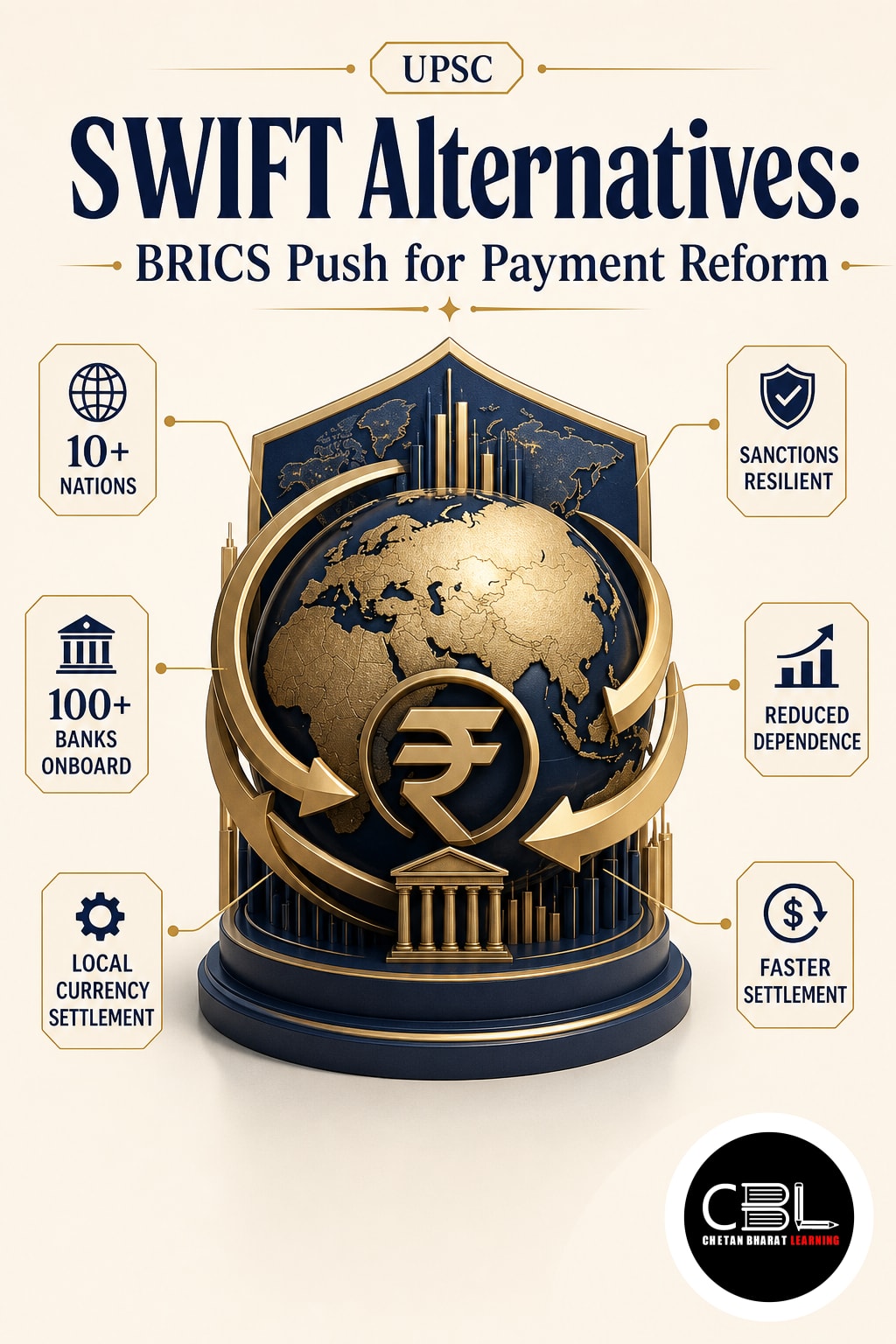
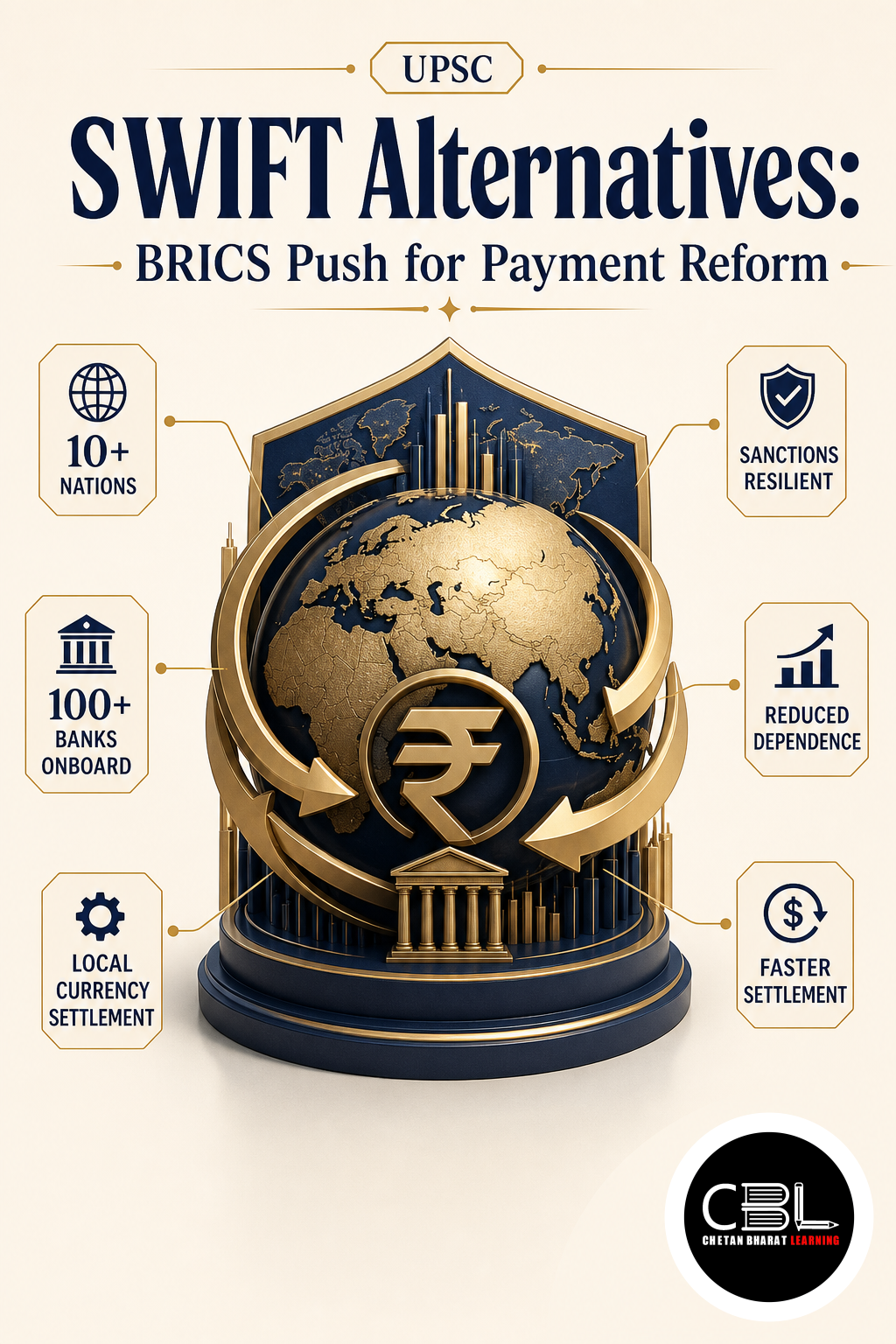
SWIFT Alternatives are gaining attention as countries diversify cross-border payment and financial-messaging channels. BRICS members support interoperable systems and local-currency settlements without proposing a common currency. Aspirants can track related economic developments through the daily current affairs archive.
Quick Facts
| SWIFT Founded | Headquarters | Organisation Type | Global Reach |
|---|---|---|---|
| 1973 | Belgium | Member-Owned Cooperative | 11,500+ Institutions |
What are SWIFT Alternatives?
SWIFT Alternatives are messaging, clearing or settlement systems that allow financial institutions to conduct cross-border transactions through channels other than the Belgium-based network. Some transmit payment instructions, while others also clear and settle funds. Their functions must therefore be compared carefully rather than treated as identical.
The Society for Worldwide Interbank Financial Telecommunication provides secure and standardised financial messaging. It does not hold customer funds, manage bank accounts or itself settle payments. Participating banks use its messages to exchange instructions before completing settlement through correspondent banks, payment systems or central-bank accounts.
Why are SWIFT Alternatives in News?
SWIFT Alternatives received renewed attention after the 18th BRICS Summit supported interoperable payment channels and wider local-currency settlement. The grouping did not propose a common BRICS currency. Its approach focuses on connecting existing national systems and reducing friction in trade and financial transactions.
The debate also reflects concerns about sanctions exposure, correspondent-banking costs and dependence on a concentrated financial infrastructure. Emerging economies want faster and cheaper payments while retaining monetary sovereignty. The Reserve Bank of India provides official information on rupee settlement, payment systems and cross-border financial innovation.
Key Features
The emerging landscape combines messaging networks, direct settlement systems, instant-payment linkages and digital-currency experiments.
- China’s CIPS: The Cross-Border Interbank Payment System supports renminbi-denominated messaging, clearing and settlement, allowing participating institutions to process cross-border RMB payments through China’s financial infrastructure.
- Russia’s SPFS: The System for Transfer of Financial Messages provides a domestic and international messaging channel developed to reduce Russian financial institutions’ dependence on SWIFT connectivity.
- Iran’s SEPAM: The System for Electronic Financial Messaging exchanges payment instructions among participating banks and has been linked with SPFS to facilitate communication between connected Iranian and Russian institutions.
- Project mBridge: This multi-central-bank digital currency initiative tests direct wholesale CBDC settlement through shared distributed-ledger infrastructure, potentially reducing reliance on conventional correspondent-banking chains.
- India’s diversified routes: SWIFT Alternatives include Special Rupee Vostro Accounts, the UPI–PayNow linkage, Nexus Global Payments, domestic SFMS messaging and exploratory cross-border e-rupee pilots.
Challenges
New payment arrangements must overcome limited network reach, regulatory differences, currency risks and concerns about financial fragmentation.
- Network-effect advantage: SWIFT connects thousands of institutions across more than 200 countries and territories, making it difficult for smaller regional systems to achieve comparable reach and acceptance.
- Interoperability problems: National systems may use different message formats, operating hours, legal rules and identity standards, increasing the technical burden of connecting them securely.
- Currency and liquidity constraints: Local-currency trade requires sufficient demand, reliable conversion arrangements and mechanisms for managing accumulated balances when bilateral trade remains significantly imbalanced.
- Compliance and cyber risks: Cross-border systems must enforce anti-money-laundering, counter-terrorist-financing, sanctions-screening, data-protection and cybersecurity requirements across multiple jurisdictions.
- Possibility of fragmented finance: Rival payment blocs could increase transaction costs and reduce transparency if systems become politically divided or technically incompatible; related analysis appears in the economy current affairs section.
Way Forward
SWIFT Alternatives should promote resilience and competition without creating isolated financial blocs. Countries need common technical standards, transparent governance and reliable dispute-resolution mechanisms. Compatibility with ISO 20022 messaging can improve data quality and reduce integration costs across established and emerging networks.
India should expand rupee settlement where genuine trade demand exists while strengthening UPI linkages and carefully testing cross-border CBDCs. The strategy must protect financial stability, privacy and regulatory autonomy. Guidance from the Department of Economic Affairs can support coordination between trade policy, diplomacy and payment-system development.
Prelims Practice Corner
Q1. What is the primary function of SWIFT?
- (a) Issuing a global currency
- (b) Secure financial messaging
- (c) Managing commercial bank accounts
- (d) Lending directly to governments
Answer: (b) SWIFT provides secure and standardised messaging for financial transactions.
Q2. Which institution operates CIPS?
- (a) Bank of Russia
- (b) European Central Bank
- (c) People’s Bank of China
- (d) Reserve Bank of India
Answer: (c) CIPS operates within China’s financial system under the People’s Bank of China.
Q3. Special Rupee Vostro Accounts facilitate which activity?
- (a) Domestic agricultural lending
- (b) International trade settlement in rupees
- (c) Cryptocurrency mining
- (d) Government bond auctions only
Answer: (b) These accounts enable eligible international trade transactions to be invoiced and settled in Indian rupees.
Q4. Project mBridge is associated with which technology?
- (a) Multi-CBDC cross-border settlement
- (b) Agricultural commodity trading
- (c) Satellite-based banking
- (d) Physical gold settlement
Answer: (a) Project mBridge tests cross-border settlement using wholesale central bank digital currencies.
Q5. Consider the following statements:
- SWIFT itself settles funds between banks.
- CIPS can support renminbi clearing and settlement.
- SPFS originated in Russia.
Which statements are correct?
- (a) 1 only
- (b) 2 and 3 only
- (c) 1 and 3 only
- (d) 1, 2 and 3
Answer: (b) SWIFT transmits messages but does not itself settle funds; statements 2 and 3 are correct.
Mains Practice Questions
Q1. The emergence of alternative cross-border payment systems reflects both technological innovation and geopolitical change. Discuss. (250 words, 15 marks)
Answer Structure:
- Intro: Distinguish financial messaging from clearing and settlement.
- Body: Discuss sanctions, costs, CIPS, SPFS, CBDCs, local currencies, interoperability and fragmentation risks.
- Conclusion: Support diversified but interoperable systems governed by transparent international standards.
Q2. Assess India’s strategy for developing resilient international payment routes. (150 words, 10 marks)
Answer Structure:
- Intro: Introduce India’s objective of reducing payment friction while preserving monetary sovereignty.
- Body: Cover rupee settlement, UPI linkages, Nexus, SFMS, e-rupee pilots, liquidity constraints and regulatory safeguards.
- Conclusion: Recommend gradual expansion based on trade demand, stability and interoperability.
FAQs on SWIFT Alternatives
Does SWIFT transfer or hold money?
SWIFT does not hold funds or maintain customer accounts. It securely transmits standardised instructions that banks use to complete transactions through separate settlement arrangements.
Is BRICS creating a common currency?
The reported BRICS approach supports interoperable payment channels and local-currency settlements. It does not propose replacing national currencies with a common BRICS currency.
How does local-currency settlement benefit India?
It can reduce conversion costs and exposure to third-country currencies in eligible trade. Its success depends on balanced demand, liquidity and confidence in the participating currencies.
Related Current Affairs
Preparing for UPSC, PCS or HCS?
Talk to a mentor at Chetan Bharat Learning, Chandigarh. Free guidance on choosing the right exam and building a study plan.
Chat on WhatsAppCall 97793 53345UPSC / IAS / PCS coaching in Chandigarh · Trusted by aspirants across Punjab & Haryana
Leave a Reply
You must be logged in to post a comment.