
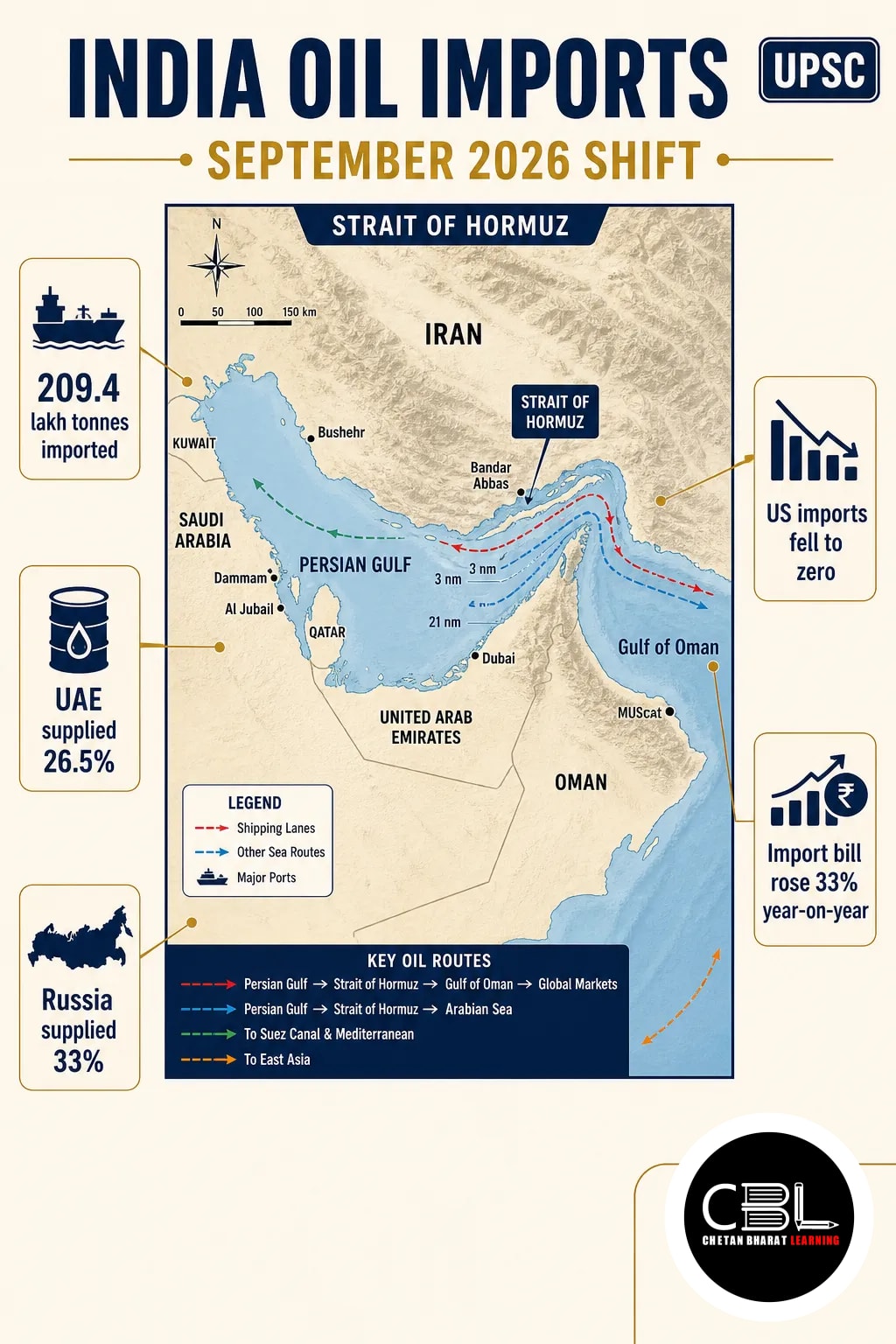

India oil imports shifted sharply in September 2026 as purchases from Russia fell and supplies from the United States stopped. The data offers a case study in international relations and energy security.
Quick answer: India oil imports reached 209.4 lakh tonnes in September 2026. Russia supplied 33%, while the United Arab Emirates supplied 26.5%; imports from the United States fell to zero. The shift coincided with a US law authorising tariffs on countries buying large quantities of Russian oil and gas, although coincidence alone does not establish causation.
What do the September import figures show?
The figures show higher total crude imports alongside a major change in suppliers. However, rising prices pushed the import bill up faster than volumes.
| Indicator | September 2026 finding |
|---|---|
| Crude import volume | 209.4 lakh tonnes; up 9.5% from August and 4.1% year-on-year |
| Import bill | Nearly $14.3 billion; up 16.4% from August and 33% year-on-year |
| Russia | 33% share; volume down nearly 18% from August |
| United Arab Emirates (UAE) | 26.5% share; volume up 67% from August and 109% year-on-year |
| United States (US) | Zero imports; its share averaged a little over 5% in the preceding 12 months |
Russia and the UAE together supplied approximately 60% of imports. Thus, the change in suppliers did not eliminate concentration risk.
How did sanctions and supply disruptions coincide with the shift?
The September change coincided with a US sanctions law, but the data alone does not establish why individual purchases changed.
On 16 September, the US House of Representatives passed the Lindsey O. Graham Sanctioning Russia and Iran Act of 2026. President Donald Trump signed it on 18 September. The law authorised tariffs of up to 100% on countries, including India and China, importing large quantities of Russian oil and gas.
Meanwhile, Russian oil had supplied around 51% of Indian imports in July and 44% in August. Its July share followed the removal of US Russian-oil-linked penal tariffs in February. It also coincided with the closure of the Strait of Hormuz during the West Asia war and resulting supply constraints.
On 16 October, Trump temporarily waived the tariffs through an executive order and certified the pause as being in the US national interest. However, October import data had not yet been released when the source reported the September figures. Therefore, the effect of the waiver on sourcing cannot be assessed from those figures.
Why does the shift matter for India?
The shift illustrates how supplier choices affect energy security, trade costs and diplomatic flexibility.
Import costs and the economy
The bill rose 33% from September 2025, while volume increased only 4.1%. Consequently, a larger import bill can put pressure on the trade balance and foreign exchange needs.
Higher crude costs can also affect refinery economics and domestic fuel prices. However, the final effect depends on factors such as exchange rates, taxes and how refiners and retailers price their products. For related context, see CBL’s coverage of diesel exports.
Concentration and maritime routes
The UAE increase reduced reliance on Russian supplies, but it also raised dependence on another major supplier. Moreover, supplier diversity and route diversity are separate concerns: disruptions to a shared shipping route can affect supplies from multiple producers.
The Strait of Hormuz connects the Persian Gulf to the Gulf of Oman and the Arabian Sea. The reported closure demonstrates why maritime access matters alongside commercial contracts. For geographic context, read about Iran’s Kharg Island oil hub.
Diplomacy and policy autonomy
Tariff threats can change the commercial risks attached to a supplier, even when crude is available. Therefore, India must weigh energy affordability against exposure to external policy changes and maintain engagement with major partners.
What are the limits of the data?
One month of import data identifies a shift, but it cannot prove the motives behind it or predict its duration.
- Timing is not proof: The sanctions law and the sourcing change coincided; however, the figures do not isolate the law’s effect.
- Shares and volumes differ: Russia’s share fell while total imports rose; therefore, both measures matter.
- Later effects remain unknown: The October waiver followed September purchases, and October data was still awaited.
How can India strengthen energy security?
India can reduce vulnerability by combining diversified sourcing with preparedness for price and route disruptions.
- Broaden suppliers and routes: Assess exposure across producers and shipping corridors, rather than treating either measure alone as sufficient.
- Plan for supply shocks: Use strategic petroleum reserves and contingency planning to cushion temporary disruptions.
- Manage demand: Improve energy efficiency and expand alternatives where feasible; this can gradually reduce exposure to imported crude.
- Maintain diplomatic engagement: Consult suppliers and partners while monitoring sanctions, freight and price risks.
In addition, the International Energy Agency’s role provides useful context for studying international energy cooperation. Overall, India oil imports demonstrate that a change of supplier is not the same as a complete reduction of risk.
Source: The Hindu, 30 October 2026
- Diesel Exports October 2026: UPSC Facts (30 Oct 2026)
- Kharg Island: Iran’s Strategic Oil Hub | UPSC Analysis (28 Oct 2026)
- International Energy Agency: Role, Members & UPSC (28 Oct 2026)
State PCS General Studies can test the Strait of Hormuz, import dependence and the effects of fuel costs on transport and agriculture. In addition, aspirants can connect energy efficiency with state-level public transport and agricultural policy.
Prelims Practice Corner
Mains Practice Questions
Frequently Asked Questions
How much crude oil did India import in September 2026?
India imported 209.4 lakh tonnes. This was 9.5% higher than in August and 4.1% higher year-on-year.
What was the UAE’s share of India’s oil imports?
The UAE supplied 26.5% in September 2026. Moreover, its supply volume rose 67% from August.
Did US tariffs cause the September import shift?
The data does not establish causation. However, the shift coincided with the signing of the US sanctions law in September.
Why is the Strait of Hormuz important for oil supplies?
It connects the Persian Gulf with the Gulf of Oman. Consequently, disruption there can constrain oil shipments from the Gulf region.
Related Current Affairs
Preparing for UPSC, PCS or HCS?
Talk to a mentor at Chetan Bharat Learning, Chandigarh. Free guidance on choosing the right exam and building a study plan.
Chat on WhatsAppCall 97793 53345UPSC / IAS / PCS coaching in Chandigarh · Trusted by aspirants across Punjab & Haryana

 Ananya RanaIAS · AIR 60
 Aditya SharmaIAS · AIR 70
 Ria Kaur SethiIPS · AIR 89
 Aman AloonIRS · AIR 295
 Sumer Singh VirkIRS · AIR 335
 Shivani PanchalIAS

Leave a Reply
You must be logged in to post a comment.