
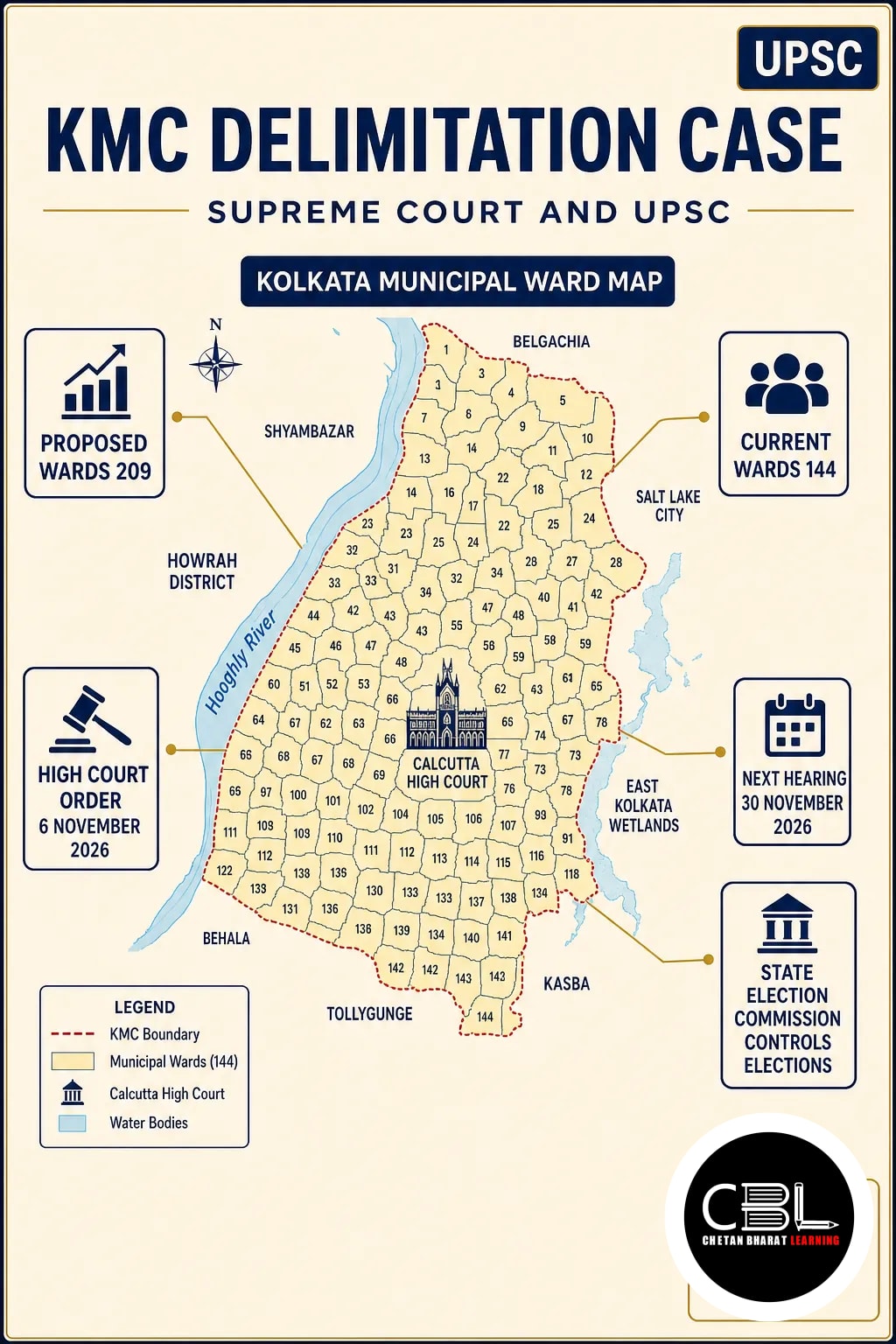

The KMC delimitation case has brought the timing of Kolkata’s civic elections before the Supreme Court. It raises questions about ward boundaries, judicial review and constitutional governance.
Quick answer: In the KMC delimitation case, the Supreme Court suggested on 25 November 2026 that the Calcutta High Court hear the dispute afresh. Kolkata’s proposed ward count may rise from 144 to 209. The court made an oral suggestion, not a final ruling, and listed the matter for 30 November.
What did the Supreme Court suggest?
The Supreme Court suggested setting aside the High Court’s order and seeking a fresh hearing of the dispute. However, the Bench expressed its inclination orally and did not decide the merits.
Chief Justice of India Surya Kant led the Bench, which also included Justices Joymalya Bagchi and V. Mohana. The Bench suggested that a High Court Division Bench could consider the entire dispute afresh. Meanwhile, the elections could remain on hold until that Bench formed a view.
The court described this as a possible ad-hoc arrangement to place both parties on an even footing. Lawyers sought time to obtain instructions; the Bench asked Solicitor General Tushar Mehta to seek instructions by 30 November.
Background of the ward dispute
The dispute concerns the revision of Kolkata Municipal Corporation (KMC) ward boundaries before civic elections. The proposed plan could increase the number of wards by 65, from 144 to 209.
Former Communist Party of India (Marxist) councillor Dipu Das challenged the expansion and sought to quash the 11 September gazette notification. He argued that the exercise used electoral rolls rather than actual population and allegedly excluded substantial numbers of residents. These are the petitioner’s allegations, not judicial findings.
A Single Judge Bench refused his request for an interim stay of the elections. Das then approached a Division Bench, which on 6 November directed the West Bengal State Election Commission not to notify elections until the Single Judge decided the delimitation challenge. The state government appealed to the Supreme Court.
Which constitutional provisions matter?
Part IXA of the Constitution provides the framework for municipalities and their elections. The 74th Constitutional Amendment introduced this framework for urban local government.
| Article | What it says |
|---|---|
| 243R | Seats in a municipality are generally filled by direct election from territorial constituencies called wards. |
| 243T | Provides for reservation of municipal seats, including for Scheduled Castes, Scheduled Tribes and women. |
| 243U | Prescribes a five-year municipal term and timelines for elections, subject to specified conditions. |
| 243ZA | Places electoral rolls and the conduct of municipal elections under the State Election Commission. |
| 243ZG | Bars courts from questioning the validity of laws on delimitation or allotment of seats; election challenges follow the election-petition route prescribed by law. |
Article 243ZA gives the State Election Commission control over municipal electoral rolls and elections. However, an electoral roll and a population count serve different purposes: the former identifies registered electors, while the latter concerns residents more broadly.
Article 243ZG is relevant to the larger question of judicial intervention in municipal elections. Its application to this particular challenge remains for the courts; the Supreme Court has not settled the merits through its oral suggestion.
Why does the case matter for local democracy?
The case highlights the tension between timely elections and scrutiny of the boundaries on which those elections depend.
- Representation: Ward boundaries shape the territorial basis on which residents choose municipal representatives.
- Data choice: Therefore, the distinction between registered electors and the wider population matters when assessing the petitioner’s claim.
- Election continuity: Article 243U seeks regular municipal elections; a prolonged dispute can affect the timing of elected representation.
- Institutional roles: The state government, election commission and courts have different responsibilities. Consequently, a remedy must account for each institution’s role.
The importance of continuity also arises in debates on local-body tenure in Uttar Pradesh, although panchayats and municipalities have separate constitutional provisions.
What are the concerns and possible way forward?
The immediate concern is how to examine the ward challenge without allowing uncertainty over elections to continue indefinitely.
- Unsettled legality: The proposed fresh hearing would need to examine the notification and the parties’ legal arguments. However, the Supreme Court has not ordered that course yet.
- Transparent evidence: The relevant authorities can place the methodology and supporting records before the court. This would help distinguish the allegations from established facts.
- Timely adjudication: A clear hearing schedule could limit uncertainty. Meanwhile, any election timetable must follow the operative court orders and applicable law.
- Balanced remedy: The court must consider both the election schedule and the consequences of disputed boundaries. Therefore, neither a delay nor a fresh poll schedule should be assumed before an order.
For Mains, the KMC delimitation case is an example of procedural balance: a court may seek further scrutiny without expressing a view on the underlying dispute.
Source: The Hindu, 26 November 2026
Punjab PCS and Haryana HCS can test municipal wards, election commissions and local-body tenure under Part IXA. Candidates should also distinguish municipal provisions from those governing panchayats under Part IX.
Prelims Practice Corner
Mains Practice Questions
Frequently Asked Questions
What did the Supreme Court decide in the KMC delimitation case?
It did not finally decide the dispute. Instead, the Bench orally suggested a fresh High Court hearing and listed the case for 30 November 2026.
How many Kolkata municipal wards are proposed?
The plan may raise the count to 209 wards. Currently, the corporation has 144 wards.
Who conducts municipal elections under the Constitution?
The State Election Commission supervises, directs and controls municipal elections under Article 243ZA. It also has responsibility for the preparation of municipal electoral rolls.
Related Current Affairs
Preparing for UPSC, PCS or HCS?
Talk to a mentor at Chetan Bharat Learning, Chandigarh. Free guidance on choosing the right exam and building a study plan.
Chat on WhatsAppCall 97793 53345UPSC / IAS / PCS coaching in Chandigarh · Trusted by aspirants across Punjab & Haryana






Leave a Reply
You must be logged in to post a comment.