

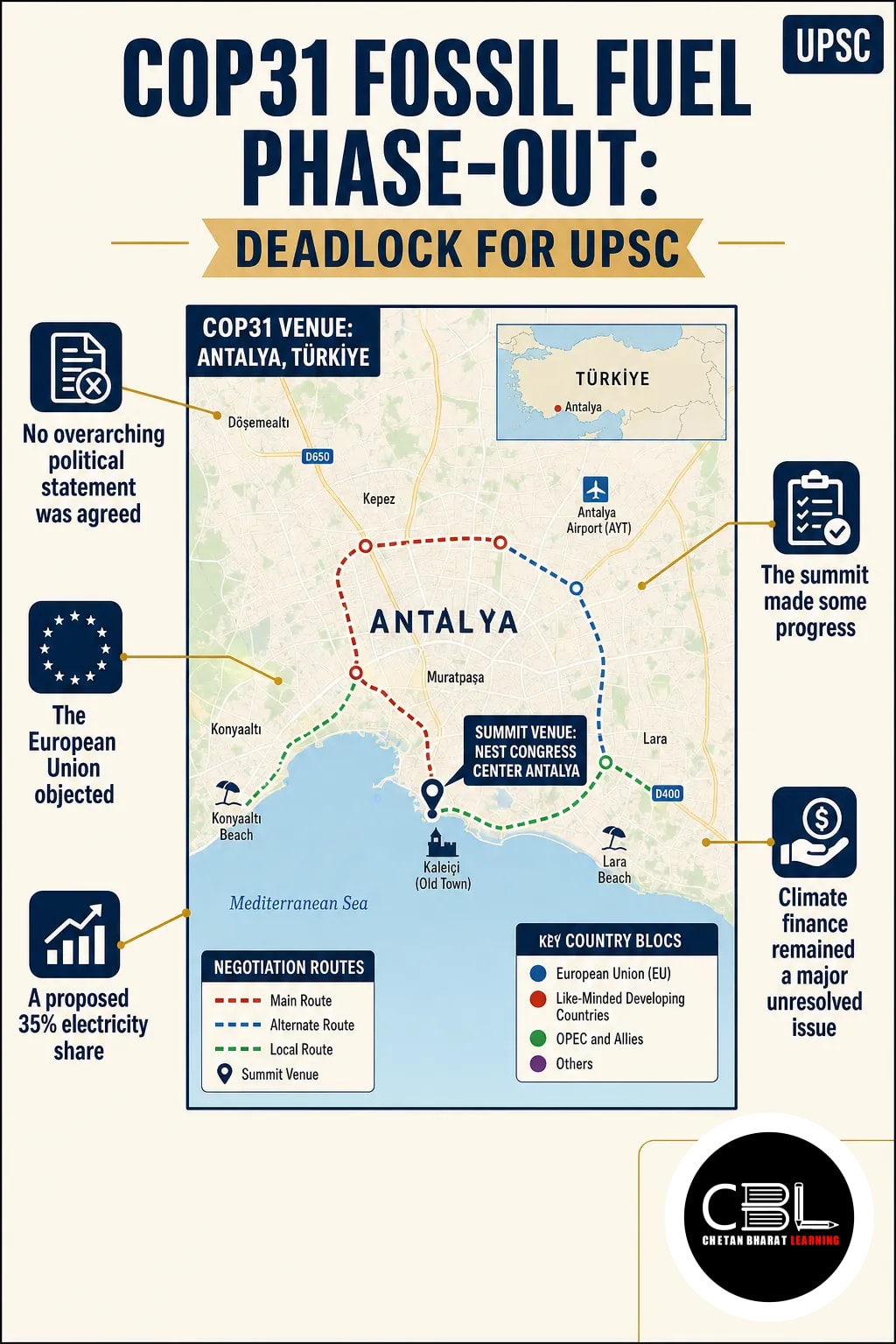
COP31 fossil fuel phase-out talks ended without an overarching political statement, a new development since CBL’s earlier coverage of the summit debate. The outcome links energy transition to questions of equity and finance. Explore related issues in environment current affairs.
Quick answer: COP31 fossil fuel phase-out language became a sticking point at the 2026 climate summit in Antalya, Türkiye. The European Union objected to a proposed cover text that omitted fossil fuels. Consequently, countries adopted no overarching political statement, although there was progress on just transition. Climate finance also remained a major unresolved issue.
What is the climate negotiation deadlock?
The deadlock concerns how to reduce fossil fuel use while distributing the costs of transition fairly. The COP31 fossil fuel phase-out dispute exposes the gap between agreement on climate action and agreement on its wording, pace and financing.
A cover text is an overarching political statement that brings together summit deliberations and can guide future collective action. Its absence does not mean that every negotiation failed. However, it leaves the summit without a common political synthesis.
The talks take place under the United Nations Framework Convention on Climate Change (UNFCCC). Its principle of common but differentiated responsibilities and respective capabilities recognises shared responsibility alongside differences in national circumstances and capacities. Therefore, historical emissions and development needs remain central to discussions on who should pay.
Why was COP31 in the news?
Countries at Antalya could not agree on a cover text after negotiations ran almost 50 hours beyond schedule. Türkiye and Australia led the summit, which brought together around 190 countries for nearly 12 days.
| Issue | Outcome or proposal |
|---|---|
| Cover text | No overarching political statement was agreed. |
| Electrification | A proposed 35% electricity share in global final energy consumption by 2035 did not become an agreed cover-text target. |
| Fossil fuels | The European Union (EU) objected to the absence of explicit fossil fuel language. |
| Just transition | The summit made some progress on a just transition agreement. |
| Climate finance | The editorial identifies a lack of comparable progress. |
Other groups, including least developed countries and island nations, also sought fossil fuel language. Moreover, the consensus-based process makes objections consequential: even one country’s objection can stall an outcome. For background, see CBL’s analysis of the climate goals delivery gap.
Why do countries seek stronger fossil fuel language?
Explicit language would connect the political outcome directly to the fuels responsible for carbon emissions. Supporters therefore see it as more meaningful than an electricity target alone.
- Clearer direction: Naming fossil fuels would signal the intended direction of the transition, rather than relying only on an indirect electrification measure.
- Accountability: Moreover, a common political statement can provide a reference point for future negotiations, even though its wording alone cannot deliver emissions cuts.
- Vulnerable countries: In addition, the demands of island and least developed countries underline the urgency of climate impacts for vulnerable populations.
- Historical responsibility: The editorial argues that developed countries should bear much of the cost because their past emissions contributed substantially to warming.
Electricity’s share of final energy consumption is distinct from the share of clean sources in electricity generation. Consequently, electrification can reduce direct fossil fuel use, but its climate effect also depends on how the electricity is generated.
What concerns complicate a phase-out?
Transition costs, development needs and energy security make a uniform pathway difficult. These concerns do not remove the need for mitigation; rather, they shape how countries can undertake it.
- Finance gap: Solar installations, storage, land and grid upgrades require investment. Thus, targets without accessible finance can be difficult to implement.
- Reliability: Solar generation depends on weather. Therefore, electricity systems also need storage, flexible supply and stronger grids.
- Equity: India and China are major fossil fuel emitters and leaders in total clean energy installations. However, both also have large populations facing poverty, making development needs relevant to transition choices.
- Energy security: The editorial notes that countries opposing coal have also strengthened gas reserves during wars. This illustrates the tension between long-term climate objectives and immediate supply concerns.
- Technology choices: Carbon capture seeks to prevent carbon dioxide from entering the atmosphere. However, treating it as a complete substitute for reducing fossil fuel dependence could weaken transition incentives; its role requires careful assessment.
There is also a distinction between a political signal and implementation. The proposed 35% figure was an electrification proposal, not an adopted COP31 fossil fuel phase-out commitment. Meanwhile, CBL’s coverage of Green India Mission funding and climate action offers another perspective on domestic climate finance.
What should be the way forward?
A credible way forward must combine emissions reduction with finance, fairness and practical transition planning. Accordingly, negotiators could pursue the following priorities:
- Deliver finance: Developed countries should honour climate finance commitments, with clear reporting on support reaching vulnerable countries.
- Link targets to implementation: Electrification plans should also address clean generation, storage and grid investment.
- Protect livelihoods: A just transition should consider workers and communities affected by changes in energy systems.
- Assess technology honestly: Carbon capture should face scrutiny on cost and effectiveness, alongside efforts to reduce fossil fuel use.
- Rebuild trust: Moreover, transparent dialogue on historical responsibility and national capabilities can support future consensus.
Useful for Essay and GS IV: Climate cooperation becomes credible when responsibility for action is matched by responsibility for enabling it.
Source: The Hindu, 24 November 2026
- COP31 Fossil Fuel Phase-Out: Key Issues for UPSC (20 Nov 2026)
- COP31 Climate Goals: The Delivery Gap for UPSC (13 Nov 2026)
- Green India Mission: Funding and Climate Action (23 Nov 2026)
Asked in UPSC: Previous Year Questions
- UPSC CSE Mains 2022 (GS Paper III): Will India meet 50 percent of its energy needs from renewable energy by 2030? Justify. How will shifting subsidies from fossil fuels to renewables help achieve this objective?
- UPSC CSE Prelims 2020 (GS Paper I): Which statement best describes the term ‘Social Cost of Carbon’?
UPSC connects the energy transition with policy instruments and the economic costs of emissions.
State PCS General Studies can test the UNFCCC, climate finance and the distinction between electrification and clean electricity. Additionally, candidates can consider how state-level electricity planning connects grid reliability with climate goals.
Prelims Practice Corner
Mains Practice Questions
Frequently Asked Questions
Why did the COP31 cover text fail?
It failed because countries could not agree on its language. The EU objected to the absence of an explicit reference to fossil fuels.
What was the proposed COP31 electrification target?
The proposal sought a 35% electricity share in global final energy consumption by 2035. However, it did not become an agreed cover-text target.
Why is climate finance important to a fossil fuel transition?
Climate finance helps countries meet the costs of transition and climate action. For example, solar installations, storage and grid upgrades require investment.
Did all COP31 negotiations fail?
No, because the summit made some progress on a just transition agreement. However, countries did not agree on an overarching cover text.
Related Current Affairs
Preparing for UPSC, PCS or HCS?
Talk to a mentor at Chetan Bharat Learning, Chandigarh. Free guidance on choosing the right exam and building a study plan.
Chat on WhatsAppCall 97793 53345UPSC / IAS / PCS coaching in Chandigarh · Trusted by aspirants across Punjab & Haryana






Leave a Reply
You must be logged in to post a comment.