

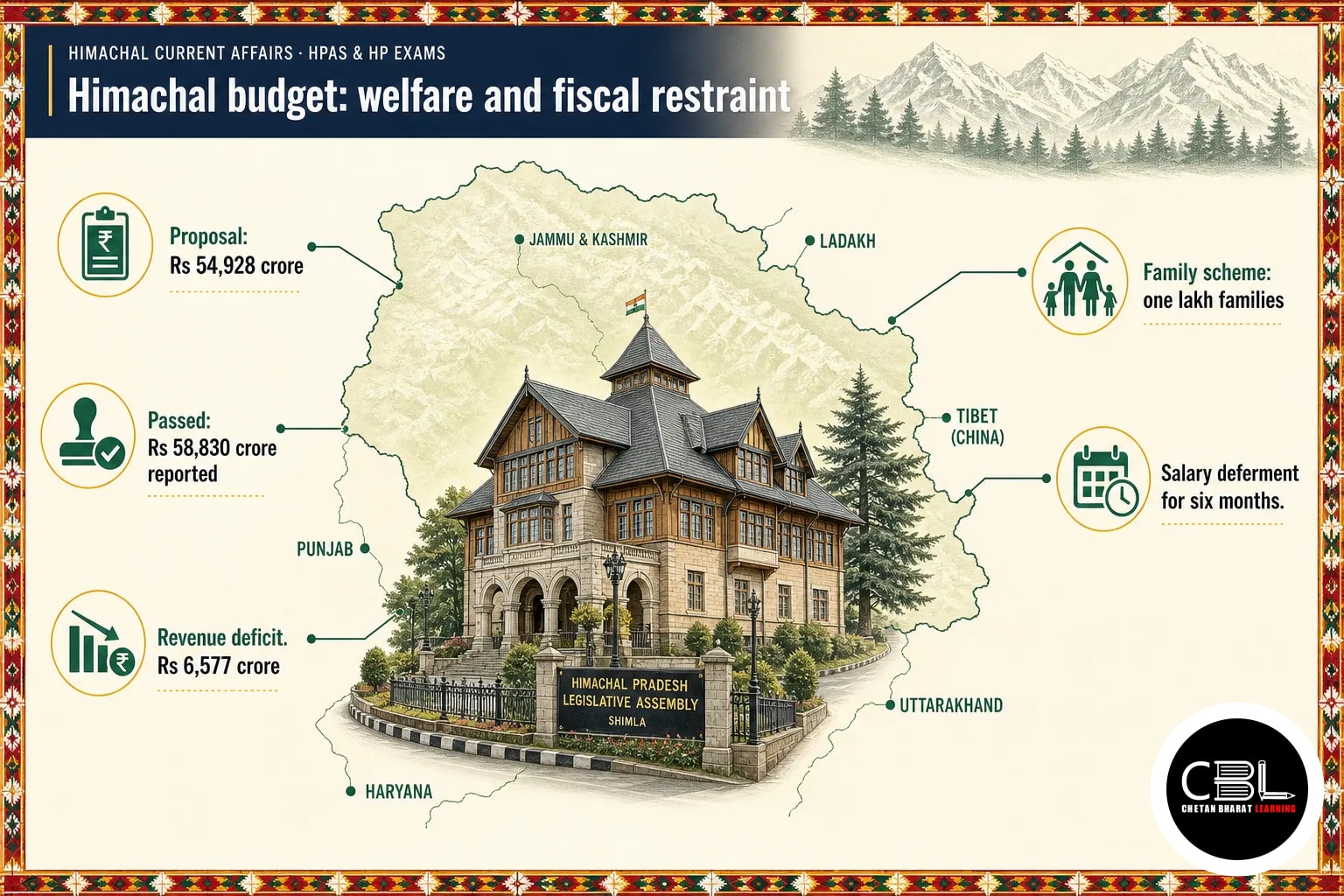
On 21 March 2026, Chief Minister Sukhvinder Singh Sukhu presented Himachal Pradesh’s Rs 54,928 crore budget for 2026-27. It proposed welfare and farm measures alongside salary deferment for senior functionaries. The smaller proposal was attributed to the discontinued Revenue Deficit Grant. The budget passed on 30 March was reported at a revised Rs 58,830 crore. In November, the cabinet approved monthly assistance for women under the announced family scheme.
Timeline: from proposal to approval
- 2025-26previous budgetBaseline
The previous budget was Rs 58,514 crore, the comparison for the 2026-27 proposal.
- 20 Mar2026Survey
The Economic Survey reported real state economic growth of 8.3% for 2025-26.
- 21 Mar2026Budget
Sukhu presented a budget of about Rs 54,928 crore.
- 21 Mar2026Measures
The budget announced a family scheme covering about one lakh poor families.
- 30 Mar2026Passage
The passed budget was reported at a revised Rs 58,830 crore.
- Nov2026Approval
The cabinet approved Rs 1,500 per month for women under the family scheme.
- Sukhvinder Singh Sukhu presented the 2026-27 budget.
- The budget proposal was approximately Rs 54,928 crore.
- The Economic Survey reported real growth of 8.3% for 2025-26.
- The proposed cow milk procurement price rose to Rs 61 per litre.
- The budget announced a State Kisan Commission.
What is the Himachal budget?
The state budget sets out the government’s proposed receipts and expenditure for a financial year. Sukhu, who also held the Finance portfolio, presented the 2026-27 proposal on 21 March 2026. Its proposed size was about Rs 3,586 crore below the 2025-26 budget.
The revenue deficit was put at Rs 6,577 crore and the fiscal deficit at Rs 9,698 crore. Revenue deficit is the excess of revenue expenditure over revenue receipts. Fiscal deficit broadly measures the gap between total expenditure and receipts excluding borrowings.
Why it matters
Mukhyamantri Apna Sukhi Parivar Yojana was announced for about one lakh poor families. It included 300 units of free electricity and phased financial help.
The announced cow milk procurement price rose from Rs 51 to Rs 61 per litre. The buffalo milk price rose from Rs 61 to Rs 71 per litre.
The discontinued Revenue Deficit Grant was cited for the smaller proposal. Parts of senior functionaries’ salaries were deferred for six months, rather than cut.
- Capital: Shimla is Himachal Pradesh’s capital.
- Institution: The Himachal Pradesh Legislative Assembly meets in Shimla.
- Constitution: Article 202 provides for a state’s annual financial statement.
Key data
| Point | Details |
|---|---|
| Budget proposal | Rs 54,928 crore for 2026-27, against Rs 58,514 crore in 2025-26 |
| Budget passage | Passed on 30 March 2026; revised size reported as Rs 58,830 crore |
| Deficits in proposal | Revenue deficit: Rs 6,577 crore; fiscal deficit: Rs 9,698 crore |
| Economic Survey | Real gross state domestic product (GSDP) growth: 8.3%; nominal growth: 10.1%; per capita income: Rs 2,83,626 |
| Family scheme | About one lakh poor families; 300 units free electricity; Rs 1,500 monthly assistance for women approved in November |
| Farm measures | Rs 100 per litre for A2 milk; minimum support price (MSP) of Rs 100 per kg for fish; State Kisan Commission announced |
| Other provisions | Health: about Rs 2,868 crore; Shimla Central Business District: Rs 400 crore |
Way forward
- Target assistance: Use transparent eligibility checks and accessible grievance channels for welfare delivery.
- Track spending: Publish regular updates on scheme expenditure and outcomes.
- Support producers: Strengthen milk collection and payment systems while monitoring procurement costs.
- Plan responsibly: Assess Shimla infrastructure for water demand, slope stability and environmental impacts.
- Manage finances: Review revenue mobilisation and expenditure priorities without weakening essential services.
HPAS Mains practice questions
Explain the major welfare and rural measures announced in the Himachal budget 2026-27. (150 words)
Answer pointers:
- Introduce the budget and its rural focus.
- Outline the family scheme and electricity provision.
- Note milk prices, fish MSP and the commission.
- Conclude with effective targeting and delivery.
Critically examine the balance between welfare commitments and fiscal restraint in Himachal’s 2026-27 budget. (250 words)
Answer pointers:
- Introduce the smaller proposal and grant context.
- Discuss potential welfare and producer benefits.
- Examine deficits, recurring commitments and deferment limits.
- Conclude with transparent, sustainable expenditure management.
As sub-divisional magistrate (SDM) of Shimla, how would you coordinate implementation of the family scheme? (150 words)
Answer pointers:
- Begin with the scheme’s intended beneficiaries.
- Coordinate eligibility verification with relevant departments.
- Provide accessible information and grievance channels.
- Monitor delivery and correct exclusion errors.
Discuss the link between Article 202 and accountability for Himachal’s budget priorities. (150 words)
Answer pointers:
- Introduce the annual financial statement under Article 202.
- Connect budget proposals with legislative scrutiny.
- Use welfare, health and fiscal deficits as examples.
- Conclude with transparent reporting on outcomes.
For Himachal Pradesh Administrative Service (HPAS) prelims and Himachal Pradesh Rajya Chayan Aayog (HPRCA) papers, memorise the proposal, reported passed amount and scheme figures. For mains, distinguish revenue deficit from fiscal deficit and examine welfare alongside fiscal constraints.
MCQ Practice Corner
Q1. Consider the following statements about the 2026-27 budget:
1. The presented proposal was about Rs 54,928 crore.
2. The reported revised amount at passage was Rs 58,830 crore.
3. The stated salary measure was a permanent cut.
(a) 1 and 2 only (b) 2 and 3 only (c) 1 and 3 only (d) 1, 2 and 3
Show answer
Answer: (a) because the salary measure was a six-month deferment, not a permanent cut.
Q2. Which pair correctly matches the deficits in the 2026-27 budget proposal?
(a) Revenue: Rs 9,698 crore; fiscal: Rs 6,577 crore (b) Revenue: Rs 6,577 crore; fiscal: Rs 9,698 crore (c) Revenue: Rs 2,868 crore; fiscal: Rs 400 crore (d) Revenue: Rs 3,586 crore; fiscal: Rs 2,868 crore
Show answer
Answer: (b) because the proposal put revenue and fiscal deficits at Rs 6,577 crore and Rs 9,698 crore respectively.
Q3. What cow milk procurement price was announced in the budget?
(a) Rs 51 per litre (b) Rs 61 per litre (c) Rs 71 per litre (d) Rs 100 per litre
Show answer
Answer: (b) because the announced cow milk price rose from Rs 51 to Rs 61 per litre.
Q4. Which commission was announced in the budget?
(a) State Kisan Commission (b) State Election Commission (c) Finance Commission of India (d) Union Public Service Commission
Show answer
Answer: (a) because the budget announced a State Kisan Commission.
Frequently Asked Questions
What was the size of the Himachal budget 2026-27?
The presented budget was about Rs 54,928 crore. The amount at passage on 30 March was reported as a revised Rs 58,830 crore.
What is Mukhyamantri Apna Sukhi Parivar Yojana?
It is a scheme announced for about one lakh poor families, with 300 units of free electricity and phased financial help. In November 2026, the cabinet approved Rs 1,500 per month for women under it.
Were salaries cut under Himachal’s budget austerity measure?
No; parts of salaries were deferred for six months. The stated deferment covered 50% of the Chief Minister’s salary, 30% of ministers’ salaries and parts of senior officials’ salaries.
Sources: Business Standard: budget proposal, Business Standard: deficits, New Kerala: budget passage, The News Mill: rural measures
Related Current Affairs
More Himachal topics for HPAS & HP exams
Preparing for UPSC, PCS or HCS?
Talk to a mentor at Chetan Bharat Learning, Chandigarh. Free guidance on choosing the right exam and building a study plan.
Chat on WhatsAppCall 97793 53345UPSC / IAS / PCS coaching in Chandigarh · Trusted by aspirants across Punjab & Haryana



Leave a Reply
You must be logged in to post a comment.