

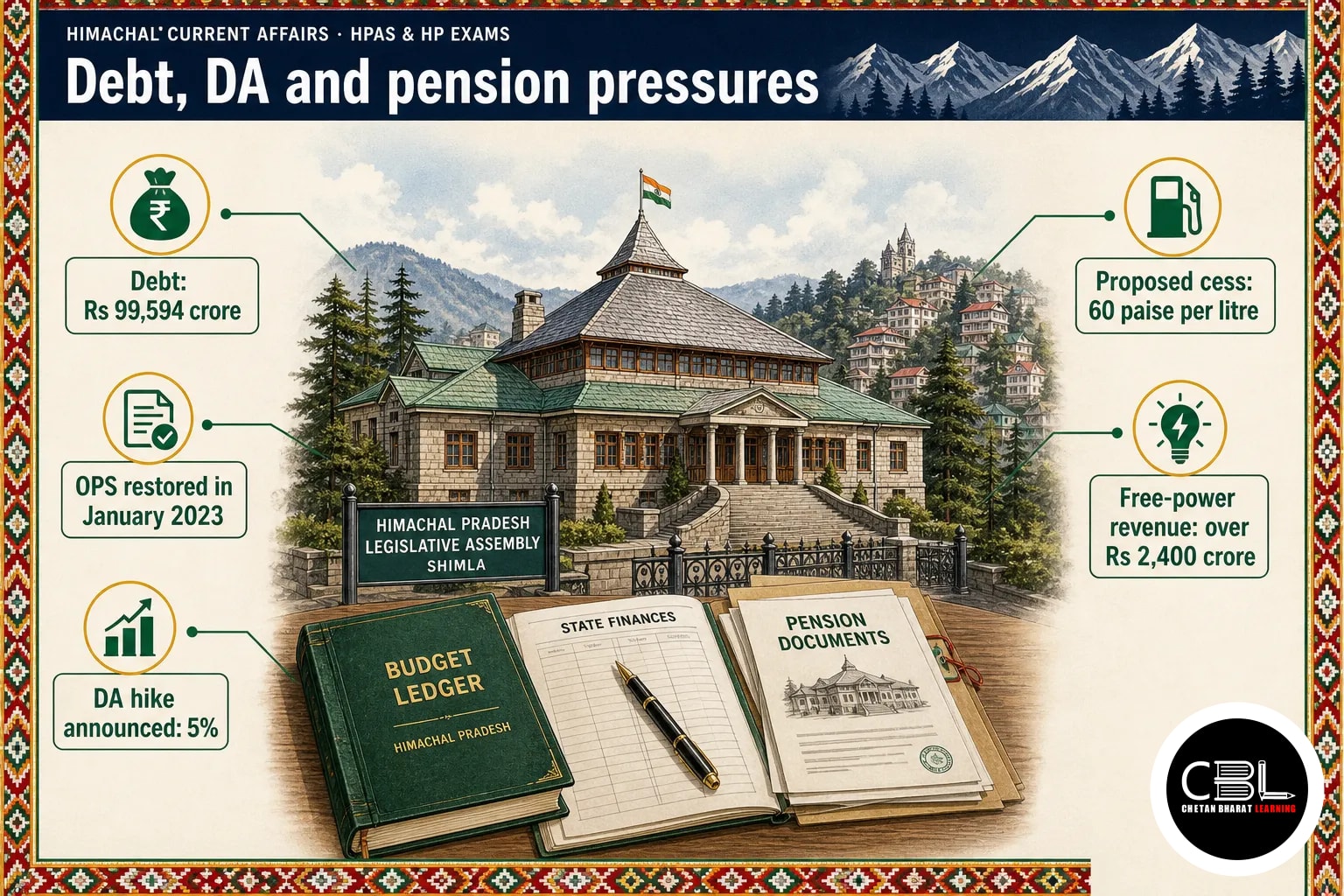
In 2026, Himachal Pradesh faced a fiscal squeeze as borrowing, employee dues and pension commitments drew attention. In October, Chief Minister Sukhvinder Singh Sukhu cited total debt of Rs 99,594 crore and announced a 5% dearness allowance (DA) hike. Employee groups said arrears remained. The Old Pension Scheme (OPS), restored in January 2023, and a court ruling on contractual employee benefits also shaped the fiscal debate.
Timeline: the squeeze in six stops
- Jan2023OPS restored
The first cabinet meeting restored OPS for over 1.36 lakh employees under the National Pension System.
- Apr2026Borrowing
The state borrowed Rs 900 crore in April.
- June2026More loans
June borrowing included Rs 400 crore and Rs 300 crore.
- Aug2026Cess bill
A VAT amendment bill proposed an orphan and widow cess of 60 paise per litre.
- Sept2026Power revenue
The Chief Minister said free-power revenue had risen to over Rs 2,400 crore.
- Oct2026Relief, ruling
A 5% DA hike was announced; the Supreme Court dismissed the state’s review petition on 31 October.
- Himachal restored OPS in its first cabinet meeting in January 2023.
- April 2026 borrowing was Rs 900 crore.
- The proposed orphan and widow cess was 60 paise per litre.
- The October 2026 DA hike announced was 5%.
- The Supreme Court dismissed the contractual-benefits review petition on 31 October 2026.
What is the fiscal squeeze?
A fiscal squeeze arises when spending commitments and financing pressures constrain a government’s choices. In Himachal, borrowing, employee benefits and pension commitments have become central to this debate. The state was described as facing an acute financial crunch largely due to discontinuation of the Revenue Deficit Grant.
OPS was restored for over 1.36 lakh employees covered by the National Pension System (NPS). The state says the Centre has not refunded about Rs 9,242 crore of NPS contributions and that its borrowing limit was reduced after OPS restoration. The reduction was reported between Rs 1,600 crore and Rs 1,700 crore.
Why it matters
The announced 5% DA hike provided relief, while employee groups said pending arrears remained. Contractual employee benefits are also part of the debate.
The Chief Minister said free-power revenue rose from about Rs 1,900 crore to over Rs 2,400 crore. Such revenue can support state finances.
The state has raised the issue of NPS contributions and its borrowing limit. Article 293 provides a constitutional framework for state borrowing.
- Capital: Shimla is the capital of Himachal Pradesh.
- River: The Bhakra Dam stands on the Sutlej River.
- River: The Beas flows through Mandi district.
Key data
| Point | Details |
|---|---|
| Total debt | Rs 99,594 crore, cited by the Chief Minister in October 2026. |
| Government borrowings | Rs 37,781 crore between 2023-24 and 22 October 2026, according to the Chief Minister. |
| OPS restoration | January 2023; over 1.36 lakh NPS employees covered. |
| NPS contributions | About Rs 9,242 crore has not been refunded by the Centre, according to the state. |
| Fuel cess bill | August 2026 proposal: 60 paise per litre on petrol and high-speed diesel. |
| Fiscal framework | Fiscal Responsibility and Budget Management (FRBM) framework; Article 293 governs state borrowing. |
| Free-power revenue | Rose from about Rs 1,900 crore to over Rs 2,400 crore, according to the Chief Minister. |
Way forward
- Transparent accounts: Publish clear estimates of debt, employee dues and pension obligations.
- Revenue management: Improve collection and assess revenue measures for their effects on households and businesses.
- Employee dialogue: Consult employees on a realistic schedule for addressing recognised dues.
- Centre-state coordination: Pursue NPS and borrowing issues through institutional dialogue and documented claims.
- Ecological safeguards: Protect fragile Himalayan ecosystems while developing revenue-generating projects.
HPAS Mains practice questions
Explain the factors behind Himachal Pradesh’s fiscal squeeze. (150 words)
Answer pointers:
- Introduce the pressure on state finances.
- Discuss borrowing and debt.
- Explain employee dues and pension commitments.
- Conclude with transparent fiscal planning.
Critically examine the fiscal implications of restoring OPS in Himachal Pradesh. (250 words)
Answer pointers:
- Introduce the 2023 restoration and its coverage.
- Discuss pension security for covered employees.
- Examine fiscal commitments, NPS contributions and reported borrowing-limit reductions.
- Conclude with dialogue and transparent long-term estimates.
As SDM of Shimla, how would you respond to employee representations about pending dues? Discuss. (150 words)
Answer pointers:
- Receive representations and verify relevant records.
- Explain applicable procedures without promising unauthorised payments.
- Forward verified cases to competent authorities and track responses.
- Maintain communication and an accessible grievance process.
Discuss how Article 293 relates to Himachal Pradesh’s borrowing and fiscal management. (150 words)
Answer pointers:
- Introduce Article 293 and state borrowing.
- Explain the Centre’s consent requirement when a state is indebted to it.
- Link borrowing decisions with debt management and fiscal commitments.
- Conclude with cooperative fiscal planning.
For prelims and HPRCA papers, memorise the OPS restoration date, proposed cess and cited debt. For HPAS Mains, connect fiscal commitments with Article 293 and revenue management.
MCQ Practice Corner
Q1. Consider the following statements about Himachal Pradesh’s fiscal developments:
1. The August 2026 bill proposed a cess of 60 paise per litre on petrol and high-speed diesel.
2. The proposed cess was Rs 6 per litre.
3. The Supreme Court dismissed the state’s review petition on contractual employee benefits in October 2026.
Which statements are correct?
(a) 1 and 2 only (b) 1 and 3 only (c) 2 and 3 only (d) 1, 2 and 3
Show answer
Answer: (b) because the proposal was 60 paise per litre and the review petition was dismissed.
Q2. Under which constitutional article does state borrowing require the Centre’s consent when the state is indebted to it?
(a) Article 21 (b) Article 32 (c) Article 280 (d) Article 293
Show answer
Answer: (d) because Article 293 governs state borrowing and the relevant consent requirement.
Q3. In which month and year was OPS restored by the Himachal cabinet?
(a) January 2023 (b) August 2024 (c) January 2025 (d) October 2026
Show answer
Answer: (a) because the first cabinet meeting restored OPS in January 2023.
Q4. What DA hike was announced in October 2026?
(a) 2% (b) 5% (c) 8% (d) 10%
Show answer
Answer: (b) because the announced DA hike was 5%.
Frequently Asked Questions
What was Himachal Pradesh’s debt in 2026?
The Chief Minister cited total debt of Rs 99,594 crore in October 2026. He also cited government borrowings of Rs 37,781 crore between 2023-24 and 22 October 2026.
When was the Old Pension Scheme restored in Himachal Pradesh?
OPS was restored in January 2023 at the first cabinet meeting. It covered over 1.36 lakh employees under NPS.
What was the proposed orphan and widow cess in Himachal Pradesh?
The August 2026 bill proposed 60 paise per litre on petrol and high-speed diesel. It was included in the Himachal Pradesh Value Added Tax Amendment Bill.
Sources: The Tribune: borrowing, The Print: OPS restoration, The Tribune: NPS contributions, ANI: power revenue
Related Current Affairs
More Himachal topics for HPAS & HP exams
Preparing for UPSC, PCS or HCS?
Talk to a mentor at Chetan Bharat Learning, Chandigarh. Free guidance on choosing the right exam and building a study plan.
Chat on WhatsAppCall 97793 53345UPSC / IAS / PCS coaching in Chandigarh · Trusted by aspirants across Punjab & Haryana



Leave a Reply
You must be logged in to post a comment.