

UPSC Mapping
- Prelims: Natural Fibres, MSMEs and Coir Vikas Yojana
- Mains: GS Paper III: Rural Industries, Employment and Sustainable Development
Quick Facts
| Raw Material | Outer husk of coconut |
|---|---|
| Nodal Ministry | Ministry of MSME |
| Development Scheme | Coir Vikas Yojana |
| Scheme Type | Central Sector Scheme |
What is the Coir Sector?
Coir is a natural fibre obtained from the tough outer husk of coconuts. Manufacturers process it into ropes, mats, brushes, mattresses and other products. The industry converts an agricultural by-product into commercially useful material.
The production chain includes husk collection, fibre extraction, spinning and product manufacturing. Coir pith, the spongy material associated with fibre processing, also has commercial applications. Processed pith can serve as a growing medium in horticulture, subject to suitable treatment and quality standards.
This industry links agriculture with rural industrialisation. Processing enterprises can create non-farm employment near raw-material sources. The extent of local benefit depends on productive enterprises, reliable markets and fair returns to workers.
Why in News?
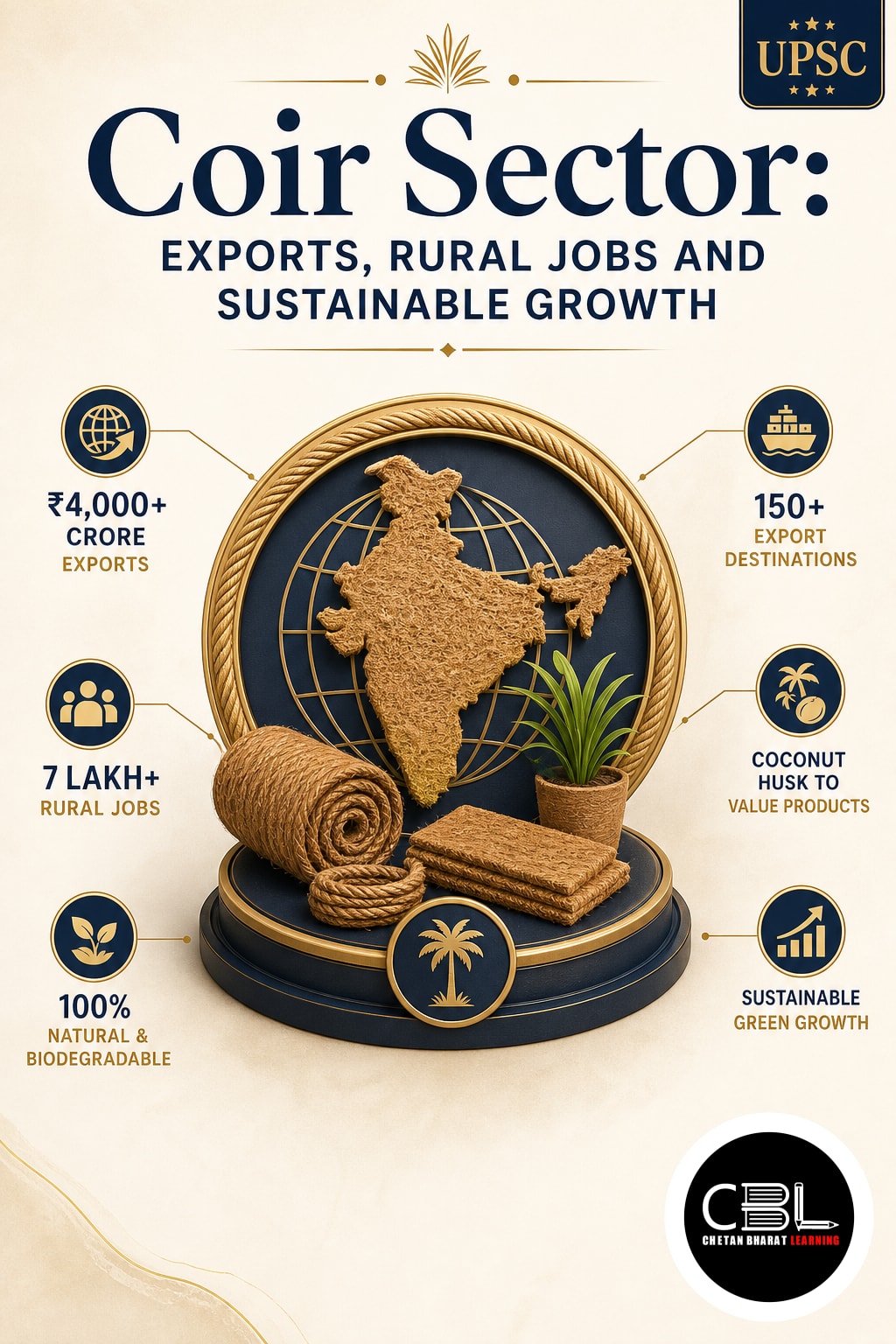
The Ministry of MSME’s update of 14 October 2026 highlighted production, exports and employment. It reported coir-product exports of ₹6,614.40 crore in FY 2025–26. The United States, China, the Netherlands, Spain and the United Kingdom were among major destinations.
The release estimates industry turnover at approximately ₹16,000 crore and identifies India as the largest producer and exporter. It estimates total direct and indirect employment at over seven lakh workers, with women accounting for around 80%. Separately, it reports 2.3 lakh persons employed by more than 21,000 Udyam-registered units; these employment measures have different coverage.
Turnover measures sales, whereas GDP contribution depends on value added. A turnover estimate cannot independently establish the industry’s share in national GDP. Keeping these concepts separate improves the accuracy of economic assessment.
Key Features
- Agricultural linkage: Coconut husks provide raw material for fibre extraction and downstream manufacturing.
- Product diversity: The value chain supplies fibre, yarn, pith-based products and finished household goods.
- Rural employment: Small enterprises create opportunities beyond farming in processing and manufacturing activities.
- Women’s participation: The workforce profile makes skills, earnings and workplace conditions important policy concerns.
- Export potential: Overseas markets offer opportunities for greater sales, product diversification and value addition.
- Resource utilisation: Commercial use of coconut husks illustrates the productive reuse of agricultural by-products.
Coir Vikas Yojana and Enterprise Support
Coir Vikas Yojana is a Central Sector Scheme implemented through the Coir Board under the Ministry of MSME. It supports industry development through technology, training and market-related interventions. The Board’s scheme information outlines the development framework.
- Technology development: Support for improved machinery and products can strengthen productivity and manufacturing capability.
- Skill development: Training helps artisans acquire production skills and improve product quality.
- Market promotion: Publicity, exhibitions and buyer engagement can improve domestic and international visibility.
- Women’s livelihoods: Skill Upgradation and Mahila Coir Yojana activities support women artisans.
The Prime Minister’s Employment Generation Programme can also support eligible coir-based microenterprises. Applicants must satisfy the relevant scheme conditions rather than assume automatic assistance. Combining technical training with business planning can help new units use support effectively.
Sustainability and Inclusive Growth
The Coir Sector demonstrates a practical connection between value addition and the circular economy. Using husks as industrial inputs can extend the economic usefulness of coconut cultivation. Product development can create additional opportunities from material that might otherwise remain underused.
Natural-fibre products may offer alternatives to some synthetic materials. Environmental performance still depends on processing methods, energy use and product composition. Biodegradability claims should distinguish untreated natural fibre from finished products containing synthetic backing or binders.
High female participation creates scope for stronger women-led entrepreneurship. Employment alone does not establish economic empowerment. Assessment should also consider earnings, decision-making authority, ownership and access to better-paid activities.
Challenges
- Productivity constraints: Small units may need better equipment, maintenance and technical skills to improve output quality.
- Finance access: Enterprises require working capital and affordable investment funding to fulfil orders and modernise.
- Market requirements: Export buyers expect consistent specifications, reliable delivery and suitable packaging.
- Worker welfare: Sustainable expansion requires safe workplaces, fair earnings and suitable protective equipment.
- Environmental management: Processing units must manage water use, residues and any treatment-related pollution.
- Distribution of gains: Higher export earnings need not automatically improve incomes across every stage of production.
These are policy considerations for development rather than findings of a fresh sector-wide survey. Their significance varies across locations, technologies and enterprise sizes. Targeted assessments can identify which constraints most affect individual clusters.
Way Forward
Policy should connect technology upgrading with practical worker training and market demand. Shared processing facilities, testing services and design support can help smaller units improve quality. Enterprise support should include maintenance capability and realistic business plans.
Women entrepreneurs need opportunities to move into ownership, marketing and higher-value production. Training should cover costing, digital sales and financial management alongside technical skills. Accessible credit and business mentoring can complement these efforts.
Export development should encourage product quality and diversified buyers. Domestic markets also matter for stable demand and enterprise resilience. Manufacturers should substantiate environmental claims and comply with applicable product standards.
The Coir Sector can support inclusive growth when higher production improves livelihoods and resource efficiency. Monitoring should track worker earnings, enterprise survival and environmental performance alongside exports. Consult the Ministry’s sector update and our economic affairs learning portal for further context.
Punjab & Haryana PCS Angle
Punjab PCS and Haryana HCS can use this industry as an example of agricultural by-product utilisation, rural enterprise and women’s livelihoods. Its policy lessons concern skills, MSME support and value-chain development, even where coconut-based production is not a major local activity. Answers can compare these principles with other locally available agricultural resources.
Prelims Practice Corner
Q1. Coir fibre is obtained from which part of the coconut?
- (a) Outer husk
- (b) Edible kernel
- (c) Coconut water
- (d) Leaf stalk
Answer: (a). Coir is a natural fibre extracted from the outer husk.
Q2. Coir Vikas Yojana operates under which ministry?
- (a) Ministry of Coal
- (b) Ministry of Micro, Small and Medium Enterprises
- (c) Ministry of Civil Aviation
- (d) Ministry of Mines
Answer: (b). The Coir Board implements the scheme under the Ministry of MSME.
Q3. Consider the following statements: 1. Coir Vikas Yojana is a Central Sector Scheme. 2. It supports technology, skills and market development. Which is correct?
- (a) 1 only
- (b) 2 only
- (c) Both 1 and 2
- (d) Neither 1 nor 2
Answer: (c). Both statements describe the scheme correctly.
Q4. Using coconut husks to manufacture useful products most directly illustrates:
- (a) Agricultural by-product valorisation
- (b) Fossil-fuel refining
- (c) Mineral beneficiation
- (d) Nuclear fuel processing
Answer: (a). Valorisation creates useful economic products from by-products or underused materials.
Q5. Consider the following statements: 1. Industry turnover is identical to its GDP contribution. 2. Finished coir products may contain synthetic components. Which is correct?
- (a) 1 only
- (b) 2 only
- (c) Both 1 and 2
- (d) Neither 1 nor 2
Answer: (b). Turnover measures sales rather than value added; some finished products incorporate synthetic backing or binders.
Mains Practice Questions
Q1. Explain how agricultural by-product-based industries can support rural livelihoods and a circular economy, using coir as an example. (150 words, 10 marks)
Answer Structure:
- Intro: Define coir and explain its link with coconut husk utilisation.
- Body: Discuss non-farm jobs, women’s participation, value addition and resource efficiency; note processing-related environmental safeguards.
- Conclusion: Connect enterprise viability with better livelihoods and responsible production.
Q2. Assess the role of technology, skills and market access in strengthening traditional rural industries. Suggest measures to ensure that growth benefits women workers. (250 words, 15 marks)
Answer Structure:
- Intro: Explain the development potential of traditional rural manufacturing.
- Body: Cover machinery, training, finance and quality; propose women’s ownership, fair earnings, safe workplaces and business mentoring.
- Conclusion: Recommend outcome-based support that combines competitiveness with economic empowerment.
Frequently Asked Questions
What products can manufacturers make from coir?
Common products include ropes, mats, brushes, mattresses and yarn. Processed coir pith also supports horticultural applications.
What does Coir Vikas Yojana support?
It supports sustainable industry development through technology, skills and market promotion. The Coir Board implements it under the Ministry of MSME.
Why are women central to the industry’s development?
The Ministry estimates that women constitute around 80% of the sector’s workforce. Improving skills, earnings, working conditions and ownership opportunities can strengthen their economic participation.
Related Current Affairs
Preparing for UPSC, PCS or HCS?
Talk to a mentor at Chetan Bharat Learning, Chandigarh. Free guidance on choosing the right exam and building a study plan.
Chat on WhatsAppCall 97793 53345UPSC / IAS / PCS coaching in Chandigarh · Trusted by aspirants across Punjab & Haryana
Leave a Reply
You must be logged in to post a comment.