
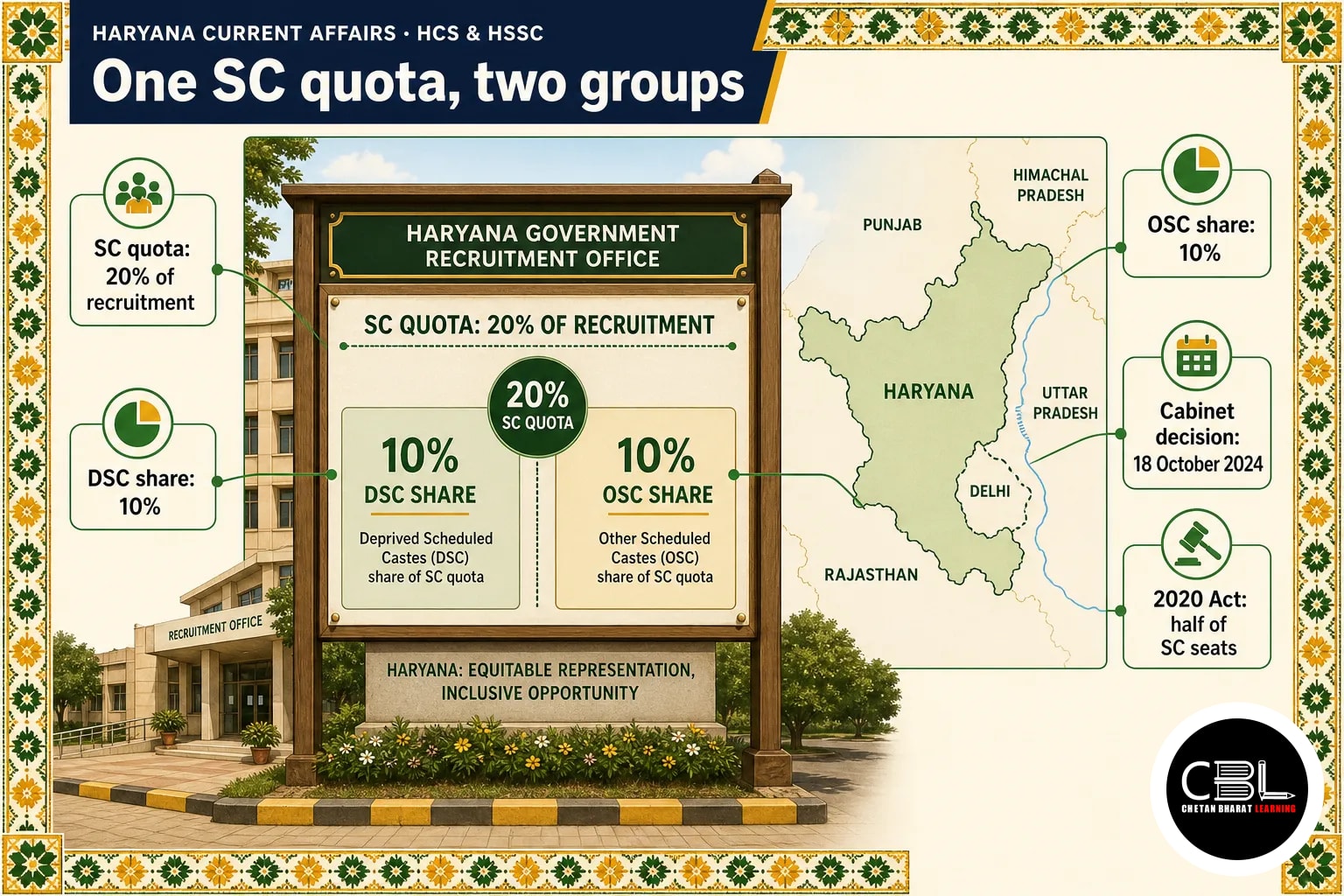
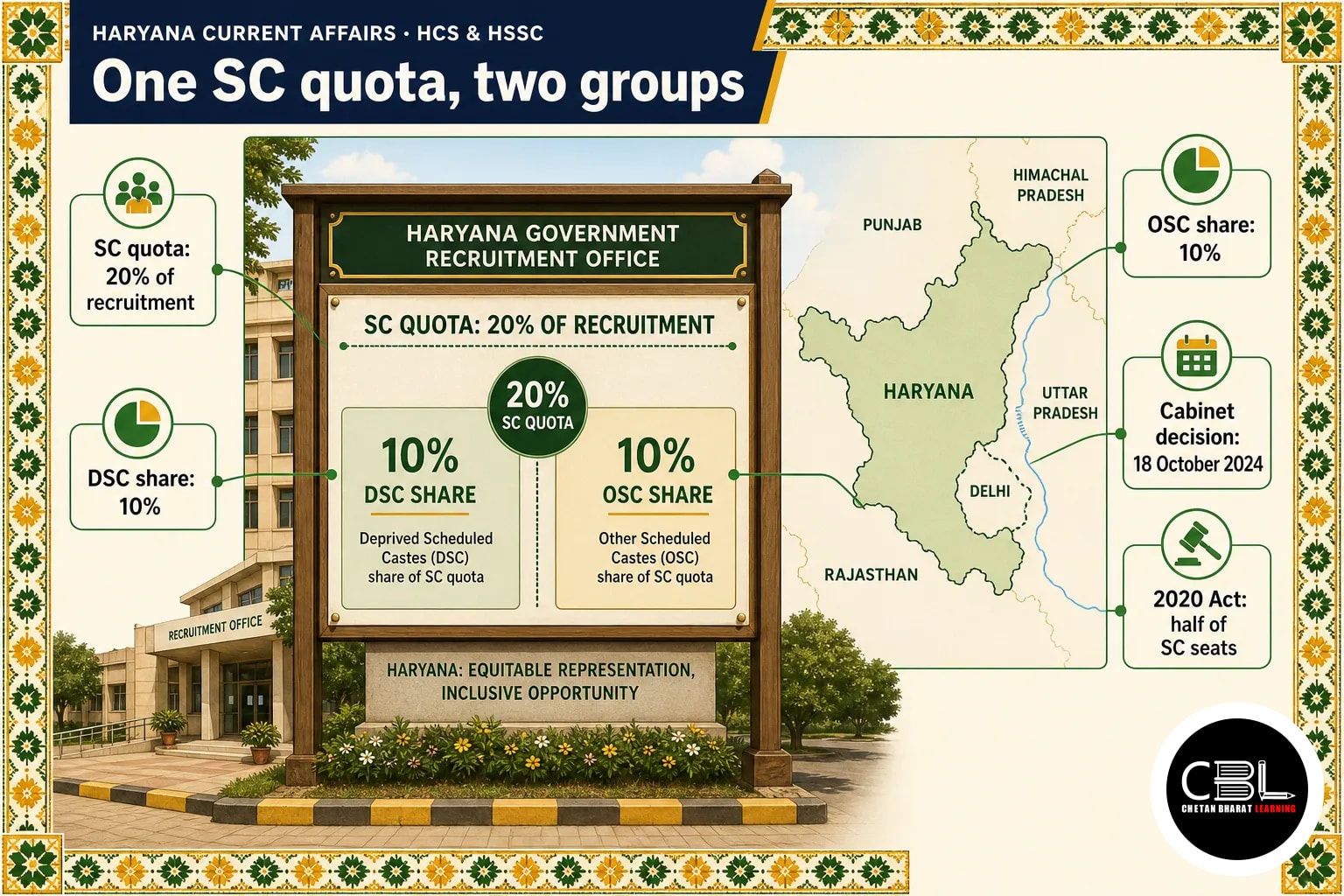
In October 2024, Haryana decided to sub-classify Scheduled Castes (SC) for direct recruitment; a notification followed in November. Its existing 20% SC quota is divided equally between Deprived Scheduled Castes (DSC) and Other Scheduled Castes (OSC). The decision followed the Supreme Court ruling of August 2024. Unfilled posts pass between the groups, and a common merit list determines inter-se seniority. For the Common Eligibility Test (CET), remember that the overall SC quota remains unchanged.
Timeline: the quota in six stops
- 1994notificationFirst split
Haryana divided its SC quota into Block A and Block B.
- 2006High CourtStruck down
The High Court struck down the earlier split.
- 2020admissionsEducation law
A Haryana Act reserved half the SC admission seats for DSC.
- 1 Aug2024Court ruling
The Supreme Court permitted sub-classification backed by quantifiable and demonstrable data.
- 18 Oct2024Cabinet decision
Haryana decided on immediate implementation; it was reported as the first state to act on the ruling.
- Nov2024Notification
A notification followed the cabinet decision.
- Haryana divides its 20% SC direct recruitment quota equally between DSC and OSC.
- The Supreme Court permitted SC sub-classification on 1 August 2024.
- Haryana’s cabinet decided on implementation on 18 October 2024.
- Balmiki and Dhanak are among the communities included in DSC.
- The 2020 Haryana education law reserved half the SC admission seats for DSC.
What is SC sub-classification?
Sub-classification divides a reservation category into groups to address unequal representation within it. Haryana’s direct recruitment arrangement allocates 10% each to DSC and OSC within the existing 20% SC quota. DSC reportedly cover 36 castes, including Balmiki, Dhanak, Mazhabi Sikh and Khatik; OSC mainly include Chamar, Jatav and related castes.
The Haryana State Commission for Scheduled Castes found DSC under-represented in government services. The Supreme Court’s decision in State of Punjab v. Davinder Singh permitted sub-classification backed by quantifiable and demonstrable data. It overruled E.V. Chinnaiah of 2004.
Why it matters
The split gives DSC and OSC distinct shares within the SC direct recruitment quota. Unfilled posts pass between the groups.
The commission found DSC under-represented in government services. The policy addresses differences within the reserved category.
Sub-classification calls for quantifiable and demonstrable data under the Supreme Court ruling. Critics, including Mayawati, said the move divides Dalits; the government said the overall quota is unchanged.
- High Court: The Punjab and Haryana High Court sits in Chandigarh.
- Capital: Chandigarh is the shared capital of Haryana and Punjab.
Key data
| Point | Details |
|---|---|
| Direct recruitment quota | 20% for SC: 10% each for DSC and OSC |
| Vacancies and seniority | Unfilled posts pass between groups; common merit list for inter-se seniority |
| Supreme Court ruling | 1 August 2024; sub-classification permitted with quantifiable and demonstrable data |
| Haryana decision | 18 October 2024; notification followed in November |
| Education law | 2020 Haryana Act reserved half the SC admission seats for DSC |
| Constitutional provisions | Articles 15(4), 16(4) and 341 |
Way forward
- Evidence: Update representation data and use clear criteria to assess the policy.
- Implementation: Give recruiting authorities consistent instructions on group allocation and unfilled posts.
- Transparency: Publish accessible guidance and recruitment outcomes while protecting personal information.
- Grievances: Provide applicants with a timely channel to resolve classification and recruitment disputes.
- Review: Assess outcomes periodically and engage affected communities without changing the overall quota arbitrarily.
HCS Mains practice questions
Explain Haryana’s sub-classification of Scheduled Castes in direct recruitment. (150 words)
Answer pointers:
- Introduce the October 2024 decision.
- Explain the 10%–10% division within the 20% quota.
- Note unfilled posts and common seniority merit list.
- Conclude with the need for evidence-based implementation.
Critically examine the merits and concerns of SC sub-classification in Haryana. (250 words)
Answer pointers:
- Introduce unequal representation within the SC category.
- Discuss targeted access and the unchanged overall quota.
- Examine concerns about division and the quality of supporting data.
- Conclude with transparent monitoring and grievance redress.
As SDM of Gurugram, how would you address applicants’ concerns about the DSC quota? (150 words)
Answer pointers:
- Identify applicants’ information and grievance needs.
- Explain the quota and refer classification queries to competent authorities.
- Coordinate with recruiting authorities and track complaints.
- Ensure accessible communication and timely responses.
Discuss Haryana’s SC sub-classification in the light of Articles 16(4) and 341. (150 words)
Answer pointers:
- Introduce reservation and sub-classification as distinct questions.
- Explain Article 16(4) in relation to public employment.
- Link Article 341 to identification of Scheduled Castes and the court ruling to sub-classification.
- Conclude with data-backed, constitutionally compliant implementation.
For Haryana Civil Services (HCS) prelims and Haryana Staff Selection Commission (HSSC) exams, memorise the 20% → 10% + 10% split and the 2024 dates. For mains, connect representation data with the constitutional provisions.
MCQ Practice Corner
Q1. Consider the following statements about Haryana’s SC sub-classification:
1. The direct recruitment SC quota is divided equally between DSC and OSC.
2. The overall SC quota was raised to 30%.
3. Unfilled posts pass between the two groups.
Which statements are correct?
(a) 1 and 2 only (b) 1 and 3 only (c) 2 and 3 only (d) 1, 2 and 3
Show answer
Answer: (b) because the 20% overall quota remains unchanged, while statements 1 and 3 are correct.
Q2. Which Supreme Court decision permitted SC sub-classification backed by quantifiable and demonstrable data?
(a) E.V. Chinnaiah (b) State of Punjab v. Davinder Singh (c) Kesavananda Bharati (d) S.R. Bommai
Show answer
Answer: (b) because the 2024 Davinder Singh decision permitted such sub-classification.
Q3. What share of Haryana’s direct recruitment quota is allocated to DSC?
(a) 5% (b) 10% (c) 20% (d) 30%
Show answer
Answer: (b) because DSC receive 10% within the 20% SC quota.
Q4. In which month did Haryana’s cabinet decide to implement SC sub-classification?
(a) August 2024 (b) September 2024 (c) October 2024 (d) December 2024
Show answer
Answer: (c) because the cabinet took the decision on 18 October 2024.
Frequently Asked Questions
What is the DSC quota in Haryana government jobs?
DSC receive 10% in direct recruitment within Haryana’s 20% SC quota. OSC receive the other 10%.
Which castes are included in Haryana’s DSC group?
DSC include Balmiki, Dhanak, Mazhabi Sikh and Khatik. The group is reported to cover 36 castes.
Did Haryana increase the overall SC quota in 2024?
No. The government said the overall SC quota remained unchanged; the direct recruitment quota was divided between DSC and OSC.
Sources: ANI, Business Standard, Deccan Herald, The Statesman
Related Current Affairs
More Haryana topics for HCS & HSSC
Preparing for UPSC, PCS or HCS?
Talk to a mentor at Chetan Bharat Learning, Chandigarh. Free guidance on choosing the right exam and building a study plan.
Chat on WhatsAppCall 97793 53345UPSC / IAS / PCS coaching in Chandigarh · Trusted by aspirants across Punjab & Haryana



Leave a Reply
You must be logged in to post a comment.