
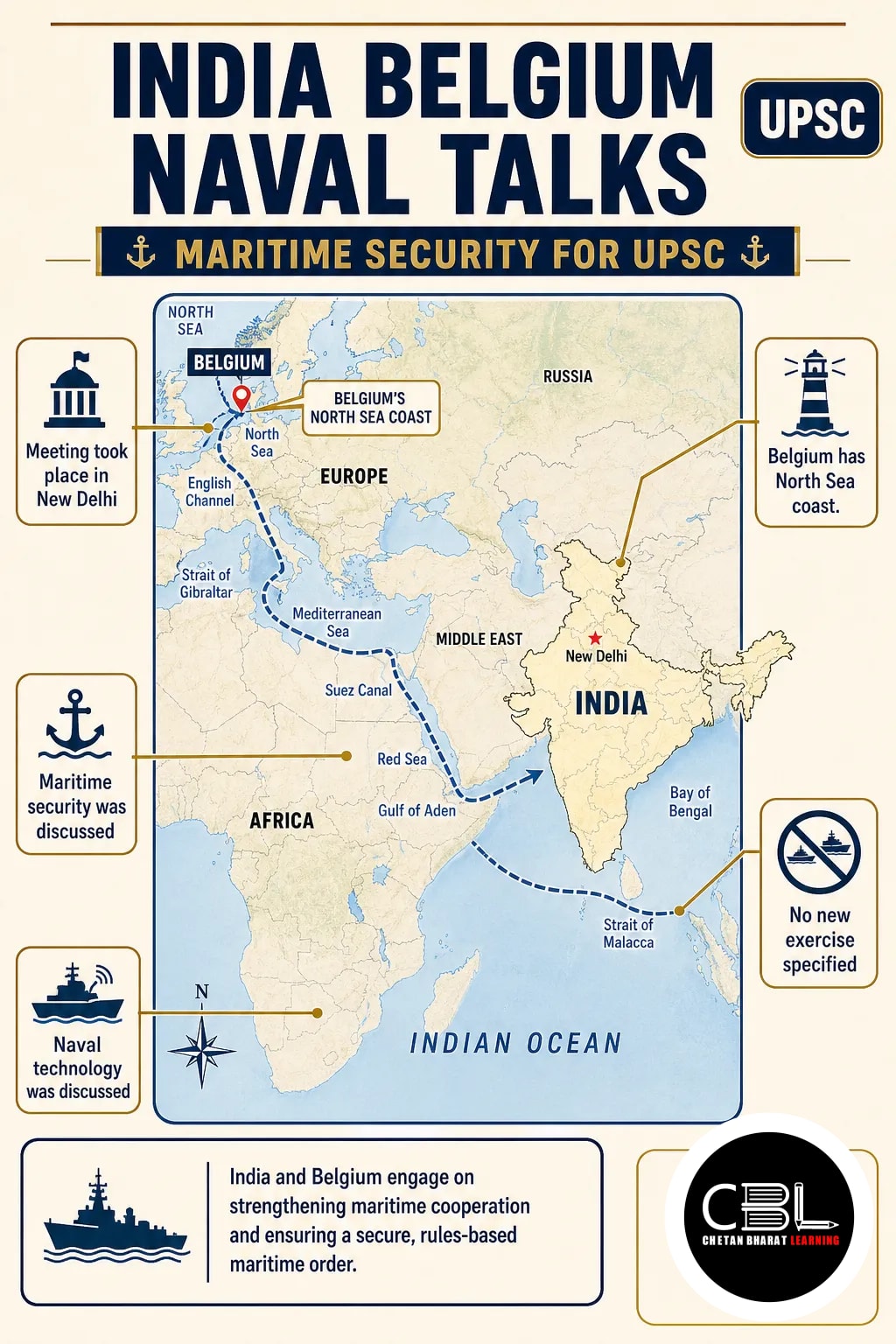
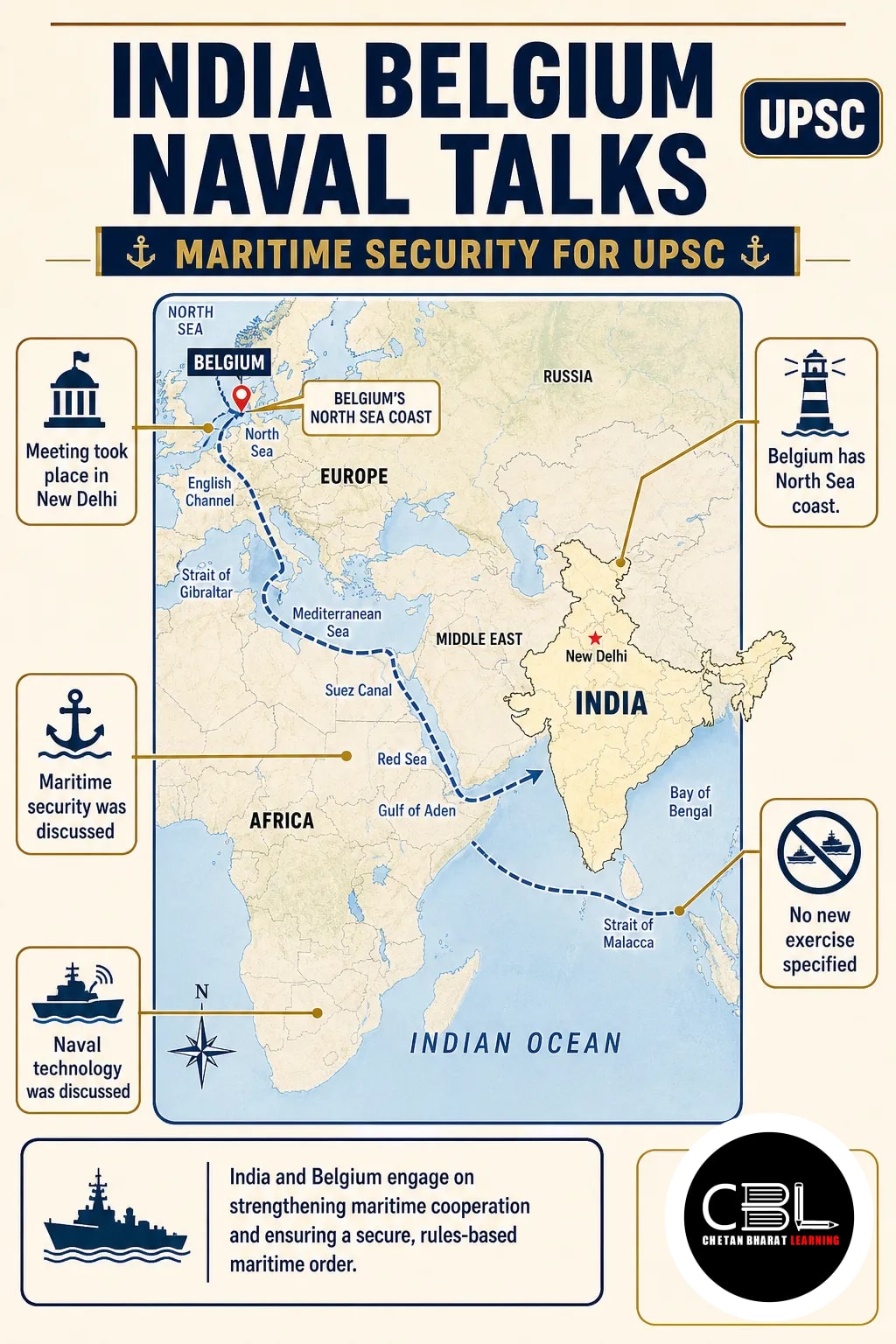
India Belgium naval talks brought the two navy chiefs together in New Delhi to discuss maritime security and operational cooperation. The meeting adds a defence dimension to India’s international relations.
Quick answer: On 15 November 2026, Indian Navy Chief Admiral Krishna Swaminathan and Belgian Navy Commander Rear Admiral Tanguy Botman met in New Delhi. The India Belgium naval talks covered maritime security, operational engagements and naval technology. They aimed to strengthen maritime cooperation and deepen engagement between the two navies.
What happened at the India Belgium naval talks?
The two naval chiefs discussed security at sea, operational engagement and possible technology collaboration. Their meeting sought to deepen navy-to-navy ties between countries with longstanding maritime links.
During his visit, Botman laid a wreath at the National War Memorial in New Delhi. Afterwards, he received a ceremonial guard of honour at the South Block lawns. He also met other senior officials to explore bilateral cooperation.
These discussions are an example of naval diplomacy: the use of naval contacts and activities to advance relationships between states. They differ from a formal agreement because the source does not announce a signed pact.
What were the key discussion areas?
The talks identified three broad areas for cooperation, but did not specify a new programme or operational commitment.
| Area | What the source establishes |
|---|---|
| Maritime security | The chiefs discussed security issues at sea. |
| Operational engagements | The meeting considered naval operational engagement; no new exercise was specified. |
| Naval technology | The chiefs discussed collaboration; no specific project was identified. |
| Senior-level contacts | Botman also interacted with other officials on bilateral cooperation. |
For comparison, CBL has covered the India–Myanmar naval exercise and the India–Oman naval exercise. However, the Belgium meeting should not be described as an exercise.
Why does maritime cooperation matter to India?
Maritime cooperation can support safer sea routes, diplomatic communication and operational learning. Its value extends beyond military combat because trade, ports and maritime infrastructure also depend on security at sea.
Security and sea trade
Ships carry goods and energy across sea lanes, so disruption can affect supply chains and economic activity. Maritime security therefore involves both conventional defence and responses to threats such as piracy and illicit trafficking.
India borders the Indian Ocean, while Belgium has a North Sea coast. Their geographical settings differ; nevertheless, both have an interest in secure maritime movement. The talks provide a channel to discuss such shared concerns without implying identical strategic priorities.
Operational and technological relevance
Regular professional exchanges can help navies understand each other’s procedures. For example, discussing communication protocols can help identify practical barriers before any future joint activity.
Technology dialogue can also help partners identify compatible areas for cooperation. However, discussion alone does not establish a transfer of technology, procurement deal or joint development project. Any such outcome would require separate details and decisions.
What are the concerns and limits?
The principal limit is that the reported meeting sets out discussion areas rather than measurable commitments.
- Implementation gap: A dialogue needs agreed follow-up if it is to produce specific operational outcomes.
- Different priorities: The partners’ distinct maritime locations may affect the activities they consider most useful.
- Technology safeguards: Any future collaboration would need clarity on information security, access and intellectual property.
- Coordination costs: Different equipment, procedures and training systems can complicate joint activity.
These are analytical considerations, not shortcomings that the source attributes to this meeting. Moreover, an announced conversation should not be equated with a binding security alliance.
What could be the way forward?
Both navies could turn the dialogue into practical cooperation through mutually agreed, clearly defined follow-up.
- Prioritise exchanges: First, identify professional interactions that address common maritime security needs.
- Clarify operational goals: Next, assess where compatible procedures could support future cooperation.
- Assess technology proposals: In addition, examine feasibility and safeguards before committing to projects.
- Review progress: Finally, use subsequent contacts to assess whether agreed activities deliver useful results.
For a Mains answer, distinguish the reported agenda from these possible next steps. This keeps analysis evidence-based while showing how diplomacy can translate into cooperation.
Source: The Hindu, 15 November 2026
Asked in UPSC: Previous Year Questions
- UPSC CSE Mains 2025 (GS Paper III): Why is maritime security vital to protect India’s sea trade? Discuss maritime and coastal security challenges and the way forward.
- UPSC CSE Mains 2022 (GS Paper III): What are India’s maritime security challenges? Discuss the organisational, technical and procedural initiatives taken to improve maritime security.
UPSC connects maritime security with trade, institutional responses and technology; therefore, revise the wider security framework alongside bilateral talks.
State PCS General Studies may test the countries, naval representatives and themes of the meeting. In addition, candidates can revise Belgium’s location and the role of maritime security in international trade.
Prelims Practice Corner
Mains Practice Questions
Frequently Asked Questions
Who represented India and Belgium at the naval talks?
Admiral Krishna Swaminathan represented the Indian Navy, while Rear Admiral Tanguy Botman represented the Belgian Navy. They met in New Delhi on 15 November 2026.
What did the two navy chiefs discuss?
They discussed maritime security, operational engagements and naval technology collaboration. In addition, the visit aimed to deepen navy-to-navy ties.
Did the meeting announce a new naval exercise or technology project?
No, the source does not specify a new exercise or technology project. Therefore, students should distinguish the discussion agenda from confirmed outcomes.
Related Current Affairs
Preparing for UPSC, PCS or HCS?
Talk to a mentor at Chetan Bharat Learning, Chandigarh. Free guidance on choosing the right exam and building a study plan.
Chat on WhatsAppCall 97793 53345UPSC / IAS / PCS coaching in Chandigarh · Trusted by aspirants across Punjab & Haryana









Leave a Reply
You must be logged in to post a comment.