
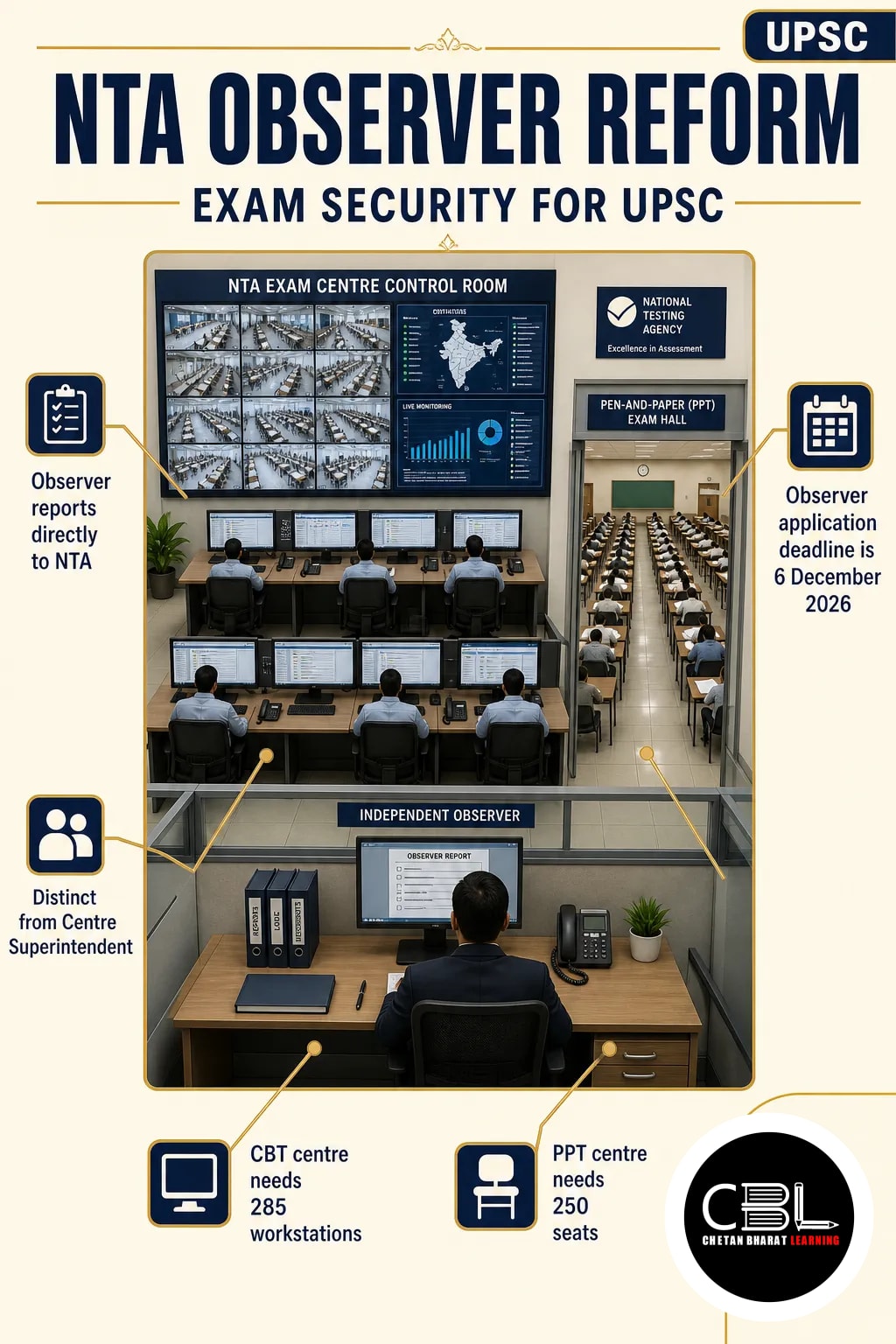

NTA observer reform follows examination security breaches and allegations of irregularities. The National Testing Agency (NTA) has invited applications for observers and examination centres. For related governance coverage, see national current affairs.
Quick answer: NTA observer reform proposes a standing pool of pre-verified observers for national examinations in India and abroad. Following paper leak concerns, NTA has invited eligible retired officials, armed forces personnel and government educators to apply. A separate invitation seeks examination centres; observer applications close on 6 December 2026.
What is the NTA observer reform?
The reform proposes a standing, pre-verified pool from which NTA can deploy observers for individual examinations. NTA currently deploys an independent observer at each test centre on examination day. However, the proposed pool aims to make deployment more timely and reliable across the annual examination cycle.
The observer represents NTA at the centre and reports directly to the agency. This role is separate from those of the City Coordinator and Centre Superintendent. The observer monitors fairness, security and the smooth conduct of the examination.
Crucially, an Expression of Interest (EOI) invites applications; it does not mean every applicant has been appointed. NTA issued a second EOI for institutions and organisations seeking empanelment as examination centres.
Why has NTA proposed the changes?
NTA proposed the changes amid security breaches and allegations of examination irregularities. The source links the overhaul to a question paper leak in the National Eligibility cum Entrance Test for undergraduate medical admissions (NEET-UG) earlier in 2026.
NTA also conducts large entrance and eligibility examinations across several thousand centres in India and abroad. These include the Joint Entrance Examination Main (JEE-Main) and the Common University Entrance Test (CUET) for undergraduate and postgraduate admissions. Consequently, advance planning and consistent oversight matter across different locations and examination formats.
The source notes that a high-powered task force headed by Nandan Nilekani has been constituted to recommend examination reforms. However, the panel has yet to submit its report.
Who can apply as an observer?
The invitation covers three broad categories: retired government officers, retired armed forces or paramilitary personnel, and government educators. The following details distinguish eligibility from the planned deployment process.
| Category or condition | Key detail |
|---|---|
| Government officers | Retired Central and State government officers; the invitation specifies a level above Pay Level 8. |
| Security personnel | Retired armed forces or paramilitary personnel can apply. |
| Educators | Serving or retired teachers and professors from government schools, colleges and universities are eligible. |
| Other conditions | Applicants must be physically fit for duty and have a clear disciplinary record. |
| Centres abroad | NTA will ordinarily empanel eligible Indian nationals resident in the same city, including certain serving or retired Indian Mission officials. |
For overseas centres, eligible locally available Indian nationals may include retired Ministry of External Affairs officers. Thus, the proposal adapts observer selection to the location of a centre. The observer application deadline is 6 December 2026.
What are the proposed examination centre requirements?
NTA seeks facilities that meet capacity and layout requirements for computer-based or pen-and-paper examinations. Applicants must own, operate or hold legally enforceable rights to use a suitable facility.
| Requirement | Centre norm |
|---|---|
| Computer-Based Test (CBT) | 285 functional workstations per shift, including buffer; at least four separate labs or halls of 30 workstations each. |
| Pen and Paper-based Test (PPT) | 250 candidate seats per shift, including buffer; at least six separate halls of 40 candidates each, or equivalent configurations. |
| Shift duration | Centres should accommodate an examination in a single three-hour shift. |
| Limited-supply locations | Centres below 285 workstations may apply, but consideration is limited to locations with limited supply. |
The buffer forms part of the stated totals, not an addition to them. Moreover, the separate lab or hall requirements concern layout; they do not replace the overall capacity norms.
Why does independent observation matter?
Independent observation creates a reporting channel outside the centre’s immediate management. Because the observer reports directly to NTA, the agency can receive an account separate from the centre superintendent’s administrative role.
A pre-verified pool can also support earlier deployment and reduce last-minute uncertainty. In addition, common eligibility conditions can provide a baseline for selecting personnel across locations. For candidates, a credible process matters because examination outcomes affect access to education and opportunities.
However, observers are part of the examination-day system, not a complete safeguard against every leak. Risks can arise before a paper reaches a centre or after an examination ends. Therefore, the reform should be assessed alongside controls over the wider examination process.
What implementation challenges remain?
The main challenge is to turn a pre-verified pool into effective, consistent oversight at every centre.
- Operational independence: An observer is distinct from centre officials, but effective scrutiny also requires freedom to report concerns without local pressure.
- Training and consistency: Recruits will bring different professional backgrounds; therefore, common instructions and examination-specific training are important.
- Coverage and capacity: Centres vary across India and abroad. Consequently, NTA must match available observers to locations and examination schedules.
- Infrastructure access: Capacity norms can improve readiness, but stringent requirements may limit centre availability in some locations. The EOI allows consideration of smaller CBT centres where supply is limited.
- Accountability: Direct reporting helps identify problems; however, its value depends on timely action and clear responsibility for follow-up.
How can examination oversight be strengthened?
NTA can complement observer deployment with safeguards across the examination cycle. The following measures are analytical suggestions, not announced features of the EOI.
- Standardise training: Provide clear checklists for centre security, incident reporting and candidate assistance before each examination.
- Protect reporting: Set out escalation procedures and maintain records of concerns, decisions and corrective action.
- Manage conflicts: Screen potential conflicts of interest and avoid deployments that could compromise impartiality.
- Secure the full chain: Strengthen controls over paper preparation, storage, transport and access, in addition to examination-day oversight.
- Review outcomes: Assess centre readiness and reported incidents after examinations; then use the findings to improve future empanelment.
Overall, NTA observer reform can strengthen centre-level accountability if the agency follows reports with action. It should also remain part of a wider strategy that protects candidates’ access and trust.
Source: The Hindu, 12 November 2026
Punjab PCS and Haryana HCS General Studies can test examination integrity through accountability, recruitment and public trust. Candidates can also apply the distinction between independent oversight and centre administration to state-level examination governance.
Prelims Practice Corner
Mains Practice Questions
Frequently Asked Questions
Who can apply for NTA observer empanelment?
Eligible retired government officers, retired armed forces or paramilitary personnel, and serving or retired government educators can apply. Applicants must also meet conditions including physical fitness and a clear disciplinary record.
What is the deadline for observer applications?
The observer application deadline is 6 December 2026. The invitation seeks applications for a pre-verified pool, rather than announcing automatic appointments.
How many computers must an NTA CBT centre have?
The stated norm is 285 functional workstations per shift, including buffer. However, smaller centres may apply for consideration in locations with limited supply.
Does an NTA observer replace the Centre Superintendent?
No, the observer has a separate role and reports directly to NTA. The Centre Superintendent and City Coordinator remain distinct from the observer.
Related Current Affairs
Preparing for UPSC, PCS or HCS?
Talk to a mentor at Chetan Bharat Learning, Chandigarh. Free guidance on choosing the right exam and building a study plan.
Chat on WhatsAppCall 97793 53345UPSC / IAS / PCS coaching in Chandigarh · Trusted by aspirants across Punjab & Haryana









Leave a Reply
You must be logged in to post a comment.