
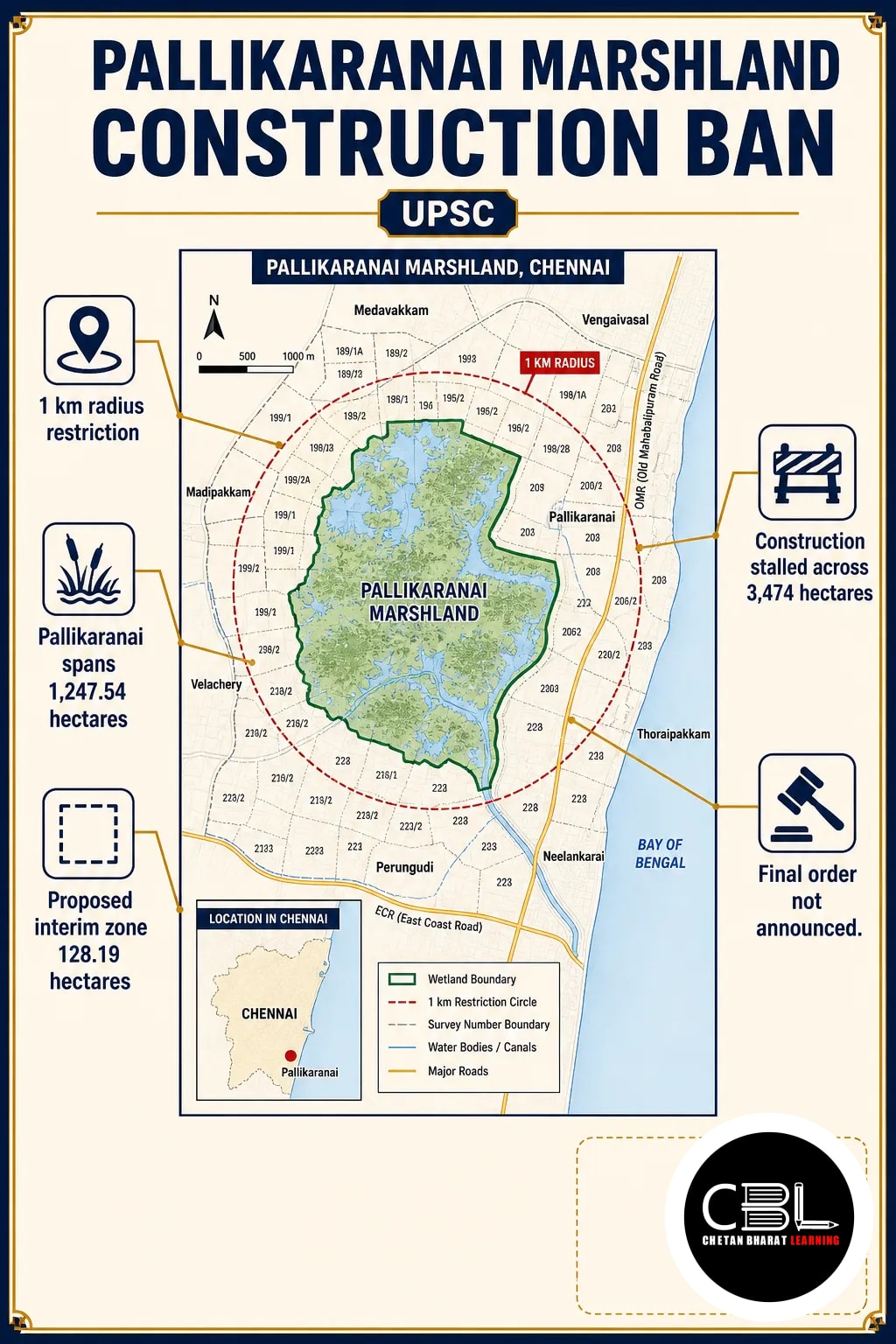
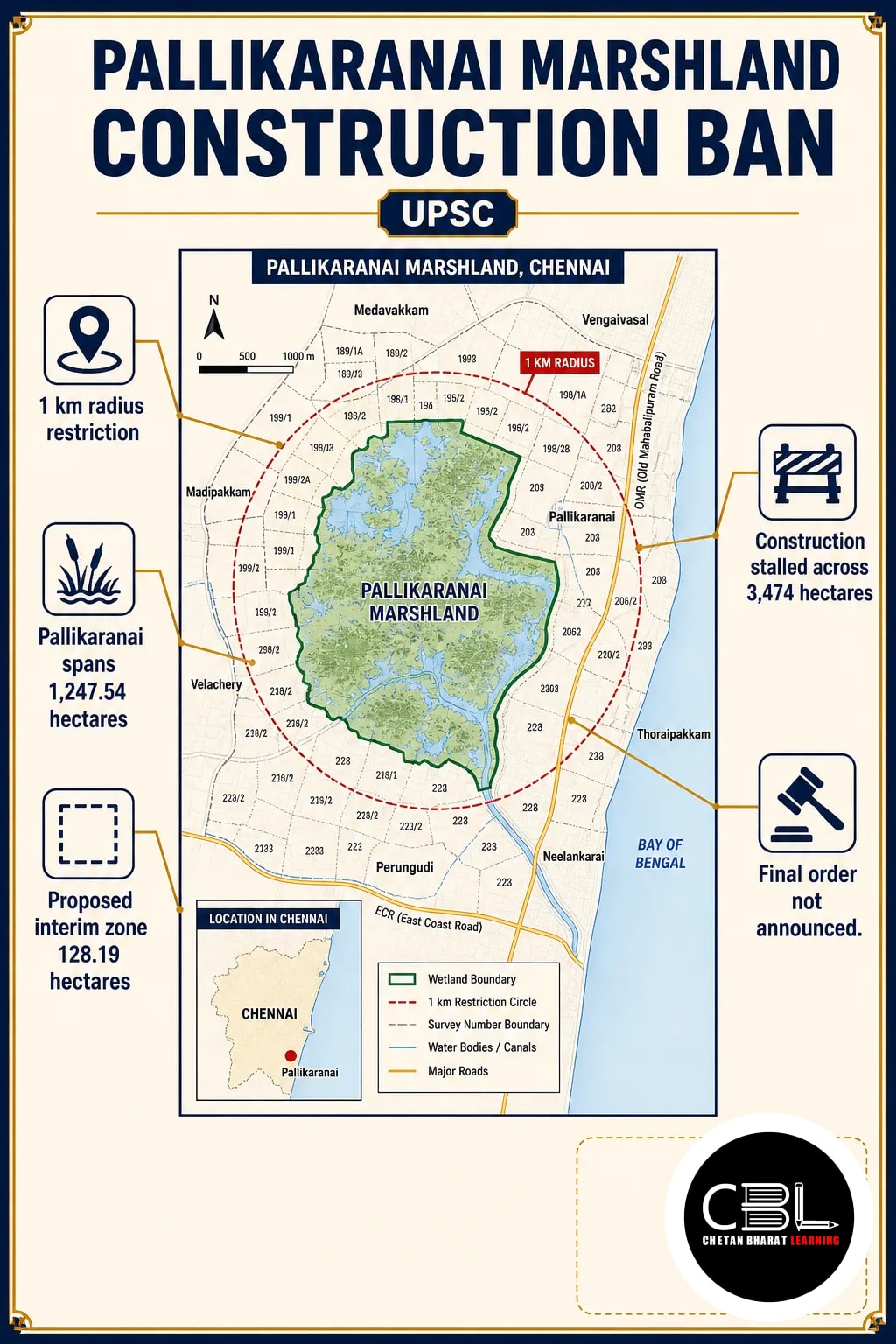
The Pallikaranai marshland construction ban is under judicial scrutiny after the Madras High Court reserved orders on challenges to a one-kilometre restriction. The case connects wetland protection with urban planning, a recurring theme in environment current affairs.
Quick answer: On 11 November 2026, the Madras High Court reserved orders on petitions against the Pallikaranai marshland construction ban. The National Green Tribunal had prohibited new construction within one kilometre of the Chennai wetland. Meanwhile, Tamil Nadu proposed a smaller interim zone with site-specific controls. The court announced no date for its decision.
What did the Madras High Court decide?
The court reserved its orders; it did not announce a final ruling or a date for pronouncing one. The First Division Bench comprised Chief Justice Sushrut Arvind Dharmadhikari and Justice G. Arul Murugan.
The judges questioned whether they could accept a smaller interim Zone of Influence (ZoI) while the Supreme Court was considering the broader protection of wetlands across India. Therefore, neither the tribunal’s authority nor the state’s proposed alternative was finally settled at this hearing.
Why was the Pallikaranai marshland construction ban challenged?
CREDAI-Chennai and other petitioners questioned the National Green Tribunal’s (NGT) authority to impose a blanket restriction around the wetland. The tribunal’s measure concerns new construction within one kilometre of the existing boundaries.
Senior counsel P.S. Raman, representing CREDAI-Chennai, sought to have the restriction set aside and the matter returned to the tribunal for fresh consideration. He argued that the radius was arbitrary and that property owners and realtors faced hardship.
According to counsel, construction had stalled across 3,474 hectares in South Chennai. He also argued that the marshland boundaries remained inconclusive and could shrink after a proper survey. These are the petitioner’s claims, not findings of the court.
Pallikaranai is a Ramsar site spread over 1,247.54 hectares. Its dispute also illustrates the challenge of protecting connected water flows beyond a wetland’s mapped boundary. For related context, see CBL’s coverage of Tamil Nadu’s waterbody restoration portal.
What alternative did Tamil Nadu propose?
The Tamil Nadu State Wetlands Authority (TNSWA) proposed an interim ZoI of 128.19 hectares across 36 survey numbers. Additional Advocate General P.V. Balasubramaniam represented the authority.
Instead of banning construction throughout this proposed zone, the authority suggested regulation based on site-specific scientific and hydrological characteristics. Its proposal remains distinct from both the tribunal’s restriction and the eventual final zone.
| Issue | Authority’s proposed control |
|---|---|
| Water movement | Prohibit obstruction or diversion of established channels, drains and hydrological pathways. |
| Waste and pollution | Prohibit waste dumping on drainage pathways and untreated discharges into connected watercourses. |
| Industry | Prohibit red-category industries with high pollution potential. |
| Construction | Require a no objection certificate from the district-level wetlands management committee under the proposed mechanism. |
The authority also proposed prohibiting permanent alteration of established hydrological connections. Its objective is to protect water flows and ecological character while accommodating development needs.
Which laws and institutions matter?
The dispute brings together wetland rules, environmental adjudication and constitutional responsibilities for conservation.
| Provision or institution | Relevance |
|---|---|
| Wetlands (Conservation and Management) Rules, 2017 | Provide the regulatory framework relevant to wetland management and the proposed final ZoI exercise. |
| National Green Tribunal Act, 2010 | Establishes the NGT for adjudication of specified environmental matters. |
| Article 48A | Directs the state to protect and improve the environment and safeguard forests and wildlife. |
| Article 51A(g) | Makes environmental protection and improvement a fundamental duty of citizens. |
| Ramsar Convention | Provides an international framework for wetland conservation and wise use. |
According to the authority, the final ZoI requires scientific and cadastral exercises, followed by ground truthing under the rules and guidelines. Cadastral work concerns land parcels and their boundaries; ground truthing checks mapped information against conditions on site.
What are the governance challenges?
The central challenge is to protect the wetland’s connected water system while making land-use rules clear and defensible.
- Boundary certainty: Disputed demarcation can affect which properties fall within a distance-based restriction. Therefore, reliable surveys matter to both conservation and affected owners.
- Hydrological connectivity: A channel outside a mapped wetland can influence its water flows. Hence, a parcel-by-parcel approach must examine connections, not merely distance.
- Regulatory design: A uniform prohibition offers a clear rule, whereas site-specific controls can reflect local conditions. However, the latter require consistent scrutiny and enforcement.
- Institutional coordination: Courts, the tribunal, wetland authorities and local bodies have distinct roles. Consequently, clarity about each decision and its legal status is essential.
The issue also relates to urban waterbody restoration. CBL’s coverage of Krishnakanth Park lake restoration provides another example of this broader theme.
What is the way forward?
A defensible final zone should combine accurate boundaries with evidence about water movement and pollution pathways.
- Complete the survey: Scientific mapping, cadastral verification and ground truthing can establish the evidence base for the final ZoI.
- Protect critical connections: In addition, regulators should identify inlet and outlet channels and prevent harmful obstruction or discharge.
- Make decisions transparent: Clear maps, criteria and reasons for construction permissions can help affected parties understand restrictions.
- Monitor compliance: Finally, coordination between wetland authorities and local agencies can support checks on waste, sewage and permitted construction.
These steps are policy options, not the court’s directions. The final position on the Pallikaranai marshland construction ban awaits the High Court’s order.
Source: The Hindu, 12 November 2026
Asked in UPSC: Previous Year Questions
- UPSC CSE Mains 2023 (GS Paper III): Comment on the National Wetland Conservation Programme and name a few Indian wetlands of international importance included in the Ramsar Sites.
UPSC links wetland conservation programmes with the identification of Ramsar sites.
State PCS General Studies can test Ramsar sites, wetland rules and the role of state authorities. In addition, candidates can connect the case to local land-use planning and protection of drainage channels.
Prelims Practice Corner
Mains Practice Questions
Frequently Asked Questions
Has the Madras High Court lifted the Pallikaranai construction ban?
No, the court reserved its orders rather than announcing a final decision. Moreover, it specified no date for pronouncing the orders.
How large is Pallikaranai marshland?
Pallikaranai marshland spans 1,247.54 hectares. It is also a Ramsar site in Chennai, Tamil Nadu.
What is the proposed interim Zone of Influence?
The proposed interim zone covers 128.19 hectares across 36 survey numbers. However, the authority said the final zone requires further scientific and land-survey work.
Did Tamil Nadu propose banning all construction in the interim zone?
No, the authority proposed site-specific regulation instead of a blanket ban throughout the zone. It also proposed a no objection certificate under its regulatory mechanism.
Related Current Affairs
Preparing for UPSC, PCS or HCS?
Talk to a mentor at Chetan Bharat Learning, Chandigarh. Free guidance on choosing the right exam and building a study plan.
Chat on WhatsAppCall 97793 53345UPSC / IAS / PCS coaching in Chandigarh · Trusted by aspirants across Punjab & Haryana









Leave a Reply
You must be logged in to post a comment.