
India’s legacy landfills deadline 2027 extends the time available to clear accumulated urban waste. The shift also raises questions about municipal capacity and environmental monitoring. Explore more environment current affairs for UPSC.
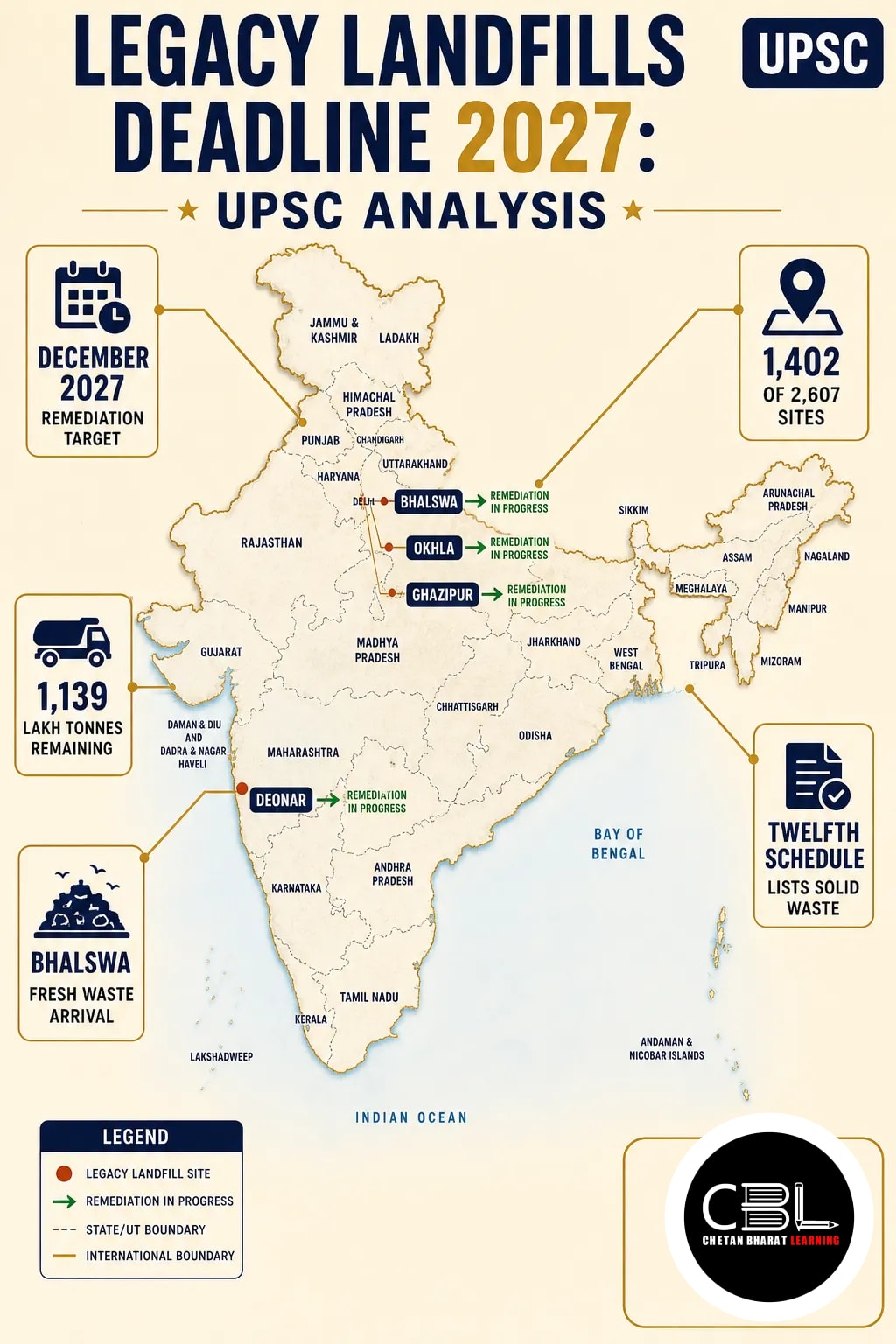
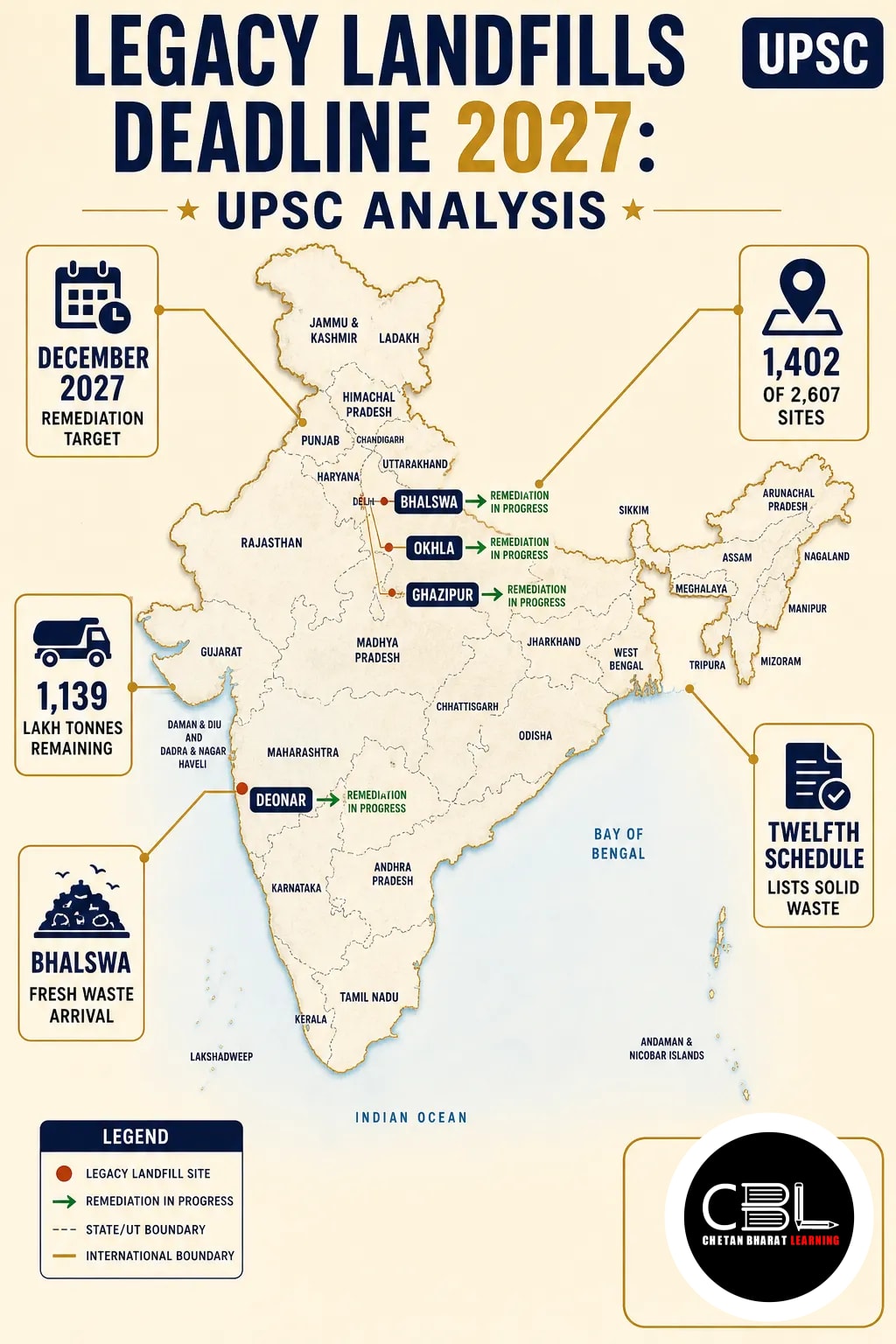
Quick answer: The Centre has pushed the legacy landfills deadline 2027 to December for urban dumpsites across India. According to the mission dashboard, 1,139 lakh tonnes of waste across 4,632 acres remained. Meanwhile, the Swachh Bharat Mission-Urban 2.0 itself has been extended only until March 2027.
What is the legacy landfills deadline 2027?
The revised target is to remediate all legacy urban dumpsites by December 2027. Legacy waste is waste accumulated at a site over time, often in mixed and unprocessed form. Remediation addresses this stockpile through assessment, processing and safe management of the material and site.
Swachh Bharat Mission-Urban 2.0 began in 2021 with a five-year plan to remove legacy dumpsites. The Ministry of Housing and Urban Affairs originally planned completion within that mission period, which was to end on 1 October 2026. For background, see the mission’s urban sanitation framework.
The mission has now been extended to March 2027, but the landfill target runs until December 2027. Officials expect most remaining sites to be cleared by March; some will need additional time. Thus, the two dates should not be treated as the same deadline.
How much legacy waste remains?
The mission dashboard shows substantial progress, but a large stockpile remains across urban sites. The figures below represent the dashboard position cited in the report, not a forecast for the new deadline.
| Indicator | Dashboard position |
|---|---|
| Total dumpsites | 2,607 |
| Completely remediated sites | 1,402 |
| Sites with work ongoing | 1,057 |
| Sites with no progress shown | 148 |
| Total recorded waste and area | 3,135 lakh tonnes across 15,545.05 acres |
| Waste remediated and area reclaimed | 64% of waste and 70% of area |
| Waste and area remaining | 1,139 lakh tonnes across 4,632 acres |
Site counts alone do not show the scale of the remaining work: dumpsites can differ greatly in size. In addition, waste quantity and reclaimed area measure different outcomes and should be read separately.
What do Delhi and Mumbai reveal?
Large dumpsites show why local conditions matter for the national target. At Bhalswa in Delhi, Urban Affairs Minister Manohar Lal said legacy waste work would finish by 31 December. However, fresh waste continued to arrive and would be processed separately.
The minister said Okhla was almost clear, while Ghazipur would take another year. He also identified Chennai and Mumbai as difficult locations among large cities. Meanwhile, Mumbai authorities began trials to remove waste from Deonar, an old and large legacy dumpsite.
The Centre’s Dumpsite Remediation Accelerator Programme targeted 214 sites in the preceding year. At its launch, those sites accounted for 80% of waste then awaiting remediation. Therefore, concentrating effort on large stockpiles can matter more than site counts alone suggest.
Why is landfill remediation difficult?
Municipalities must manage old deposits while preventing fresh waste from creating another backlog. The issues are operational as well as environmental:
- Mixed legacy waste: Old deposits can contain different materials, so assessment and segregation must precede suitable treatment or disposal.
- Continuing inflows: Bhalswa illustrates how fresh waste can reach a site even during clearance. Consequently, old-waste remediation needs a separate daily waste-management system.
- Pollution pathways: Leachate is liquid that drains through waste and can carry contaminants. Therefore, groundwater and surface-water protection require attention; see landfill leachate and pollution control.
- Safe handling: Excavation and transport can expose workers and nearby residents to dust and other hazards. Thus, protective equipment, site controls and monitoring matter.
- End-use of land: Removing visible waste alone does not establish that a site is safe for every future use. Soil and water assessments should inform reclamation decisions.
What policy framework supports urban waste management?
Urban local bodies have a central role in waste collection, processing and disposal, while national rules provide a regulatory framework. The Solid Waste Management Rules, 2016 address segregation, processing and management of waste, including old dumpsites.
The Constitution’s Twelfth Schedule lists solid waste management among functions that states may entrust to municipalities. However, effective delivery depends on state legislation, local institutions and resources. The mission provides a programme framework; the rules and municipal responsibilities address the wider waste system.
How can cities prevent another legacy waste backlog?
Cities need to link time-bound dumpsite remediation with reliable management of fresh waste. The legacy landfills deadline 2027 provides a target, but lasting results also depend on the quality of processing and site restoration.
- Plan site-wise: Survey waste volumes and composition, and publish milestones for large and stalled sites. In addition, distinguish waste processed from land verified as safe for reuse.
- Manage fresh waste: Strengthen segregation at source, collection and suitable processing capacity. Consequently, less mixed waste should reach disposal sites.
- Track environmental outcomes: Monitor leachate, groundwater and soil during and after remediation. Moreover, disclose results to communities near dumpsites.
- Protect workers: Provide protective equipment and safer handling procedures. Also, involve workers and waste pickers in planning transitions to improved systems.
- Coordinate institutions: Align municipal operations, state oversight and central programme support. Finally, use site-specific reviews rather than relying solely on aggregate national percentages.
Overall, a cleared dumpsite and a functioning municipal waste system are complementary goals. Therefore, the quality of remediation and the prevention of new dumping are both relevant measures of success.
Source: The Indian Express, 12 November 2026
- Landfill Leachate: Groundwater Pollution and Control (28 Oct 2026)
- Swachh Bharat Mission (SBM) 2.0 Urban (1 Oct 2024)
Asked in UPSC: Previous Year Questions
- UPSC CSE Mains 2026 (GS Paper III): Discuss solid waste management challenges, the government policy framework, and successes or failures of initiatives in Delhi and Indore.
- UPSC CSE Mains 2018 (GS Paper III): What impedes disposal of continuously generated solid waste, and how can accumulated toxic waste be safely removed from inhabited environments?
UPSC connects waste-management challenges with policy frameworks, safe disposal and city-level examples.
Punjab PCS and Haryana HCS can test municipal responsibilities for waste segregation, processing and dumpsite remediation. In addition, candidates should connect local governance with groundwater protection and the Twelfth Schedule.
Prelims Practice Corner
Mains Practice Questions
Frequently Asked Questions
What is the new deadline for legacy landfill remediation?
December 2027 is the revised target for all legacy urban dumpsites. Meanwhile, officials expect most remaining sites to be cleared by March 2027.
How much legacy waste remains to be remediated?
1,139 lakh tonnes remained, according to the dashboard cited in the report. In addition, the remaining waste covered 4,632 acres.
What is landfill leachate?
Landfill leachate is liquid that drains through waste and can carry contaminants. Therefore, controlling it is important for protecting water resources.
Is the mission extension the same as the landfill deadline?
No, the mission extension ends in March 2027, while the landfill target is December 2027. Thus, some remediation is expected to continue beyond the extended mission period.
Related Current Affairs
Preparing for UPSC, PCS or HCS?
Talk to a mentor at Chetan Bharat Learning, Chandigarh. Free guidance on choosing the right exam and building a study plan.
Chat on WhatsAppCall 97793 53345UPSC / IAS / PCS coaching in Chandigarh · Trusted by aspirants across Punjab & Haryana









Leave a Reply
You must be logged in to post a comment.