

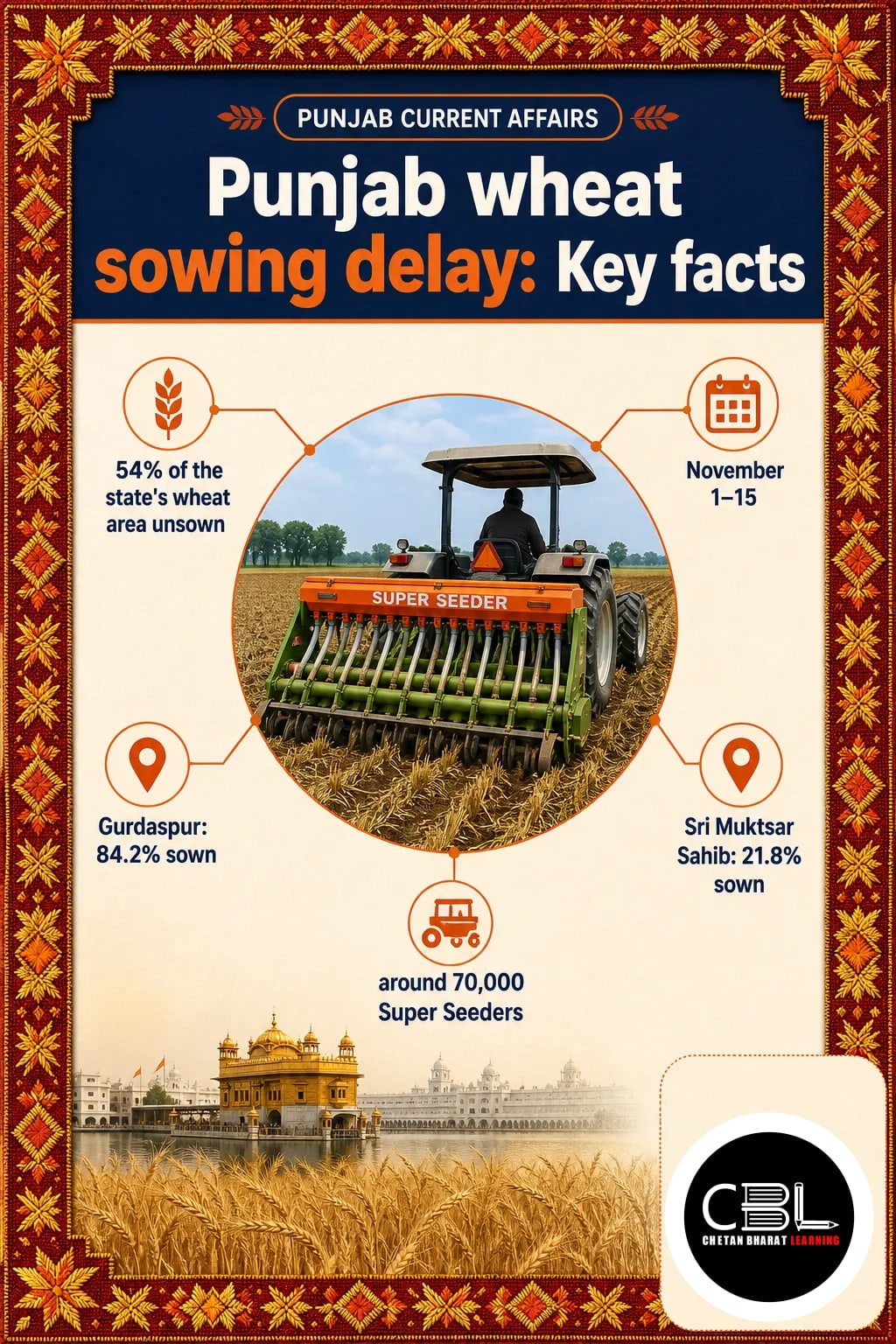
Punjab wheat sowing delay has left about 54% of the state’s wheat area unsown as farmers prepare harvested paddy fields. The narrowing window also puts pressure on residue management. For more state exam updates, visit Punjab current affairs.
Quick answer: Punjab wheat sowing delay has left about 54% of the state’s wheat area unsown, despite 94% of paddy harvesting being completed. The recommended wheat sowing window is November 1–15. Gurdaspur recorded 84.2% sowing, while Sri Muktsar Sahib recorded 21.8%. Farmers face pressure to clear paddy residue quickly.
| Point | Details |
|---|---|
| Recommended window | November 1–15 |
| Wheat sown | 46.1%, or 16 lakh hectares |
| Highest sowing progress | Gurdaspur: 84.2% sown |
| Lowest sowing progress | Sri Muktsar Sahib: 21.8% sown |
| Farm fires | 4,657 between September 15 and November 9 |
Why is wheat sowing delayed in Punjab?
Farmers must prepare harvested paddy fields for wheat while the recommended sowing window is narrowing. Although 94% of paddy harvesting was complete, many harvested fields still had residue to clear. A late sowing can affect crop yield.
The reported wheat area is approximately 34.5 to 35 lakh hectares. Of this, 16 lakh hectares, or 46.1%, had been sown. Farmers often start on October 26–27; therefore, they have more time to finish within the recommended period.
Progress also varies across districts. Gurdaspur led with 84.2%, followed by Malerkotla at 74.5% and Patiala at 69.9%. Meanwhile, Sri Muktsar Sahib had reached 21.8%, followed by Bathinda at 23.7% and Fazilka at 25.3%.
How is the delay linked to farm fires?
The Punjab wheat sowing delay increases pressure to clear paddy residue quickly, either using machines or by burning it. Punjab recorded 4,657 farm fires between September 15 and November 9. Of these, 4,076 occurred from October 26 to November 9.
The highest single-day count was 1,152 fires on November 8. Thus, fires intensified during the period when farmers were preparing fields for wheat. The report also notes that machine access, timely availability and operating costs affect residue management choices.
How can a Super Seeder manage paddy residue?
A Super Seeder cuts and incorporates standing paddy residue into the soil while preparing the field and sowing wheat. Punjab has more than 1.25 lakh crop-residue management machines, including around 70,000 Super Seeders. One machine can cover approximately seven to eight acres a day.
However, machine availability does not guarantee effective use. Farmers have cited operating costs and local shortages as barriers. Therefore, timely access to machinery matters when the sowing window is short.
- Wheat: Wheat is a rabi crop, generally grown during the winter season.
- Paddy: Paddy is a major kharif crop, generally grown during the monsoon season.
- District headquarters: Gurdaspur town is the headquarters of Gurdaspur district.
Source: Indian Express Chandigarh, 12 November 2026
Prelims Practice Corner
Frequently Asked Questions
How much of Punjab’s wheat area remains unsown?
About 54% remains unsown. The reported sown area is 16 lakh hectares, or 46.1% of the total wheat area.
Which Punjab district had the lowest reported wheat sowing progress?
Sri Muktsar Sahib had the lowest reported progress at 21.8%. Bathinda followed at 23.7%.
What does a Super Seeder do?
A Super Seeder incorporates standing paddy residue into the soil while preparing the field and sowing wheat. One machine can cover approximately seven to eight acres a day.
Related Current Affairs
Preparing for UPSC, PCS or HCS?
Talk to a mentor at Chetan Bharat Learning, Chandigarh. Free guidance on choosing the right exam and building a study plan.
Chat on WhatsAppCall 97793 53345UPSC / IAS / PCS coaching in Chandigarh · Trusted by aspirants across Punjab & Haryana









Leave a Reply
You must be logged in to post a comment.