
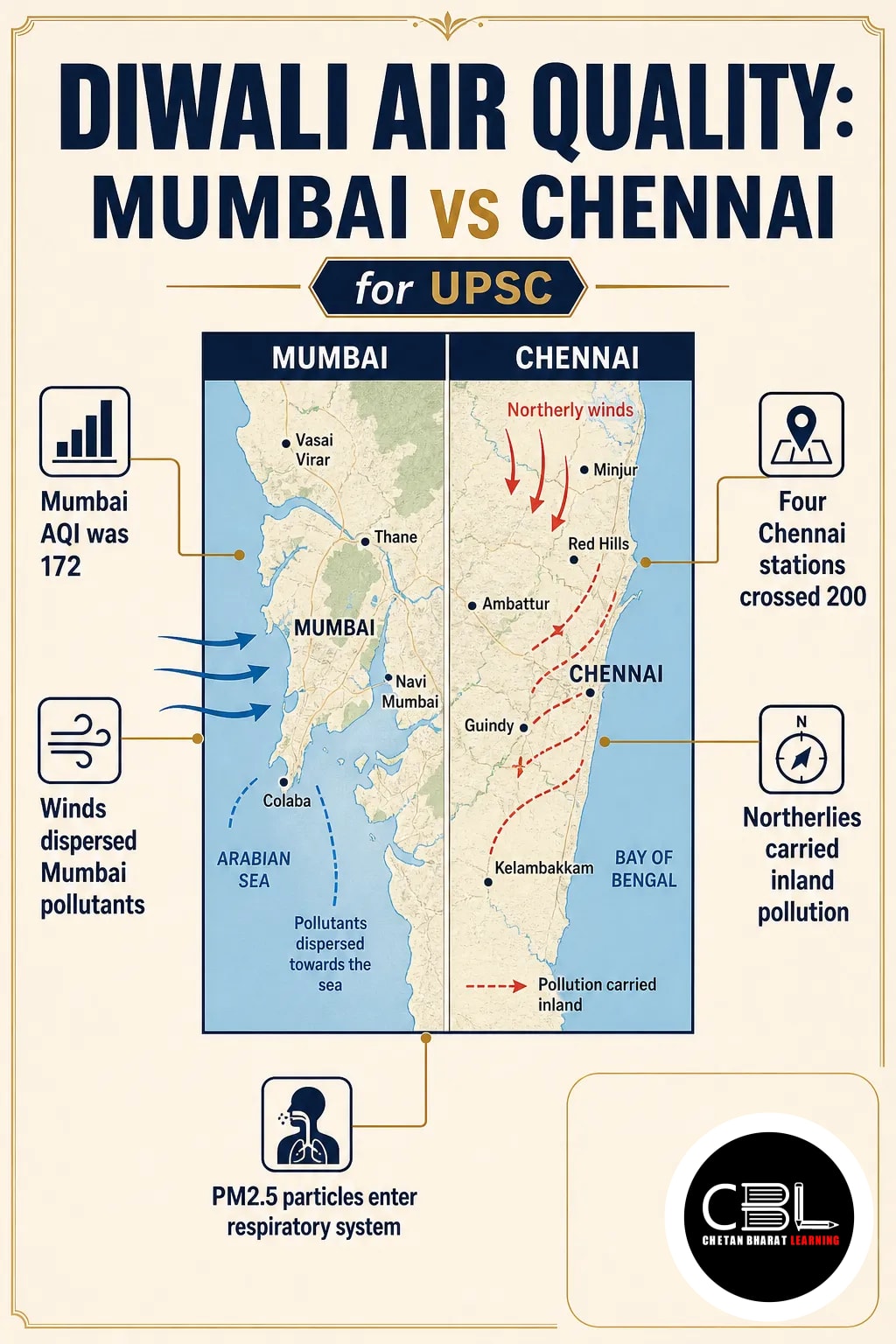
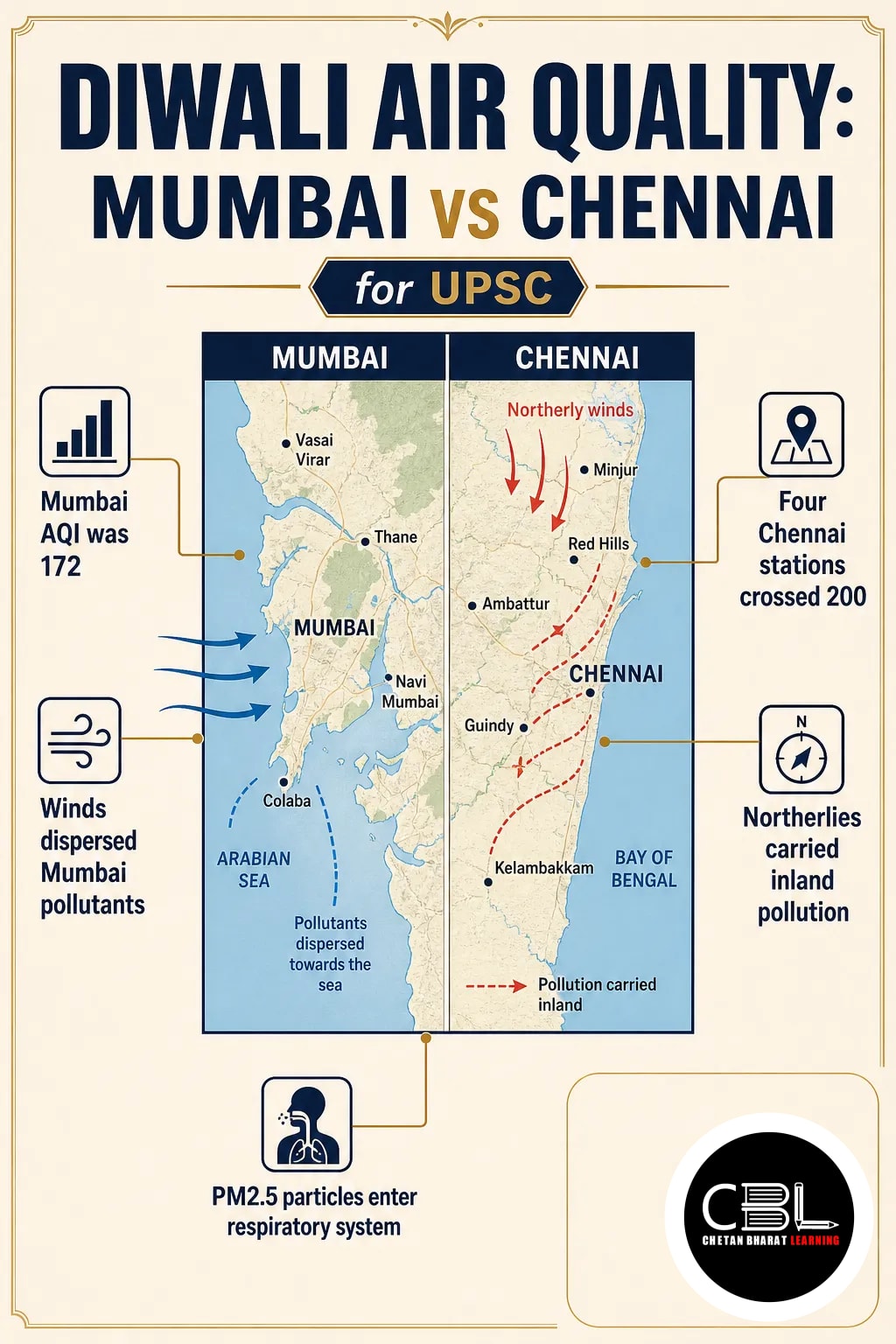
Diwali air quality differed sharply in Mumbai and Chennai despite both cities being coastal. The contrast shows why weather and geography matter to air pollution alongside emissions.
Quick answer: After Diwali, Mumbai recorded an Air Quality Index (AQI) of 172, in the moderate category. Chennai had poor air through Monday morning, with four of seven operational stations above 200. Winds helped disperse Mumbai’s pollutants, while northerlies carried additional pollution towards Chennai from inland areas.
Where did air quality differ after Diwali?
Mumbai recorded moderate air, whereas Chennai experienced poor air through Monday morning. Several Maharashtra cities also recorded poor or very poor conditions.
| Place | Observation and geographical context |
|---|---|
| Mumbai | AQI 172; Arabian Sea lies to its west. |
| Chennai | Four of seven operational stations exceeded 200; the Bay of Bengal lies to its east. |
| Maharashtra cities | Thirteen recorded poor or very poor air, including Pune, Nagpur and Chandrapur. |
The Mumbai figure is a city AQI, while the Chennai figures describe individual stations. Therefore, they should not be presented as directly equivalent citywide readings.
Why did winds affect the two cities differently?
Wind direction changed whether air carried pollution away from a city or towards it. Coastal location alone did not guarantee cleaner air.
Mumbai: dispersion towards the sea
Mumbai is surrounded by the sea on three sides. Consequently, alternating land and sea breezes can help disperse pollutants near the ground.
The report also attributes easterly winds along western India to an anticyclonic circulation over the Himalayas. These winds moved from the mainland towards the sea and helped disperse Mumbai’s suspended pollution. Alongside Mumbai, eight other cities in the Mumbai Metropolitan Region remained in the moderate category despite heavy firecracker use.
Chennai: pollution arriving from inland
Chennai faces the Bay of Bengal to its east, so easterlies can bring air from the sea. However, strong northerlies instead arrived from inland Andhra Pradesh and northern Tamil Nadu.
These winds carried pollution from industrial and urban centres. In addition, firecracker emissions remained suspended in the lower atmosphere. Experts expected Bay of Bengal easterlies to improve dispersion, but that was a forecast rather than an observed outcome.
Why did Maharashtra cities record poor air?
The report links the poorer readings to limited ventilation, industrial emissions and firecracker smoke. Unlike Mumbai, these cities did not benefit from the same coastal winds.
Among the 13 affected cities were Pimpri Chinchwad, Nanded, Pune, Malegaon, Nagpur, Jalna, Parbhani, Jalgaon, Nashik, Akola, Belapur, Chhatrapati Sambhajinagar and Chandrapur. The report connects persistent heat and deficient rainfall since October with El Niño conditions; it also links the heat to disrupted wind reversal and longer pollutant retention.
Industrial activity adds another layer to the problem. For example, Pune and Pimpri Chinchwad have automobile, pharmaceutical and heavy engineering industries. Nagpur has steel, engineering and power activities, while Chandrapur has thermal power plants and mining. Jalna has agro-processing and manufacturing.
What makes fine particles a public-health concern?
Fine particles can enter the respiratory system, making exposure a health concern. Firecrackers release particulate matter with a diameter of 2.5 micrometres or less, known as PM2.5.
Smoke from a short-lived event can combine with pollution from continuing sources. Moreover, weak dispersion can prolong exposure even after emissions decline. An AQI condenses air-quality information into a public-facing measure, but station readings remain important for identifying local variation.
For a related urban comparison, see the Delhi air pollution analysis. The examples should be compared by pollutant sources and weather, not by assuming identical local conditions.
What does the comparison mean for pollution control?
Effective control must reduce emissions while accounting for local weather and pollution transported across boundaries.
- Festival emissions: Firecracker smoke is a short-duration addition to existing pollution; therefore, planning should begin before high-exposure periods.
- Continuous sources: Industrial and other urban emissions require sustained attention, since better winds alone do not eliminate emissions.
- Regional coordination: Winds can carry pollution across administrative boundaries; consequently, neighbouring jurisdictions need shared monitoring and response.
- Local information: Station-level data can reveal differences within a city; moreover, public advisories can reflect changing conditions.
Enforcement of applicable firecracker restrictions forms one part of prevention. For legal context, see the Supreme Court green firecrackers order.
Ultimately, Diwali air quality reflects both emissions and the atmosphere’s capacity to disperse them. A moderate reading during favourable winds should not substitute for year-round source control.
Source: The Indian Express, 10 November 2026
Punjab PCS and Haryana HCS may test the relationship between emissions, wind direction and regional air quality. Therefore, connect local pollution-control measures with coordination across state boundaries, without assuming that coastal wind patterns apply inland.
Prelims Practice Corner
Mains Practice Questions
Frequently Asked Questions
What was Mumbai’s AQI after Diwali?
Mumbai’s AQI was 172, in the moderate category. The report links the reading partly to winds that dispersed pollutants.
Why was Chennai’s air poor despite its coastal location?
Northerly winds carried pollution from inland areas towards Chennai. Meanwhile, firecracker emissions remained suspended in the lower atmosphere.
What is PM2.5?
PM2.5 means particulate matter measuring 2.5 micrometres or less in diameter. Firecrackers release these particles, which can enter the respiratory system.
Can winds alone solve urban air pollution?
No, because winds disperse or transport pollution rather than eliminate its sources. Therefore, cities also need sustained emission control and monitoring.
Related Current Affairs
Preparing for UPSC, PCS or HCS?
Talk to a mentor at Chetan Bharat Learning, Chandigarh. Free guidance on choosing the right exam and building a study plan.
Chat on WhatsAppCall 97793 53345UPSC / IAS / PCS coaching in Chandigarh · Trusted by aspirants across Punjab & Haryana

 Ananya RanaIAS · AIR 60
 Aditya SharmaIAS · AIR 70
 Ria Kaur SethiIPS · AIR 89
 Aman AloonIRS · AIR 295
 Sumer Singh VirkIRS · AIR 335
 Shivani PanchalIAS

Leave a Reply
You must be logged in to post a comment.