
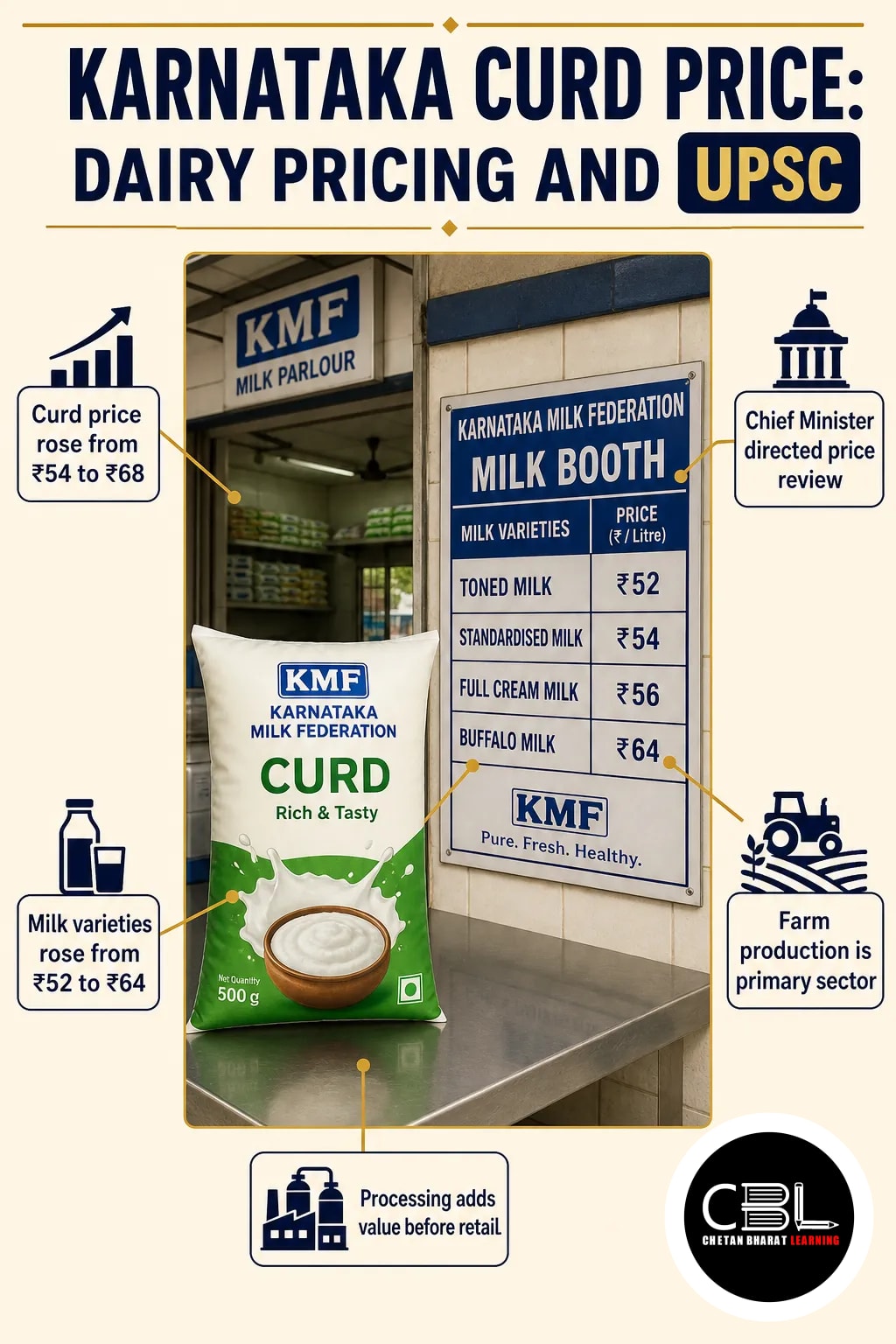
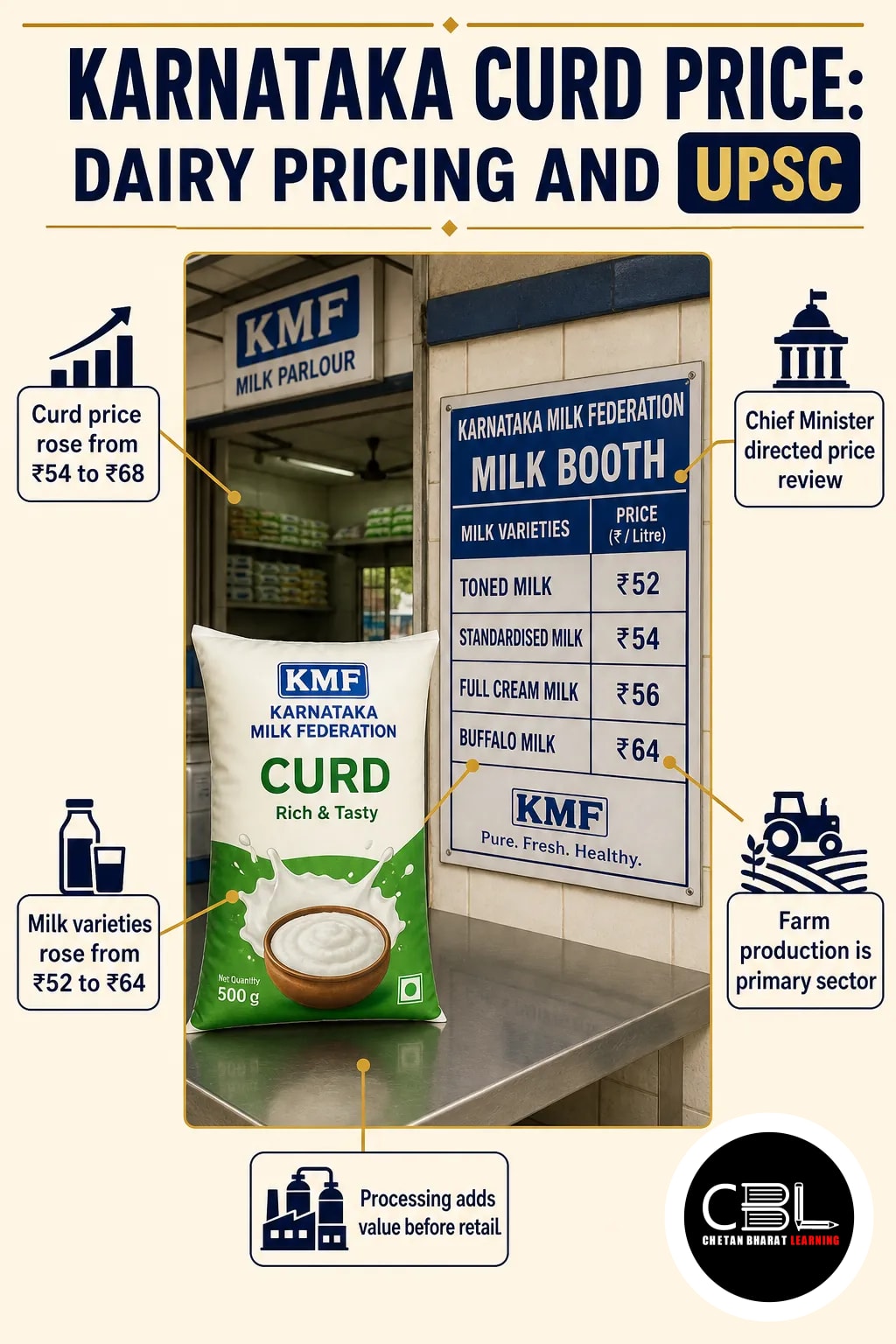
Karnataka curd price became a public issue after a sharp increase prompted calls for a review. The dispute highlights producer incomes and consumer affordability, central themes in economy current affairs.
Quick answer: On 2 November 2026, Karnataka Chief Minister D.K. Shivakumar directed the Karnataka Milk Federation to reduce curd prices after public and hotelier protests. The Karnataka curd price had risen from ₹54 to ₹68 per litre on 1 November. The federation is reworking prices; a revised rate has not yet been announced.
What happened to dairy prices in Karnataka?
Curd and selected milk varieties became costlier from 1 November 2026. Following criticism, the Chief Minister asked the Karnataka Milk Federation (KMF) to rework the curd price.
The direction covers curd; the source does not announce a corresponding milk price reduction. Moreover, KMF said it would release the revised curd prices soon, without specifying the new rate.
| Item | Price change |
|---|---|
| Curd, one litre | ₹54 to ₹68; increase of ₹14 |
| Shubham and special toned milk, per litre | ₹52 to ₹64; increase of ₹12 |
| Coffee, tea and milk at some city hotels | Increase of ₹2 to ₹3 |
The curd increase is approximately 25.9% over its earlier price. By comparison, the listed milk increase is approximately 23.1%; these calculations use the old prices as the base.
Why did the price rise draw criticism?
Hoteliers and members of the public questioned the size of the curd increase. In particular, the Bangalore Hotels Association challenged the difference between the curd increase and an ₹8-per-litre milk increase it understood as support for farmers.
Association honorary president P.C. Rao argued that applying an ₹8 increase to the earlier ₹54 curd price would yield ₹62. Therefore, he sought an explanation for the additional ₹6 in the ₹68 price and asked whether farmers or KMF would receive it.
Rao also said the curd increase added 15% to hotel expenditure. This is the association representative’s estimate, not an independently established figure for every hotel.
How does a dairy price reach the consumer?
The retail price must account for procurement and activities that move milk or curd to buyers. Thus, a change in the price paid to a farmer need not equal the change in a processed product’s retail price.
KMF sources cited milk purchase expenditure, fat content and other factors. The Chief Minister said higher-fat milk costs more and that officials would explain differences between milk categories.
A KMF official also cited imported bacterial culture, refrigeration electricity, fuel and margins for Nandini booth vendors. However, the source does not provide a product-wise cost breakdown or show how much of the increase reaches farmers.
For examination purposes, distinguish farm production from processing and retail. Dairy farming belongs to the primary sector; processing adds value, while retail connects products to consumers.
What are the policy implications?
The Karnataka curd price dispute exposes a trade-off between viable farm returns and affordable dairy products. A price review must also consider the costs of processing and distribution.
- Farm incomes: The Chief Minister said the milk price increase would support 11 lakh farming families. However, the available account does not quantify the benefit per family.
- Household affordability: A higher curd price directly raises expenditure for households that purchase it. Therefore, affordability matters alongside producer returns.
- Food-service costs: Hotels use curd in meals, buttermilk and other dishes. Consequently, a sustained input increase can pressure their margins or selling prices.
- Price transmission: Some city hotels raised prices of coffee, tea and milk by ₹2 to ₹3. However, this does not establish the effect on every outlet or product.
- Public confidence: Unexplained differences between product increases can weaken trust. Thus, a clear cost explanation is important for a cooperative selling essential food products.
What should the price review address?
The review should explain how each major cost contributes to the final price. It should also clarify the share intended for milk producers and the basis for differences across products.
First, KMF could publish separate explanations for milk procurement, processing, refrigeration and vendor margins. Moreover, it could identify which costs have changed and whether the proposed reduction affects farmer payments.
Second, consultation with producer representatives, consumers and hotels could clarify competing concerns before a revised rate takes effect. Finally, periodic disclosure of prices and costs would allow scrutiny without assuming that every product has the same cost structure.
The immediate test remains the announced curd rate, which KMF had not released in the source account. Therefore, the direction to reduce prices should not be treated as a completed reduction.
Source: The Hindu, 3 November 2026
Asked in UPSC: Previous Year Questions
- UPSC CSE Prelims 2024 (GS Paper I): How many sector–activity pairs are correctly matched: secondary–agricultural storage, primary–dairy farm, tertiary–mineral exploration, and secondary–weaving cloth?
UPSC tests the classification of dairy farming within the economy, so distinguish production from processing and retail.
State PCS General Studies may test dairy cooperatives, procurement costs and the distinction between farm and retail prices. In addition, candidates should examine how state-level decisions balance producer returns with consumer affordability.
Prelims Practice Corner
Mains Practice Questions
Frequently Asked Questions
What was the Karnataka curd price increase?
The price rose by ₹14 per litre, from ₹54 to ₹68, on 1 November 2026. This represents an increase of approximately 25.9% over the earlier price.
Has a lower curd price been announced?
No, the source does not give a revised rate. However, KMF said it was reworking prices following the Chief Minister’s direction.
Why did KMF cite higher costs for curd?
KMF cited procurement and processing-related expenses, including imported culture and refrigeration. In addition, an official mentioned fuel costs, vendor margins and farmer viability.
Why does the dairy price review matter for UPSC?
It illustrates the balance between farmer returns, processing costs and consumer prices. Moreover, it helps candidates distinguish primary production from processing and retail.
Related Current Affairs
Preparing for UPSC, PCS or HCS?
Talk to a mentor at Chetan Bharat Learning, Chandigarh. Free guidance on choosing the right exam and building a study plan.
Chat on WhatsAppCall 97793 53345UPSC / IAS / PCS coaching in Chandigarh · Trusted by aspirants across Punjab & Haryana

 Ananya RanaIAS · AIR 60
 Aditya SharmaIAS · AIR 70
 Ria Kaur SethiIPS · AIR 89
 Aman AloonIRS · AIR 295
 Sumer Singh VirkIRS · AIR 335
 Shivani PanchalIAS

Leave a Reply
You must be logged in to post a comment.