
UPSC Syllabus Mapping
- GS Paper: GS-II (International Relations) & GS-III (Infrastructure and Trade)
- Subject: India-Iran Relations, Connectivity, Maritime Security
- Prelims: Chabahar Port, INSTC, Strait of Hormuz, Gwadar Port
- Mains: Strategic connectivity, Regional geopolitics, Energy security
Article
Chabahar Port has returned to the spotlight after escalating US-Iran tensions raised uncertainty over India’s long-term investment and operational plans at the Iranian port. The developments have renewed concerns about India’s connectivity strategy to Afghanistan, Central Asia and Europe through the International North-South Transport Corridor (INSTC).
Why in News?
- Escalation in US-Iran tensions has increased uncertainty surrounding Chabahar Port operations.
- Sanctions and geopolitical instability may affect India’s long-term investment plans.
- The issue has strategic implications for India’s regional connectivity and trade.
What is Chabahar Port?
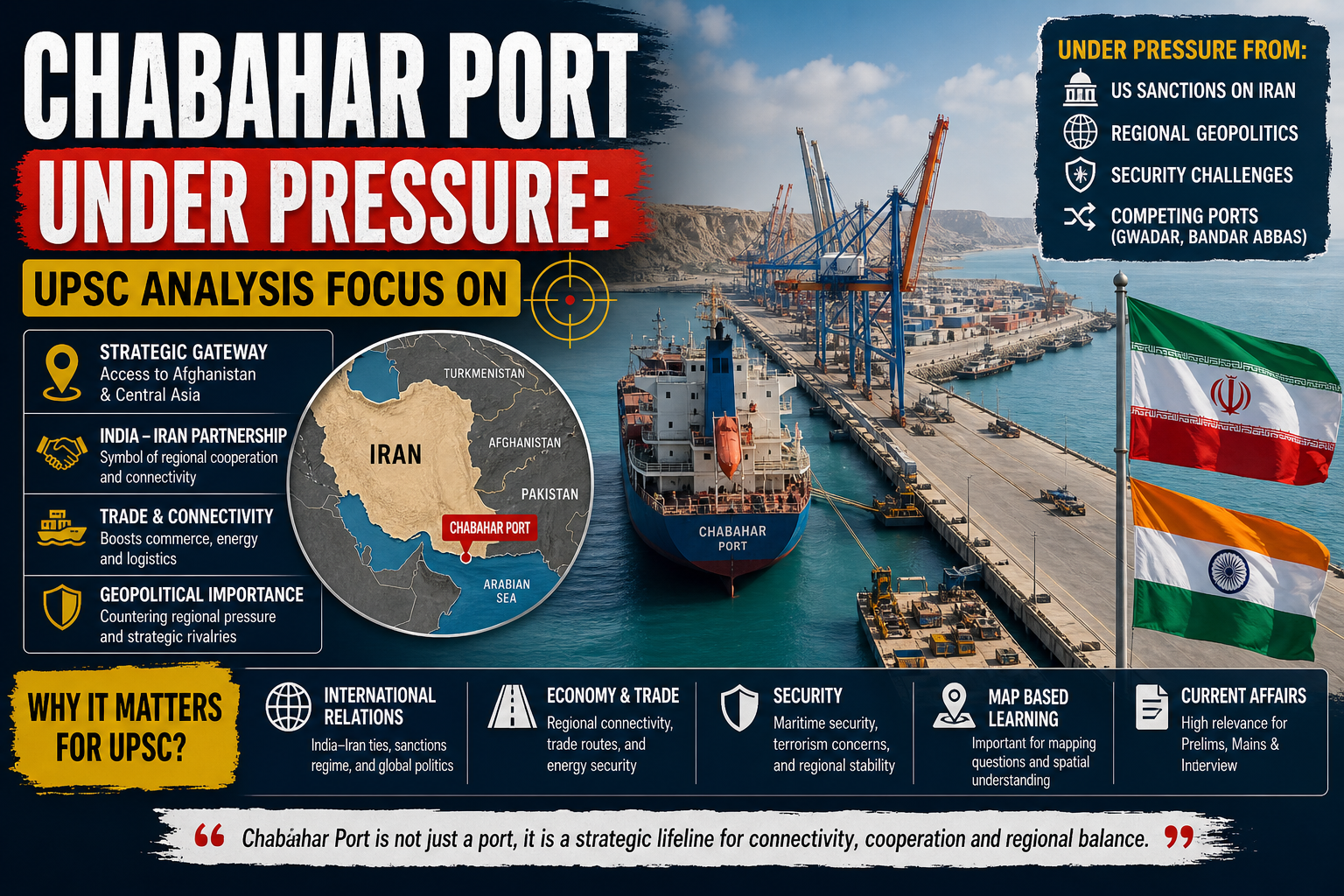
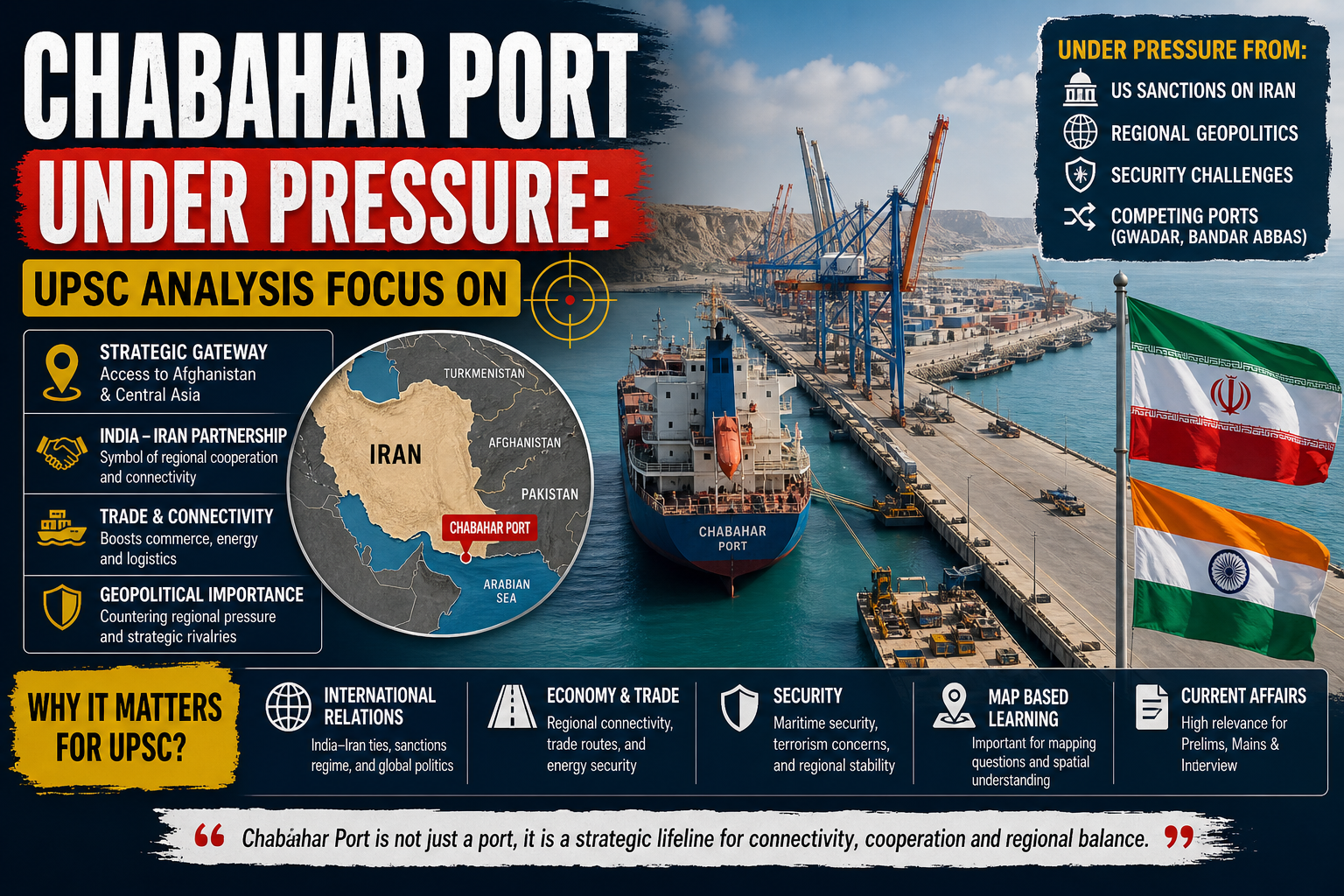
Chabahar is Iran’s only ocean-facing port located on the Gulf of Oman, outside the Strait of Hormuz. India is developing the Shahid Beheshti Terminal through India Ports Global Limited (IPGL). The port provides India direct access to Afghanistan and Central Asia while bypassing Pakistan.
Strategic Importance for India
- Access to Afghanistan: Enables trade without relying on Pakistan.
- Gateway to Central Asia: Supports commerce with resource-rich Central Asian countries.
- Counter to Gwadar Port: Offers a strategic alternative to China’s Gwadar Port under the China-Pakistan Economic Corridor (CPEC).
- INSTC Connectivity: Forms an important node in the International North-South Transport Corridor linking India with Iran, the Caucasus, Russia and Europe.
- Energy Security: Strengthens India’s maritime and trade outreach in West Asia.
Key Concepts for UPSC
| Term | Meaning |
|---|---|
| Chabahar Port | Iran’s ocean-facing commercial port developed with Indian participation. |
| Gwadar Port | Pakistan’s deep-sea port developed by China under CPEC. |
| INSTC | A multimodal transport corridor connecting India with Iran, Russia and Europe. |
| Strait of Hormuz | One of the world’s most important oil shipping chokepoints. |
Challenges Facing the Project
- US sanctions on Iran create uncertainty for investments and financial transactions.
- Escalating regional conflict affects operational stability.
- Insurance, shipping and logistics costs may increase.
- Private companies may hesitate due to sanctions risks.
- Potential disruptions to the global supply chain.
Way Forward
- Continue diplomatic engagement with all stakeholders.
- Strengthen the INSTC as a diversified trade corridor.
- Develop resilient financing and logistics mechanisms.
- Promote strategic autonomy while complying with international obligations.
- Expand maritime partnerships to secure regional connectivity.
Prelims Practice Corner
- Q1. Chabahar Port is located in: A. Pakistan B. Iran C. Oman D. UAE
Ans: B. Chabahar is located on Iran’s southeastern coast. - Q2. Chabahar Port provides India direct access to: A. China B. Afghanistan and Central Asia C. Australia D. Japan
Ans: B. - Q3. Which corridor connects India with Russia through Iran? A. IMEC B. CPEC C. INSTC D. BCIM
Ans: C. - Q4. Gwadar Port has been developed primarily by: A. India B. Russia C. China D. Japan
Ans: C. - Q5. The Strait of Hormuz is strategically important because: A. It is a major global oil shipping route. B. It is the deepest ocean trench. C. It connects the Atlantic and Pacific Oceans. D. It is located in the Arctic.
Ans: A.
Mains Practice Questions & Answer Structure
Q1. Discuss the strategic importance of Chabahar Port in India’s connectivity and foreign policy.
- Introduction: India’s maritime vision.
- Body: Afghanistan access, Central Asia, INSTC, energy security, balancing China.
- Conclusion: Strategic autonomy through diversified connectivity.
Q2. Evaluate how geopolitical conflicts and sanctions influence India’s connectivity projects in West Asia.
- Introduction: Geopolitics and infrastructure.
- Body: Sanctions, trade, logistics, diplomacy, regional stability.
- Way Forward: Diversification and multilateral engagement.
FAQs
Why is Chabahar Port important for India?
It provides strategic access to Afghanistan and Central Asia while bypassing Pakistan and strengthens India’s regional connectivity.
How is Chabahar different from Gwadar?
Chabahar is developed with Indian participation in Iran, whereas Gwadar is developed by China in Pakistan under CPEC.
Why is this topic important for UPSC?
It links International Relations, maritime security, regional geopolitics, trade corridors and India’s strategic interests, making it highly relevant for Prelims and GS-II Mains.
Related Current Affairs
Preparing for UPSC, PCS or HCS?
Talk to a mentor at Chetan Bharat Learning, Chandigarh. Free guidance on choosing the right exam and building a study plan.
Chat on WhatsAppCall 97793 53345UPSC / IAS / PCS coaching in Chandigarh · Trusted by aspirants across Punjab & Haryana
Leave a Reply
You must be logged in to post a comment.