
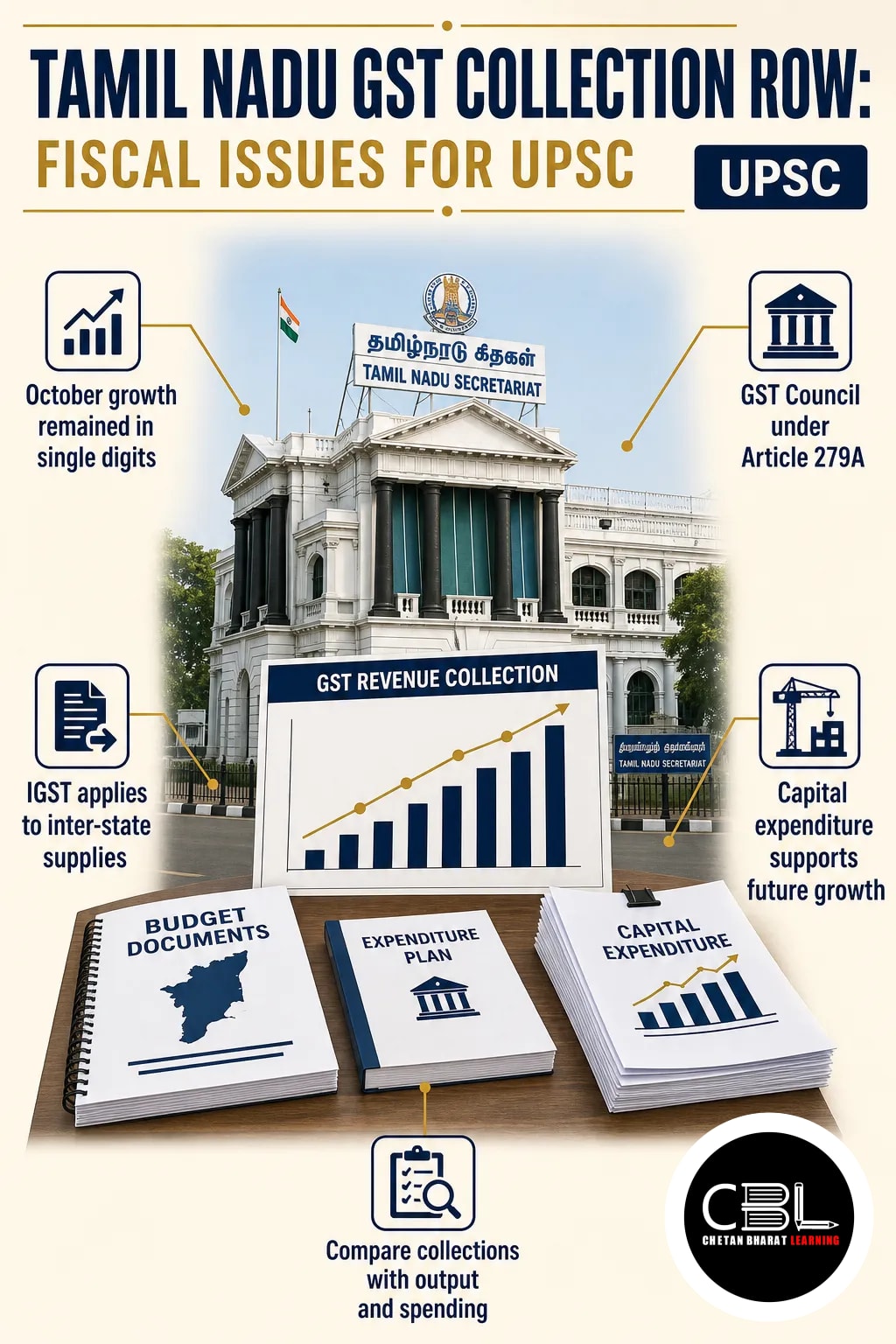

Tamil Nadu GST collection has become the subject of a political debate over revenue and public spending. The issue connects with wider questions of state finances and economic policy.
Quick answer: On 2 November 2026, former BJP leader K. Annamalai questioned Tamil Nadu GST collection over the preceding six months. He said October growth remained in single digits after several months of decline. He also called for monitoring departmental capital expenditure, linking government investment with economic activity and revenue generation.
Why is Tamil Nadu GST collection in the news?
K. Annamalai argued that the recent collection trend raises questions about the state’s economy and fiscal priorities. The former Bharatiya Janata Party (BJP) leader has started the ‘We The Leaders’ movement.
He said revenue growth returned in October after several months of decline. However, he considered the single-digit growth inadequate despite the festive season, extended school holidays and increased tourist activity.
He also questioned the Tamilaga Vettri Kazhagam (TVK) government’s ability to generate sustainable revenue. Moreover, he called for monitoring capital expenditure across departments, citing a perception that such spending had slowed.
These are political assessments, not independently established findings about the causes of the trend. The source does not give monthly collection amounts, the exact October growth rate or its comparison base.
What is GST and how does it affect state revenue?
The Goods and Services Tax (GST) is a destination-based indirect tax on the supply of goods and services. It generally allows credit for eligible tax paid on inputs, reducing tax cascading.
For intra-state supplies, the Centre and the state generally levy Central GST and State GST respectively. For inter-state supplies, Integrated GST (IGST) applies; Parliament provides for its apportionment between the Union and states.
Consequently, a state’s fiscal analysis must distinguish collection figures from the revenue it ultimately receives. It must also account for IGST settlement and the specific measure used in a comparison.
| Constitutional provision | Relevance |
|---|---|
| Article 246A | Gives Parliament and state legislatures power to make GST laws; Parliament has exclusive power over inter-state supplies. |
| Article 269A | Provides for levy and collection of GST on inter-state trade by the Union and its apportionment. |
| Article 279A | Provides for the GST Council, which makes recommendations to the Union and states on specified GST matters. |
Can GST collections alone measure economic health?
GST collections offer a useful revenue signal, but they cannot by themselves establish the state of the economy. Several factors can change receipts without an equivalent change in overall output.
- Taxable base: GST captures taxable transactions rather than every activity in the economy. Therefore, changes in the composition of activity matter.
- Prices and rates: Higher prices can raise nominal collections, while rate changes can alter receipts. Thus, collections do not directly measure real output.
- Compliance and timing: Filing behaviour, enforcement and payment timing can affect receipts. Similarly, refunds and settlements matter when comparing different revenue measures.
- Comparison base: A growth rate depends on the period against which it is calculated. Hence, a monthly percentage needs a clearly identified base.
For a fuller assessment, analysts should compare consistent revenue series with output, employment and sectoral indicators. In addition, they should examine whether spending and receipts differ from budget estimates.
How can capital expenditure affect revenue?
Capital expenditure can support future economic activity by creating assets such as roads and other public infrastructure. In the short term, government contracts can also generate demand for goods and services.
Annamalai linked departmental capital spending with a cycle of economic activity and tax receipts. However, the source gives no departmental expenditure data to establish that spending slowed or caused the collection trend.
The fiscal relationship also works in the other direction: weaker revenue can constrain spending choices. Therefore, policymakers must assess borrowing, committed expenditure and project quality alongside tax receipts.
Legislative scrutiny can help distinguish allocations from actual expenditure and examine outcomes. For the institutional context, see the role of Public Accounts Committees in fiscal oversight.
What should policymakers examine next?
A credible response would first establish comparable revenue and expenditure data before attributing causes. It could then combine administrative improvements with scrutiny of investment outcomes.
- Publish comparable data: Show monthly collections, the comparison base, refunds and settlements separately. Also distinguish gross collections from revenue available to the state.
- Review capital spending: Compare departmental allocations with actual expenditure and project progress. In addition, assess whether assets deliver the intended services.
- Improve compliance: Use risk-based scrutiny and simpler taxpayer services to support compliance. However, enforcement should avoid unnecessary burdens on compliant businesses.
- Coordinate fiscally: Use the GST Council framework to discuss shared tax design issues. Meanwhile, states should protect expenditure priorities through transparent budgeting.
Overall, the Tamil Nadu GST collection debate is best assessed through evidence on receipts, spending and economic activity together. A single month’s growth rate cannot resolve the wider fiscal question.
Source: The Hindu, 3 November 2026
Punjab PCS and Haryana HCS may test the division of GST powers and the role of the GST Council. State General Studies can also examine how revenue trends influence budgeting and capital expenditure.
Prelims Practice Corner
Mains Practice Questions
Frequently Asked Questions
Why is Tamil Nadu’s GST collection being discussed?
Because K. Annamalai questioned the trend over the preceding six months. He said October growth remained in single digits after several months of decline.
Does a rise in GST collection prove real economic growth?
No, because nominal receipts can change with prices, rates and compliance. Therefore, they must be assessed alongside other economic indicators.
Which constitutional article provides for the GST Council?
Article 279A provides for the GST Council. The Council also makes recommendations to the Union and states on specified GST matters.
Did the source establish that capital spending fell?
No, the source gives no departmental expenditure figures. Instead, it reports Annamalai’s reference to a perception of slower spending.
Related Current Affairs
Preparing for UPSC, PCS or HCS?
Talk to a mentor at Chetan Bharat Learning, Chandigarh. Free guidance on choosing the right exam and building a study plan.
Chat on WhatsAppCall 97793 53345UPSC / IAS / PCS coaching in Chandigarh · Trusted by aspirants across Punjab & Haryana

 Ananya RanaIAS · AIR 60
 Aditya SharmaIAS · AIR 70
 Ria Kaur SethiIPS · AIR 89
 Aman AloonIRS · AIR 295
 Sumer Singh VirkIRS · AIR 335
 Shivani PanchalIAS

Leave a Reply
You must be logged in to post a comment.