

UPSC Mapping
| Prelims | Bharatiya Nyaya Sanhita, IT Act, Cyber Laws, Privacy |
|---|---|
| Mains | GS Paper II – Governance, Fundamental Rights, Women; GS Paper III – Cyber Security |
Article
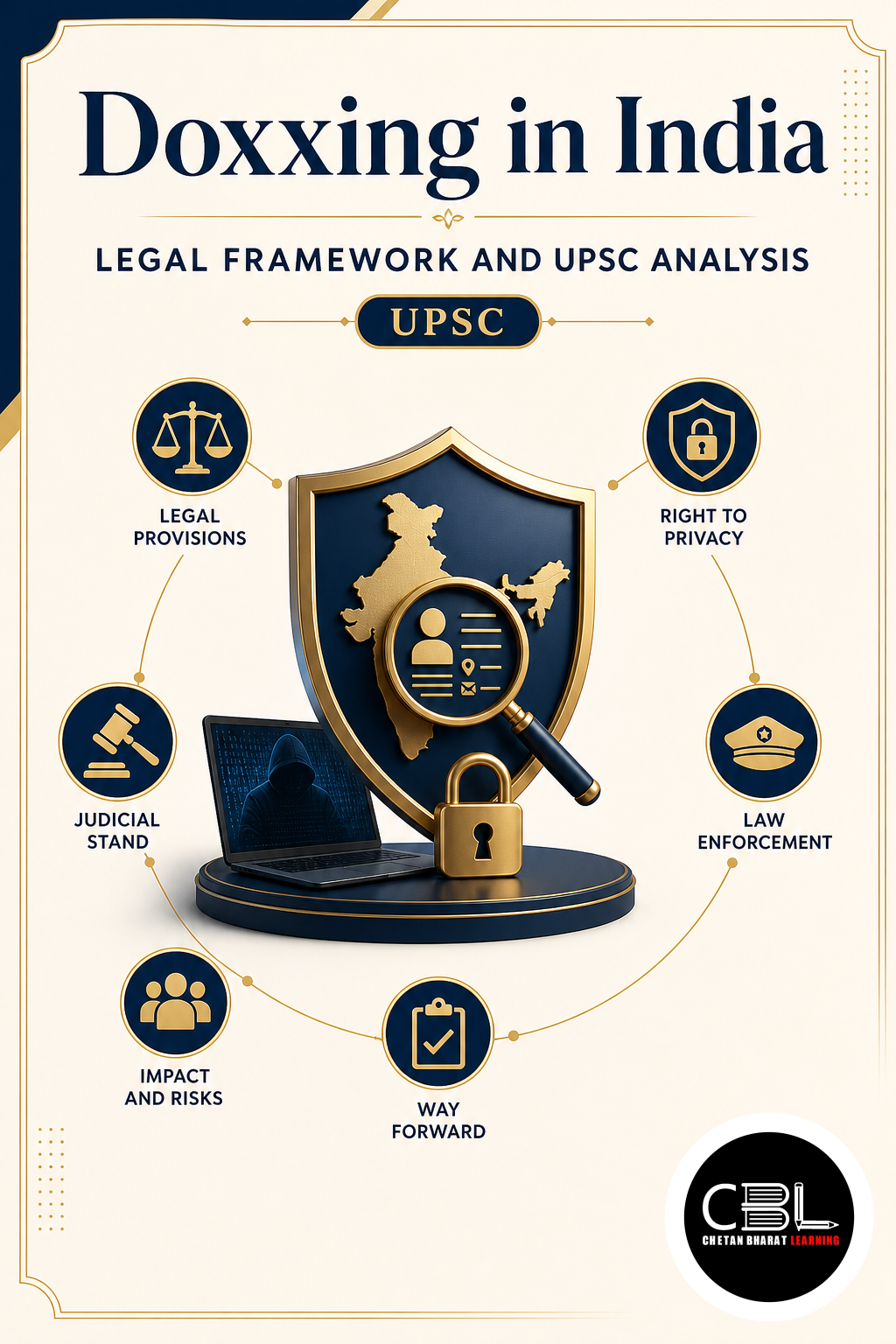
Doxxing in India has emerged as a critical issue after women participating in protests at New Delhi’s Jantar Mantar allegedly faced online harassment through the publication of their personal information on social media. Aspirants should also explore the daily current affairs archive to understand developments in cyber law, privacy and digital governance. The issue is important for UPSC because it connects fundamental rights, cyber security, women’s safety and intermediary regulation under GS Paper II and GS Paper III.
Quick Facts
| Issue | Online disclosure of personal information |
|---|---|
| Current Position | No standalone law criminalising doxxing |
| Relevant Laws | BNS, IT Act, POCSO (where applicable) |
| Affected Groups | Women, activists and online users |
What is Doxxing in India?
Doxxing in India refers to the public disclosure of an individual’s private personal information, such as phone numbers or home addresses, to intimidate, shame or facilitate harassment. According to the source, doxxing itself is not explicitly defined or criminalised under Indian law, creating a legal grey area for victims.
The source distinguishes between two aspects of the problem. The first is the dissemination of personal information, which remains legally uncertain and difficult to prosecute. The second involves threats, stalking or harassment resulting from that disclosure, which can be prosecuted under existing criminal laws.
Why is Doxxing in India in News?
The issue came into focus after women participating in protests at Jantar Mantar allegedly had their videos, photographs, phone numbers and residential addresses shared on social media, leading to harassment, including rape and death threats. These incidents highlighted the absence of a dedicated law specifically addressing doxxing.
According to the source, while threats arising from doxxing may be prosecuted under the Bharatiya Nyaya Sanhita (BNS), the publication of personal information itself generally remains a civil matter under the Information Technology Act unless intimate images are involved. Official cyber safety resources are available through the National Cyber Crime Reporting Portal.
Key Features
- Legal provisions under BNS: Section 78 (stalking), Section 351 (criminal intimidation), Section 79 (acts intended to insult the modesty of a woman or intrude upon privacy) and criminal defamation provisions may apply depending on the circumstances.
- Information Technology Act: Section 66E criminalises publishing images of private body parts without consent, while Section 72A provides a civil remedy for unauthorised disclosure of general personal data.
- Protection of minors: Section 12 of the POCSO Act may apply where the victim is a minor and the conduct amounts to sexual harassment.
- Platform accountability: Under the Information Technology (Intermediary Guidelines and Digital Media Ethics Code) Rules, 2021, intermediaries are expected to act against privacy-invasive or gender-based harassment and respond to complaints within prescribed timelines.
- Victim remedies: The source recommends preserving evidence, reporting content through platform mechanisms, filing complaints on the National Cyber Crime Reporting Portal and seeking assistance from digital security organisations.
Challenges
- No standalone offence: Doxxing is not independently recognised as a criminal offence, creating uncertainty for victims seeking legal remedies.
- Civil nature of disclosure: Unauthorised publication of personal information is generally treated as a civil matter under Section 72A of the IT Act unless intimate images are involved.
- Patchwork enforcement: Victims often rely on multiple legal provisions depending on whether stalking, intimidation, harassment or defamation has occurred.
- Platform compliance: The responsiveness of social media platforms in removing harmful content varies despite obligations under intermediary rules.
- Women’s online safety: Women protesters became particularly vulnerable to targeted online abuse, reinforcing broader concerns regarding digital privacy and gender-based violence.
Way Forward
According to the source, the Jantar Mantar incidents reveal the need for a more comprehensive legal framework that explicitly recognises and addresses doxxing. Stronger legal protection, improved platform accountability and faster grievance redressal mechanisms could strengthen victims’ rights.
Enhancing digital literacy, encouraging prompt reporting of online abuse and improving coordination among law enforcement agencies, technology platforms and civil society organisations can further strengthen cyber safety. Aspirants should also refer to the Ministry of Electronics and Information Technology for updates on cyber governance and digital policy.
Prelims Practice Corner
Q1. Doxxing primarily refers to:
(a) Hacking bank accounts (b) Public disclosure of private personal information (c) Identity verification (d) Data encryption
Answer
(b) Public disclosure of private personal information.
Q2. According to the source, India currently has:
(a) A standalone anti-doxxing law (b) No explicit law criminalising doxxing (c) Constitutional prohibition only (d) International treaty-based legislation
Answer
(b) No explicit law criminalising doxxing.
Q3. Which legislation governs intermediary obligations regarding online content?
(a) Companies Act (b) Information Technology (Intermediary Guidelines and Digital Media Ethics Code) Rules, 2021 (c) Consumer Protection Act (d) Competition Act
Answer
(b) Information Technology (Intermediary Guidelines and Digital Media Ethics Code) Rules, 2021.
Q4. Victims of cyber offences may report complaints through:
(a) National Cyber Crime Reporting Portal (b) UIDAI (c) GST Portal (d) DigiLocker
Answer
(a) National Cyber Crime Reporting Portal.
Q5. Under the source, Section 351 of the Bharatiya Nyaya Sanhita relates to:
(a) Criminal intimidation (b) Theft (c) Trespass (d) Cheating
Answer
(a) Criminal intimidation.
Mains Practice Questions
Q1. Examine the legal challenges posed by doxxing in India. Discuss whether the existing legal framework adequately protects victims. (10 Marks)
Answer Structure
Intro: Define doxxing and explain its growing significance.
Body: Existing legal provisions, limitations, intermediary responsibility, women’s safety and privacy concerns.
Conclusion: Suggest a comprehensive legal framework balancing privacy and freedom of expression.
Q2. Analyse the role of intermediary regulation in addressing online harassment and protecting digital privacy in India. (15 Marks)
Answer Structure
Intro: Explain the importance of intermediaries in the digital ecosystem.
Body: Safe harbour, grievance redressal, privacy protection, platform accountability and enforcement challenges.
Conclusion: Highlight the need for responsible digital governance and stronger user protection.
FAQs on Doxxing in India
What is doxxing?
According to the source, doxxing is the act of publicly revealing someone’s private personal information to intimidate, shame or facilitate harassment.
Is doxxing a criminal offence in India?
The source states that India does not currently have a standalone law explicitly criminalising doxxing, although related conduct may attract liability under existing criminal and cyber laws.
Why is this topic important for UPSC?
It links cyber security, digital governance, privacy, women’s safety, intermediary regulation and constitutional rights, making it relevant for both Prelims and GS Paper II and III.
Related Current Affairs
Preparing for UPSC, PCS or HCS?
Talk to a mentor at Chetan Bharat Learning, Chandigarh. Free guidance on choosing the right exam and building a study plan.
Chat on WhatsAppCall 97793 53345UPSC / IAS / PCS coaching in Chandigarh · Trusted by aspirants across Punjab & Haryana
Leave a Reply
You must be logged in to post a comment.