
The animal cruelty rules draft has triggered a debate over laboratory oversight and animal welfare. For broader context, explore CBL’s environment and wildlife coverage.
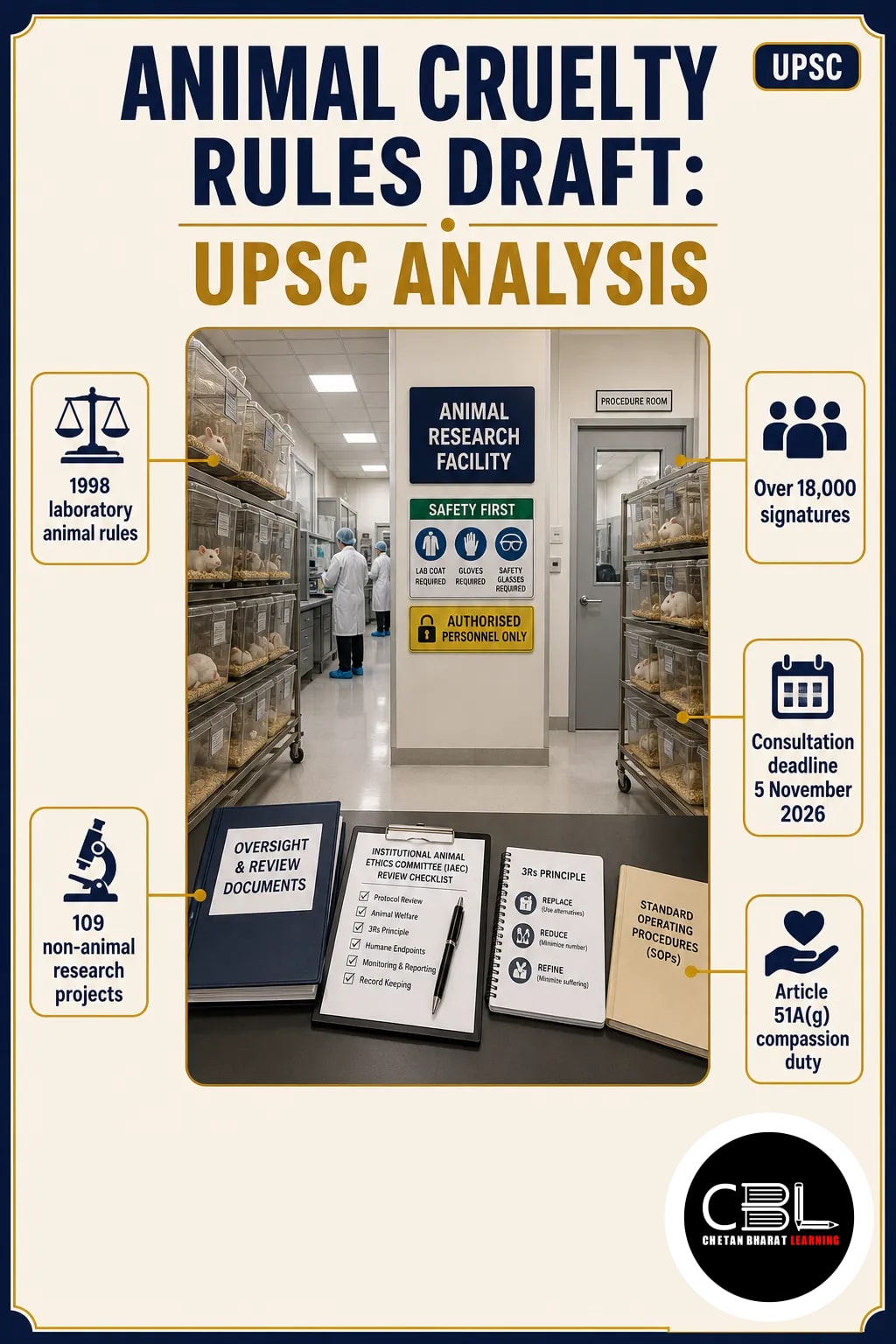
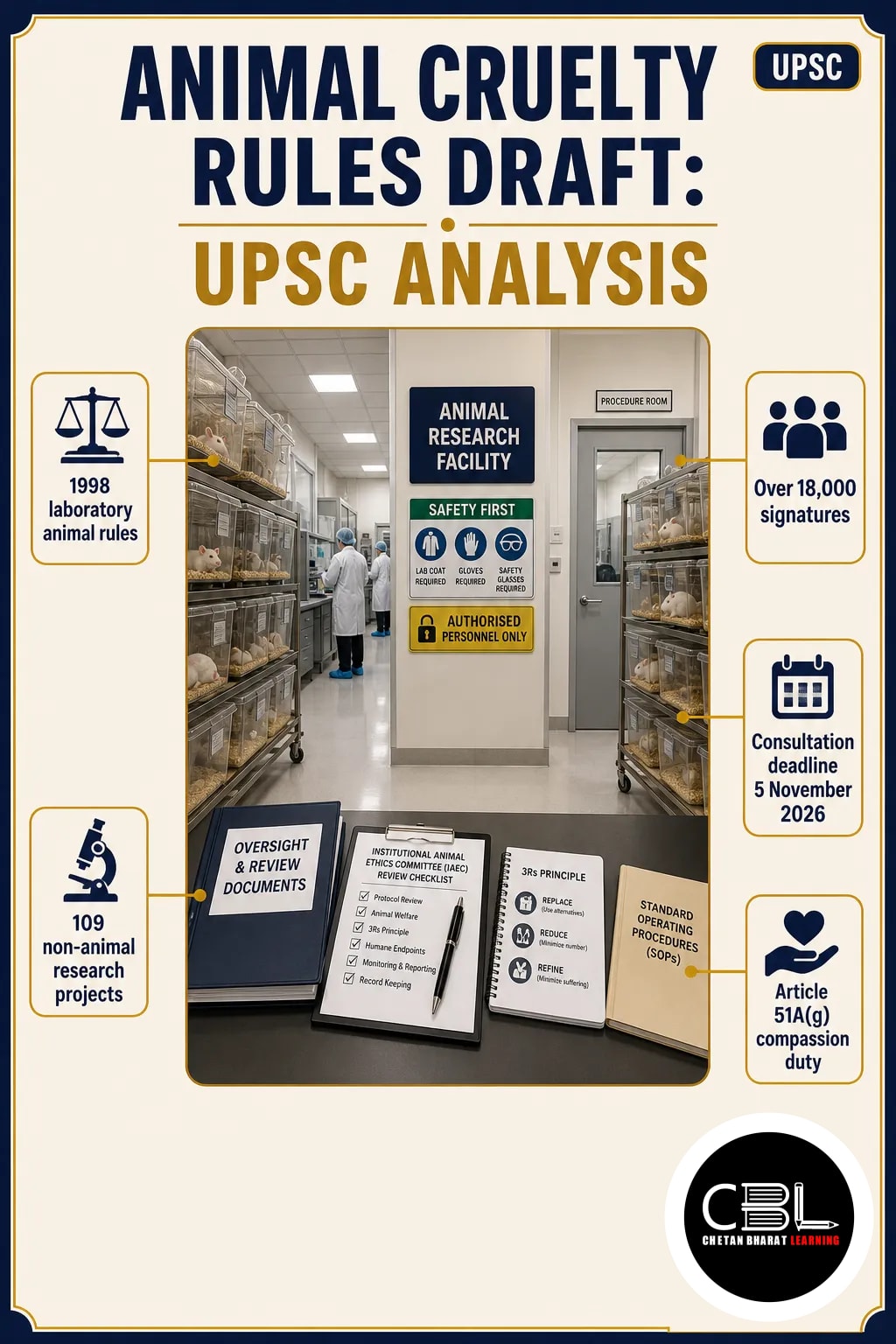
Quick answer: The Centre’s animal cruelty rules draft proposes replacing the 1998 laboratory animal rules with a system emphasising institutional self-regulation. People for the Ethical Treatment of Animals (PETA) India warns of weaker safeguards; its petition has attracted over 18,000 signatures. The government has invited objections and suggestions until 5 November 2026.
What does the animal cruelty rules draft propose?
The draft proposes a new framework for experiments on, and the breeding and trading of, laboratory animals. Its official title is the Prevention of Cruelty to Animals (Control and Supervision of Experiment, Breeding and Trading of Laboratory Animals) Rules, 2026.
It would replace the Breeding of and Experiments on Animals (Control and Supervision) Rules, 1998. Through institutional self-regulation, the proposal seeks to reduce delays and accelerate approvals for pharmaceutical, medical and academic research. The government says it would also strengthen animal welfare and ethical accountability.
The proposal remains a draft, not a finalised change. Therefore, its stated objectives must be distinguished from concerns about its potential effects.
Why is the proposal in the news?
PETA India has sought withdrawal of the proposal, arguing that it could weaken safeguards for animals in experiments. More than 18,000 people signed its website petition, according to the organisation.
The appeal also has support from more than 100 scientists, over 100 veterinarians and more than 60 animal protection organisations. Signatories include actor and Lok Sabha member Hema Malini, Rajya Sabha member Sulata Deo and Lok Sabha member Mohammad Jawed; cricketer K.L. Rahul has endorsed it.
Meanwhile, the government has invited objections and suggestions until 5 November 2026. Public consultation allows researchers, welfare groups and citizens to identify possible consequences before final rules emerge.
What are the main objections?
PETA India’s objections concern animal sourcing, painful procedures and the strength of independent oversight. These are the organisation’s claims about possible effects, not findings that those effects have occurred.
- Wildlife and community animals: PETA says the draft could increase the capture and experimental use of protected wildlife. It also says community dogs and cats could enter laboratories under specified circumstances.
- Pain and distress: The organisation objects to continued experiments involving severe suffering, including inescapable electric shocks, induced tumours and toxicity tests with death as an endpoint.
- Central scrutiny: PETA alleges reduced oversight by the Central Committee for Control and Supervision of Experiments on Animals (CCSEA) over several experiments.
- Care safeguards: It also alleges dilution of safeguards relating to anaesthesia, euthanasia and rehabilitation.
These objections raise a governance question: can quicker institutional decisions preserve effective scrutiny? For related context on wildlife governance, see the discussion of Kerala Wildlife Board nominees.
Which legal and constitutional provisions matter?
The Prevention of Cruelty to Animals Act, 1960, provides the statutory context for regulating animal welfare and experimentation. The Constitution also supplies principles and legislative fields relevant to animal protection.
| Provision | Relevance |
|---|---|
| Prevention of Cruelty to Animals Act, 1960 | Provides a framework to prevent unnecessary pain or suffering to animals, including provisions on experimentation. |
| Article 51A(g) | Makes compassion for living creatures a fundamental duty of citizens. |
| Article 48A | Directs the state to protect and improve the environment and safeguard forests and wildlife. |
| Concurrent List, entries 17 and 17B | Cover prevention of cruelty to animals and protection of wild animals and birds, respectively. |
Fundamental duties and Directive Principles guide public policy, although they are not directly enforceable like fundamental rights. Moreover, Concurrent List entries allow both Parliament and state legislatures to legislate, subject to constitutional rules.
What alternatives exist to animal experiments?
Non-animal approaches include organ-on-chip technologies, three-dimensional tissue models and computer-based methods. They can help researchers study biological processes without relying solely on animals, although their suitability depends on the research question.
According to PETA India, the Indian Council of Medical Research (ICMR) has supported 109 non-animal research projects across 71 institutes and laboratories. The organisation also cites the 2014 prohibition on animal testing for cosmetics and recognition of advanced, human-relevant methods through the New Drugs and Clinical Trials (Amendment) Rules, 2023.
The established 3Rs offer an ethical framework: replace animals where possible, reduce the number used and refine procedures to minimise suffering. Thus, alternatives and welfare safeguards serve complementary purposes: a method must be suitable for its scientific use, while remaining animal procedures require scrutiny.
How can research and animal welfare be balanced?
A balanced framework would pair proportionate approval processes with credible, independent safeguards. Faster decisions matter for research, but speed alone cannot establish that experiments are necessary or humane.
Oversight and accountability
First, the final rules could clearly assign responsibilities between institutions and central oversight. They could also require documented justification for animal use and scrutiny of procedures involving severe distress.
Second, traceable sourcing and clear care requirements could address concerns about wildlife and community animals. In addition, transparent records and review mechanisms would make institutional decisions easier to assess without prescribing an outcome for every experiment.
Alternatives and consultation
Third, regulators and researchers could examine validated non-animal methods before approving animal use. Training and investment in suitable alternatives would help institutions apply the 3Rs in practice.
Finally, the consultation should consider scientific feasibility alongside submissions from veterinarians and welfare organisations. A One Health perspective also encourages attention to the connections among human, animal and environmental health, without replacing experiment-specific ethical review.
Source: The Hindu, 2 November 2026
State PCS General Studies may connect this debate to animal welfare legislation and Concurrent List subjects. Candidates can also examine how state institutions and local bodies contribute to animal welfare without assuming a specific role under the draft.
Prelims Practice Corner
Mains Practice Questions
Frequently Asked Questions
Have the proposed laboratory animal rules been finalised?
No, the proposal remains a draft. The government has invited objections and suggestions until 5 November 2026.
Why does PETA India oppose the proposal?
PETA India says it could weaken animal safeguards and central oversight. In particular, it raises concerns about sourcing animals, painful experiments and care provisions.
What are the 3Rs of animal research ethics?
The 3Rs are replacement, reduction and refinement. Together, they encourage alternatives, fewer animals and procedures that minimise suffering.
Related Current Affairs
Preparing for UPSC, PCS or HCS?
Talk to a mentor at Chetan Bharat Learning, Chandigarh. Free guidance on choosing the right exam and building a study plan.
Chat on WhatsAppCall 97793 53345UPSC / IAS / PCS coaching in Chandigarh · Trusted by aspirants across Punjab & Haryana

 Ananya RanaIAS · AIR 60
 Aditya SharmaIAS · AIR 70
 Ria Kaur SethiIPS · AIR 89
 Aman AloonIRS · AIR 295
 Sumer Singh VirkIRS · AIR 335
 Shivani PanchalIAS

Leave a Reply
You must be logged in to post a comment.