
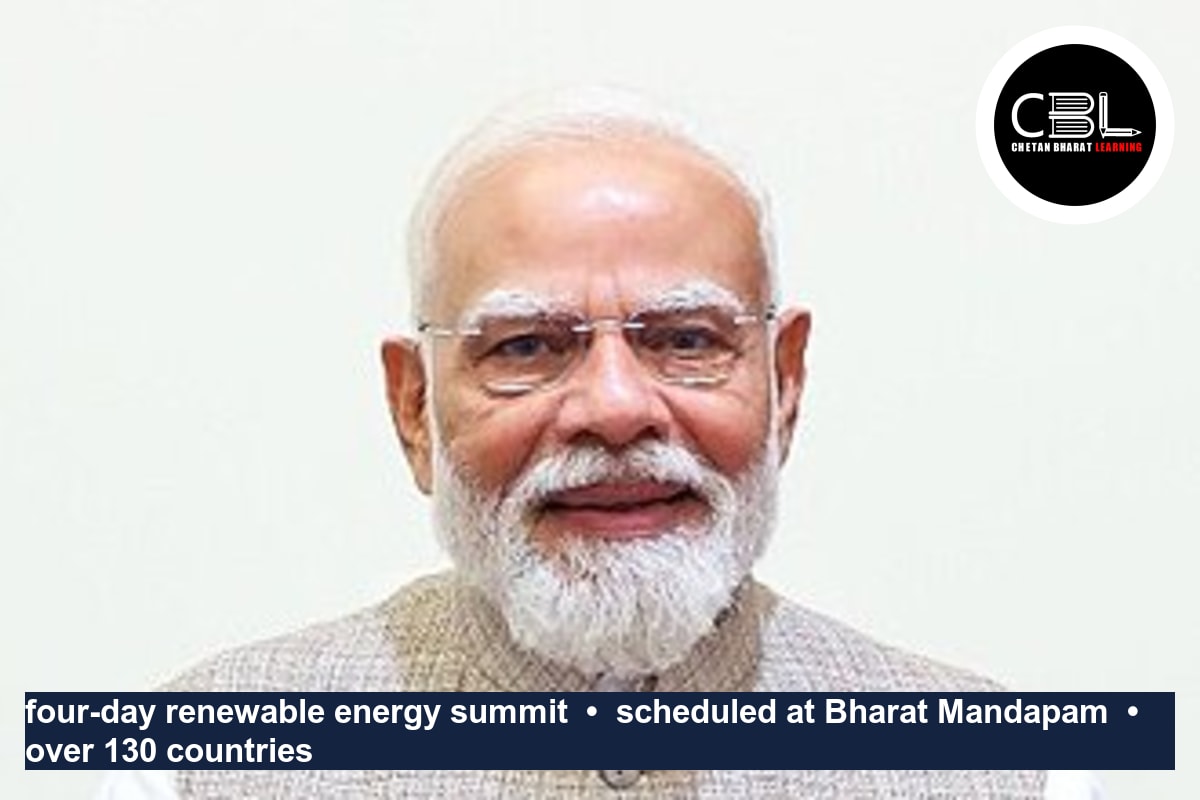

Photo: Narendra Modi, via Wikimedia Commons
RE Summit 2026 is scheduled to begin in New Delhi on 2 November, bringing investment and technology partnerships into focus. The event is relevant to environment and energy current affairs for UPSC.
Quick answer: RE Summit 2026 is a four-day renewable energy summit and expo scheduled from 2 to 5 November at Bharat Mandapam, New Delhi. Prime Minister Narendra Modi is scheduled to inaugurate it. Participants from over 130 countries and more than 400 exhibitors will engage on clean energy investment, manufacturing and technology.
What is planned at RE Summit 2026?
India Renewable Energy Summit and Expo 2026 will bring governments, investors and industry together to discuss clean energy projects. The Prime Minister is scheduled to inaugurate the event at approximately 4:30 pm on 2 November and address participants.
The four-day event carries the theme Invest, Innovate, Inspire and builds on the legacy of RE-INVEST, India’s renewable energy investment summit. In addition to participants from over 130 countries, the gathering will include over 40 ministers, policy-makers, investors, financial institutions and industry leaders.
The announced partner participants are Australia, Denmark, the European Union, France, Germany, the Netherlands, Norway, Sweden and the United Kingdom. However, the announcement describes a planned platform; it does not establish any investment deal or completed outcome.
How will the summit and related meetings work?
The summit combines political discussions, business meetings and an expo to connect finance with clean energy opportunities. Its programme includes plenary sessions, ministerial discussions, chief executive officer roundtables and country- and state-focused sessions.
- Business engagement: Business-to-business meetings can connect suppliers, developers and investors.
- Government engagement: Business-to-government and government-to-government discussions can address project and partnership opportunities.
- Technology showcase: More than 400 exhibitors will display solutions in solar and wind energy, green hydrogen and energy storage.
Meanwhile, two associated international meetings will address complementary parts of the energy transition.
| Platform | Primary focus |
|---|---|
| India Renewable Energy Summit | Investment, industry and technology partnerships |
| 9th International Solar Alliance (ISA) Assembly | Solar cooperation, finance and institutional capacity |
| 4th International Conference on Green Hydrogen | Green hydrogen technology, investment and scale-up |
For context, see CBL’s coverage of BRICS solar cooperation. Solar photovoltaic technology converts sunlight directly into electricity; green hydrogen can be produced using renewable electricity to electrolyse water.
Why does the summit matter for India?
The summit offers India a platform to link renewable energy deployment with investment, manufacturing and international cooperation. Its importance lies in converting such connections into viable projects rather than treating participation itself as an outcome.
Investment and industrial development
Renewable projects require capital for generation, transmission and supporting infrastructure. Therefore, discussions with financial institutions can help developers identify financing and risk-sharing options.
The expo also highlights Indian manufacturing capabilities. For example, exchanges between equipment producers and project developers may help identify opportunities across solar, wind and storage value chains.
State participation and international cooperation
Thirteen states and Union Territories (UTs) will present their renewable energy potential, investment opportunities and manufacturing capabilities. They are Andhra Pradesh, Assam, Bihar, Chhattisgarh, Delhi, Gujarat, Karnataka, Madhya Pradesh, Maharashtra, Odisha, Rajasthan, Uttar Pradesh and West Bengal.
States influence implementation through land, local approvals and electricity-sector institutions. Therefore, their participation can connect national investment discussions with project-level conditions.
The ISA Assembly adds a cooperation channel focused on solar finance and institutional capacity. Likewise, the hydrogen conference brings technology and scale-up into the same conversation as renewable electricity supply.
What challenges could affect clean energy projects?
Financing, grid integration and implementation risks can limit the benefits of renewable energy partnerships.
- Variable generation: Solar and wind output depend on weather and time; therefore, grids need flexibility and suitable storage or other balancing options.
- Finance and execution: Capital costs, payment risks and project delays can affect investment decisions. Consequently, an announced partnership need not become an operational project.
- Land and communities: Projects need land and transmission access; therefore, planning must account for local livelihoods and environmental impacts.
- Supply chains: Manufacturing requires reliable access to materials and equipment. For a related dimension, see critical minerals and supply chains.
- Hydrogen scale-up: Green hydrogen requires renewable electricity and water for electrolysis. Thus, cost, resource availability and demand matter alongside production technology.
What should follow the summit?
Follow-up should connect proposed partnerships with transparent project implementation and measurable results. Governments and investors could prioritise the following steps:
- Track commitments: Publish project milestones and distinguish investment intentions from financial closure and commissioned capacity.
- Plan the grid: Coordinate generation, transmission and storage so that new supply can reach consumers reliably.
- Reduce project risk: Improve the clarity of approvals, contracts and payment arrangements; consequently, viable projects can attract finance more effectively.
- Build local capacity: Support skills, responsible land planning and community consultation alongside manufacturing and technology partnerships.
Overall, RE Summit 2026 can provide a meeting point for these priorities. Its eventual impact, however, depends on implementation after the discussions.
Source: Press Information Bureau, 2 November 2026
- Photovoltaic Action Plan: BRICS Solar Cooperation (17 Sep 2026)
Asked in UPSC: Previous Year Questions
- UPSC CSE Mains 2022 (GS Paper III): Can India meet 50 per cent of its energy needs from renewables by 2030? How would shifting subsidies from fossil fuels to renewables help?
UPSC links renewable energy to financing and policy choices; therefore, revise both implementation challenges and transition measures.
State PCS questions can test renewable energy technologies, state-level project implementation and the role of electricity distribution institutions. In addition, compare how land, grid access and local consultation influence projects without assuming that Punjab or Haryana is among the announced participants.
Prelims Practice Corner
Mains Practice Questions
Frequently Asked Questions
Where and when is the renewable energy summit scheduled?
Bharat Mandapam, New Delhi, from 2 to 5 November 2026. The Prime Minister is scheduled to inaugurate it on 2 November.
What is the summit theme?
Invest, Innovate, Inspire is the announced theme. Accordingly, the programme focuses on investment, industry engagement and technology partnerships.
Which meetings accompany the summit?
The 9th ISA Assembly and the 4th International Conference on Green Hydrogen accompany it. The former focuses on solar cooperation; meanwhile, the latter addresses hydrogen technology, investment and scale-up.
Related Current Affairs
Preparing for UPSC, PCS or HCS?
Talk to a mentor at Chetan Bharat Learning, Chandigarh. Free guidance on choosing the right exam and building a study plan.
Chat on WhatsAppCall 97793 53345UPSC / IAS / PCS coaching in Chandigarh · Trusted by aspirants across Punjab & Haryana

 Ananya RanaIAS · AIR 60
 Aditya SharmaIAS · AIR 70
 Ria Kaur SethiIPS · AIR 89
 Aman AloonIRS · AIR 295
 Sumer Singh VirkIRS · AIR 335
 Shivani PanchalIAS

Leave a Reply
You must be logged in to post a comment.