
Cyclone Arnab Odisha package links immediate food and cash relief with assistance for damaged livelihoods and property. Odisha announced the measures after reviewing floods and heavy rainfall; explore more geography and environment current affairs.
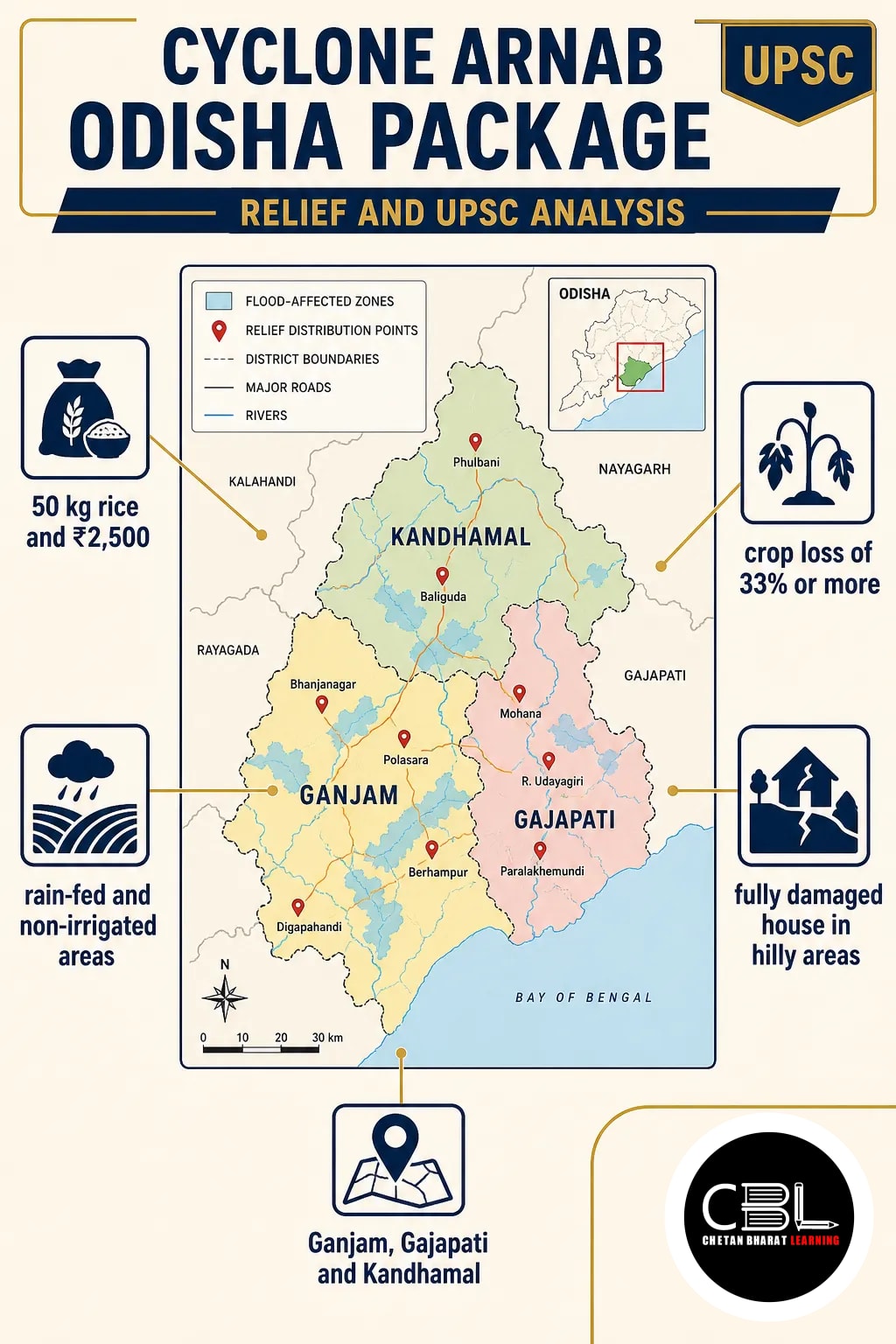
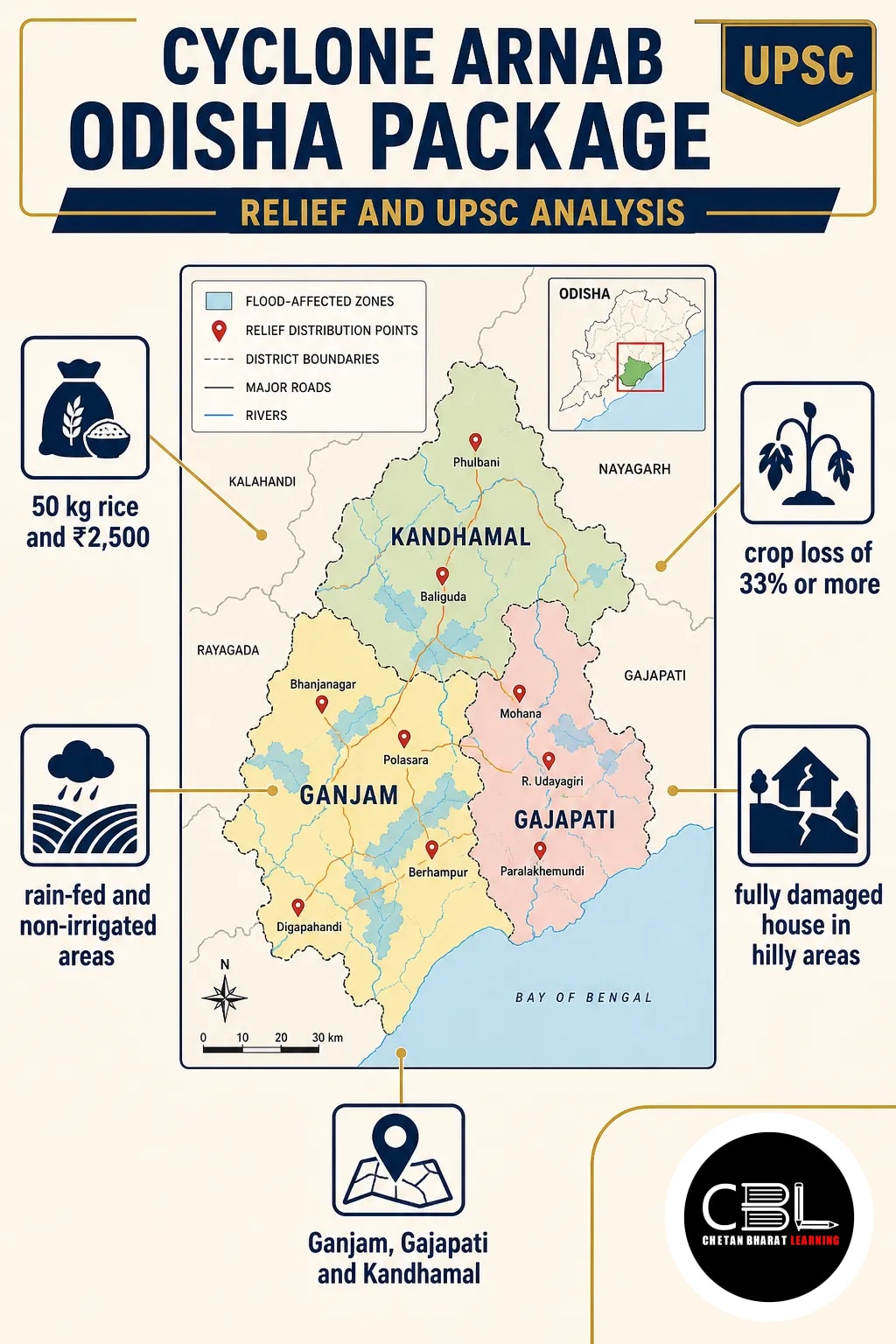
Quick answer: On 2 November 2026, Chief Minister Mohan Charan Majhi announced the Cyclone Arnab Odisha package after a flood review. Each affected family will receive 50 kg of rice and ₹2,500. The package also covers crop, housing and livelihood losses, particularly in Ganjam, Gajapati and Kandhamal.
Where did Cyclone Arnab cause damage?
Cyclone Arnab and subsequent heavy rainfall affected several Odisha districts, especially Ganjam, Gajapati and Kandhamal. The Chief Minister said thousands of acres of crops and several houses suffered damage. Meanwhile, the administration was assessing losses and prioritising relief distribution and restoration.
| Location or feature | Key fact |
|---|---|
| Ganjam | One of the districts singled out in the flood review. |
| Gajapati | Also identified among the affected districts. |
| Kandhamal | Also identified among the affected districts. |
| Damage assessment | Underway when the package was announced. |
For related local context, see CBL’s coverage of the Ganjam landslide and rescue. The government also planned to review the package after assessing damage from another weather system expected near Andhra Pradesh. For context on that forecast, read about the Andhra cyclone alert.
What does the Cyclone Arnab Odisha package provide?
The package combines family-level relief with assistance linked to specific types of loss. Its rates distinguish crop conditions, housing damage and affected occupations; therefore, the eligibility details matter for both implementation and Prelims.
Crop and field assistance
Small and marginal farmers with crop losses of 33% or more qualify for the announced agricultural input subsidy. The government set separate rates for rain-fed or non-irrigated land, assured irrigation and perennial crops.
| Crop or measure | Announced assistance |
|---|---|
| Rain-fed and non-irrigated areas | ₹8,500 per hectare; minimum ₹1,000 for non-irrigated areas. |
| Assured irrigation | ₹17,000 per hectare. |
| Perennial crops, including mango and cashew | ₹22,500 per hectare; minimum ₹2,500. |
| Sand and silt removal | ₹18,000 to each affected farmer. |
| Farm inputs | 1.75 lakh mini kits to be supplied free to farmers. |
The crop threshold applies to the announced input subsidy for small and marginal farmers. In addition, the field-clearing assistance addresses a different recovery need: removing sand and silt before land can be prepared for cultivation.
Housing and livelihood support
Housing assistance varies by the extent of damage and, for fully damaged houses, by terrain. The package also covers commerce, fisheries and artisans, whose productive assets or goods may suffer disaster losses.
| Category | Announced assistance |
|---|---|
| Fully damaged house | ₹1.20 lakh in plains; ₹1.30 lakh in hilly areas. |
| Partially damaged house | ₹6,500 for a pucca house; ₹4,000 for a kutcha house. |
| Small shops, street vendors and kiosks | ₹10,000. |
| Big shops and commercial establishments | ₹25,000. |
| Fisherfolk | ₹22,500 for boat purchase and ₹15,000 for fishing nets. |
| Affected fish farmers | Assistance up to 75% at a rate of ₹1.12 lakh per hectare. |
| Handloom and handicraft artisans | ₹5,000 per artisan for equipment replacement and ₹5,000 per artisan for lost raw material or goods. |
Why does livelihood recovery matter after a cyclone?
Livelihood recovery matters because immediate relief cannot by itself restore incomes or productive assets. Rice and cash address near-term household needs; crop inputs, boats and artisan equipment support the return to work. Similarly, house assistance addresses shelter losses that may persist beyond the flood emergency.
The Cyclone Arnab Odisha package recognises that one event can damage farms, homes and non-farm occupations together. Therefore, assessment must identify the type and extent of loss rather than treat every affected household as economically identical. The announced rates are assistance amounts, not a completed estimate of total damage.
For disaster management, this distinction connects response with recovery. Response focuses on urgent needs and restoration; recovery also involves rebuilding the assets and activities on which households depend. However, the announcement alone does not establish when every beneficiary will receive assistance.
What implementation challenges need attention?
The main task is to turn announced entitlements into timely, accurate assistance while damage assessments continue. The following are implementation risks, not established findings about this package:
- Assessment and timing: Crop-loss verification takes time; however, families may need food and cash before a full assessment ends.
- Different loss categories: Officials must distinguish full and partial housing damage and identify eligible livelihood losses.
- Access to relief: Therefore, distribution arrangements must reach affected settlements as well as people whose work involves mobile or informal activity.
- Renewed weather risk: Further damage could change needs; consequently, the announced review after the next weather system is significant.
What should the recovery response prioritise?
The response should combine rapid household support with transparent assessment and livelihood restoration. These are policy priorities for implementation, rather than additional measures announced by Odisha.
- Sequence assistance: First distribute urgent food and cash; then complete verified crop, housing and livelihood assessments.
- Explain eligibility: Publicly communicate rates, required evidence and grievance channels so affected people can check their claims.
- Coordinate locally: District administrations and local bodies can help identify needs and monitor distribution; moreover, local feedback can expose omissions.
- Restore productive assets: Alongside shelter repairs, prioritise field clearance, farm inputs and equipment needed to restart work.
- Review and prepare: Update assessments after further weather impacts; also use recovery planning to reduce exposure to future cyclones and floods.
Source: The Hindu, 2 November 2026
- Odisha landslide: Ganjam Rescue and UPSC Facts (31 Oct 2026)
- Andhra Cyclone November 2026: UPSC Facts (1 Nov 2026)
- Bay of Bengal Depression: Telangana Rain for UPSC (31 Oct 2026)
State PCS General Studies may test crop-loss assessment, relief delivery and district-level disaster management through this example. In addition, compare immediate flood relief with longer-term livelihood recovery.
Prelims Practice Corner
Mains Practice Questions
Frequently Asked Questions
What relief will each affected family receive?
Each affected family will receive 50 kg of rice and ₹2,500. In addition, the announcement provides separate assistance for specified property and livelihood losses.
What crop loss qualifies small and marginal farmers for input subsidy?
A crop loss of 33% or more qualifies them for the announced input subsidy. The rate then varies by irrigation and crop category.
Which Odisha districts were particularly affected?
Ganjam, Gajapati and Kandhamal were particularly identified. Several districts faced cyclone impacts and subsequent heavy rainfall; meanwhile, damage assessment continued.
What assistance was announced for fisherfolk?
Fisherfolk were offered ₹22,500 for boat purchase and ₹15,000 for fishing nets. Separately, affected fish farmers were promised assistance up to 75% at a rate of ₹1.12 lakh per hectare.
Related Current Affairs
Preparing for UPSC, PCS or HCS?
Talk to a mentor at Chetan Bharat Learning, Chandigarh. Free guidance on choosing the right exam and building a study plan.
Chat on WhatsAppCall 97793 53345UPSC / IAS / PCS coaching in Chandigarh · Trusted by aspirants across Punjab & Haryana

 Ananya RanaIAS · AIR 60
 Aditya SharmaIAS · AIR 70
 Ria Kaur SethiIPS · AIR 89
 Aman AloonIRS · AIR 295
 Sumer Singh VirkIRS · AIR 335
 Shivani PanchalIAS

Leave a Reply
You must be logged in to post a comment.