
The Manipur SOO rally brought Meitei and Naga participants together in Imphal to demand peace, justice and an end to the truce with Kuki militant groups. The mobilisation raises questions about civilian protection and conflict resolution; explore related coverage in CBL’s national current affairs hub.
Quick answer: The Manipur SOO rally in Imphal demanded abrogation of the Suspension of Operations truce with Kuki militant groups. The Coordinating Committee on Manipur Integrity organised it, while the United Naga Council backed it and held district marches. The protests followed an ambush of 14 Meitei men, three of whom were killed.
What happened at the Manipur SOO rally?
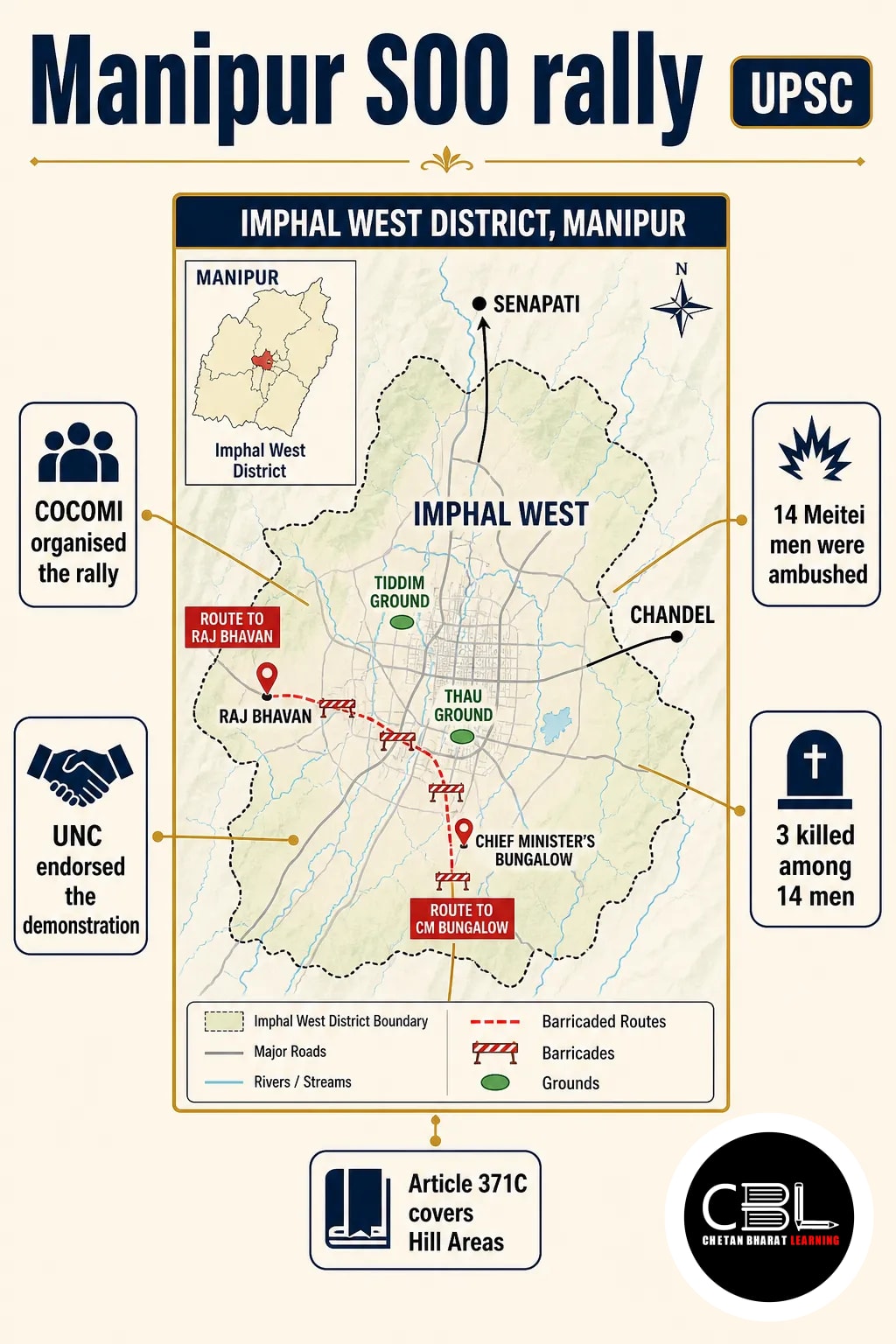
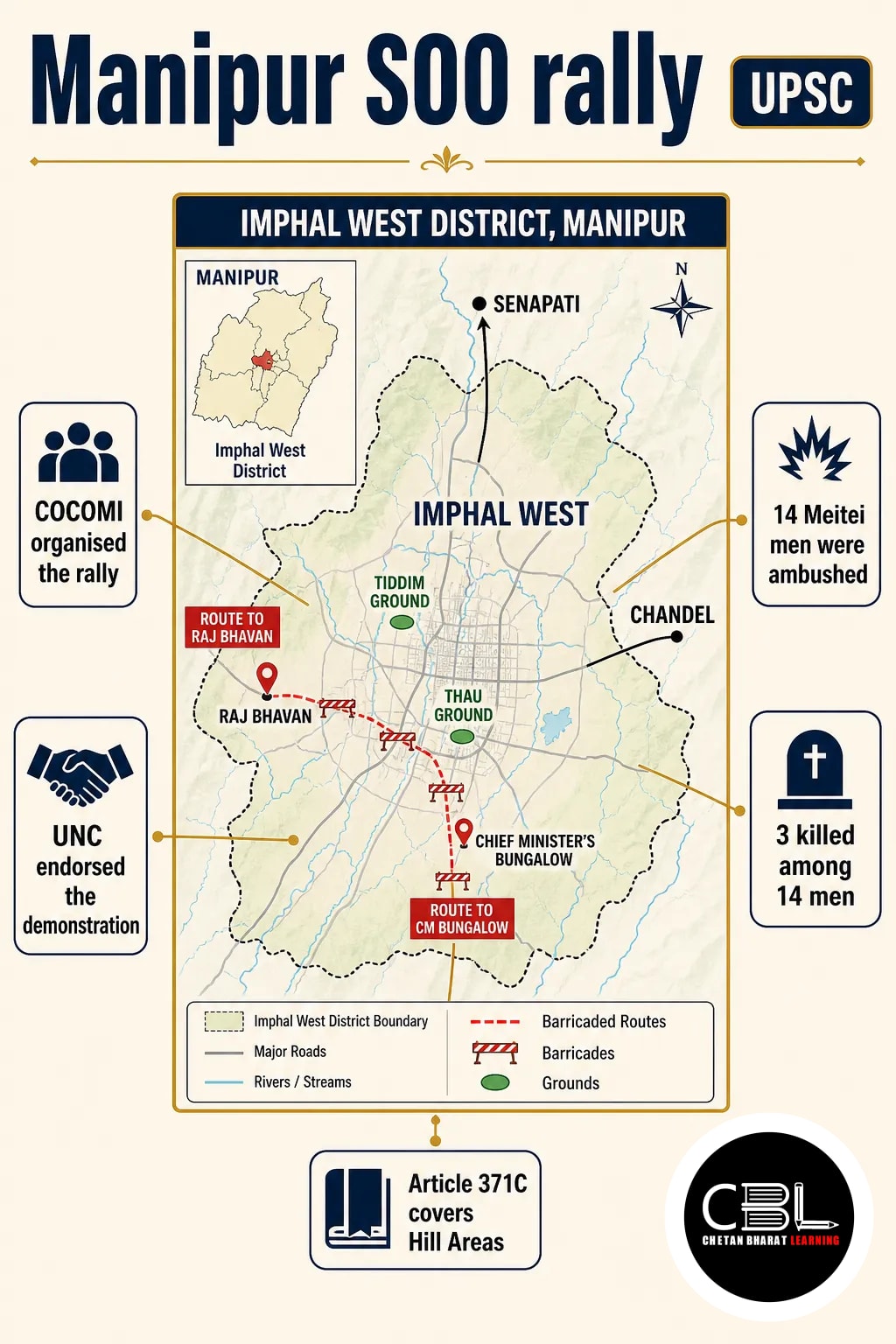
The rally brought thousands to Imphal West after a fresh episode of violence intensified tensions. Militants ambushed 14 Meitei men and killed three on 18 October, triggering protests.
The Coordinating Committee on Manipur Integrity (COCOMI) organised the march. It began at Tiddim Ground in Kwakeithel and ended with a public meeting at Thau Ground in Thangmeiband.
Meanwhile, the United Naga Council (UNC) endorsed the demonstration and organised rallies with affiliated bodies, including in Senapati and Chandel. Businesses and educational institutions closed, and public transport stopped in response to COCOMI’s protest call.
Authorities deployed personnel, barricaded roads towards the Chief Minister’s bungalow and Raj Bhavan, and introduced traffic diversions. Such measures bring public safety and the right to peaceful assembly into focus; see the related discussion on rally restrictions and constitutional rights.
What are the demands and competing positions?
Protesters sought an end to the truce as well as justice, lasting peace and safe resettlement. The positions differ, however, on security and the political future of the state.
| Actor | Position in the source |
|---|---|
| COCOMI | Demanded abrogation of the Suspension of Operations (SOO) agreement, justice and safe resettlement. |
| UNC | Backed the rally; its president emphasised protection of ancestral land. |
| Kuki Zo Council (KZC) | Questioned protection and accountability for Kuki-Zo civilians and reiterated its demand for a Union Territory. |
SOO refers here to a truce arrangement with Kuki militant groups. The demand to abrogate it is a protest demand, not an announcement that the agreement has ended. The source does not establish its detailed terms or the consequences of ending it.
In addition, the KZC said security forces had taken over an SOO camp despite no established link to the recent killings. It also warned that it could consider stronger political measures if security, justice and political demands remained unmet.
A Naga representative accused the state government and Assam Rifles of favouring Kuki groups and sought the force’s withdrawal. These are allegations by a participant; the source does not establish them as findings of an investigation.
Why does the truce debate matter for governance?
The debate connects security arrangements with civilian trust, displacement and competing political demands. Therefore, its resolution requires more than a decision on a single agreement.
- Civilian safety: The ambush and the KZC’s concerns show why authorities must protect people across communities without discrimination.
- Accountability: Rival allegations require impartial investigation; otherwise, unverified claims can deepen distrust.
- Displacement: Safe resettlement requires physical security and access to livelihoods and public services, not merely a return to an address.
- Political dialogue: Demands for ancestral land protection and a Union Territory point to different expectations of a settlement.
Moreover, the truce debate poses a policy trade-off. Reviewing an agreement may address public concerns about its implementation; however, any decision should also consider its effects on violence, dialogue and civilian safety.
Security deployment must work alongside accountable civilian administration. For the wider governance question, see CBL’s discussion of security-force deployment and rights.
Which constitutional provisions are relevant?
The Constitution provides a framework for peaceful protest, protection of life and Centre–state responsibilities. These provisions guide analysis; they do not by themselves resolve the dispute over the truce.
| Provision | Relevance |
|---|---|
| Article 19(1)(b) and Article 19(3) | Citizens may assemble peacefully and without arms, subject to specified reasonable restrictions. |
| Article 21 | Protects life and personal liberty except according to procedure established by law. |
| Article 355 | Places duties on the Union concerning protection of states and constitutional governance. |
| Article 371C | Provides for special arrangements concerning Manipur’s Hill Areas, including a legislative committee. |
What could support a durable peace process?
A durable process needs impartial protection, credible accountability and dialogue across affected communities. First, the Centre and state should communicate clearly about security decisions and investigate attacks independently.
Second, consultations should include displaced people, civil society and representatives with differing political views. In addition, return and rehabilitation should be voluntary and accompanied by access to services and safeguards against renewed violence.
Finally, any review of the SOO should assess implementation and civilian risks transparently. A negotiated approach can then connect immediate security measures with longer-term political questions, without treating any community’s allegations as established fact.
Source: The Indian Express, 31 October 2026
State PCS General Studies can test this issue through public order, peaceful assembly and the rehabilitation of displaced people. In addition, candidates should distinguish the state’s administrative role from the Union’s constitutional responsibilities.
Prelims Practice Corner
Mains Practice Questions
Frequently Asked Questions
What did the Manipur SOO rally demand?
It demanded abrogation of the truce with Kuki militant groups. In addition, organisers sought lasting peace, justice and safe resettlement.
Who organised and supported the Imphal rally?
COCOMI organised it, and the UNC endorsed it. Meanwhile, Naga bodies also held marches in Senapati and Chandel.
Has the SOO agreement been abrogated?
The source does not announce its abrogation. Rather, ending the agreement was a demand raised at the rally.
What is the Kuki Zo Council’s position?
The KZC questioned protection for Kuki-Zo civilians and reiterated its Union Territory demand. It also called for justice and a meaningful political solution.
Related Current Affairs
Preparing for UPSC, PCS or HCS?
Talk to a mentor at Chetan Bharat Learning, Chandigarh. Free guidance on choosing the right exam and building a study plan.
Chat on WhatsAppCall 97793 53345UPSC / IAS / PCS coaching in Chandigarh · Trusted by aspirants across Punjab & Haryana

 Ananya RanaIAS · AIR 60
 Aditya SharmaIAS · AIR 70
 Ria Kaur SethiIPS · AIR 89
 Aman AloonIRS · AIR 295
 Sumer Singh VirkIRS · AIR 335
 Shivani PanchalIAS

Leave a Reply
You must be logged in to post a comment.