
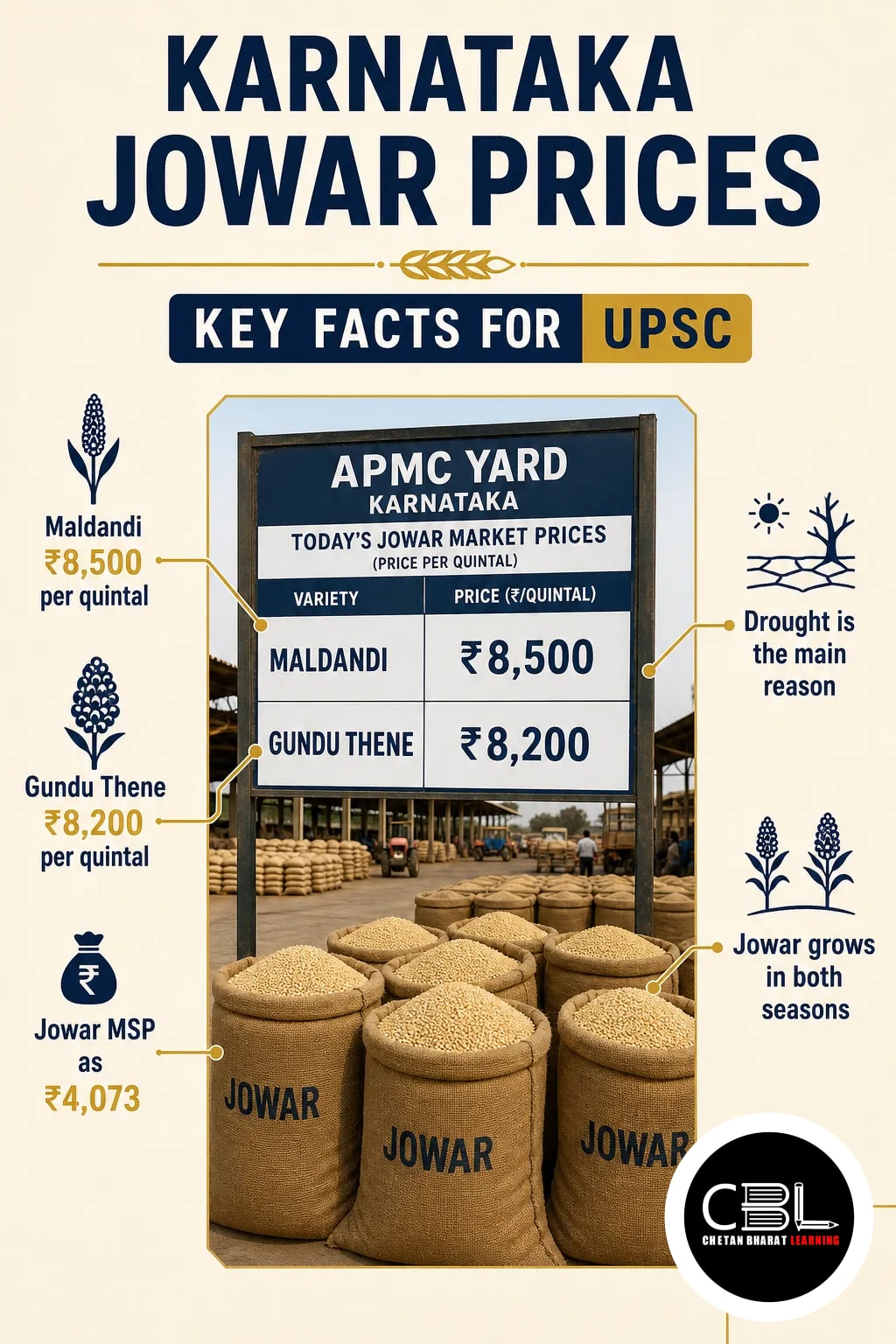

Karnataka jowar prices have surged amid drought, drawing attention to millet cultivation and food prices. For related topics, see CBL’s economy current affairs.
Quick answer: Karnataka jowar prices reached ₹8,500 per quintal for Maldandi and ₹8,200 for Gundu Thene, according to merchants in Vijayapura and Kalaburagi. Both prices rose sharply from September. Drought and low market stocks contributed to the increase; the two varieties are mainly grown during the rabi season.
How much have Karnataka jowar prices risen?
Both varieties have recorded substantial increases since September, according to Agricultural Produce Market Committee (APMC) merchants. However, their latest quoted prices were below the previous week’s peaks.
| Variety | September price per quintal | Latest price per quintal | Previous week’s peak |
|---|---|---|---|
| Maldandi | ₹5,500 | ₹8,500 | ₹9,200 |
| Gundu Thene | ₹5,000 | ₹8,200 | ₹9,000 |
The figures are market quotations, not retail prices. A quintal equals 100 kilograms.
Why have prices increased?
Drought is the main reason for the increase, while traders also point to low market stocks. Officials and experts additionally cite limited mechanisation of jowar cultivation and the fixed Minimum Support Price (MSP) when comparing prices with previous years.
The report gives the jowar MSP as ₹4,073 per quintal and the toor MSP as ₹8,450 per quintal. The quoted market prices for both jowar varieties therefore exceed the stated jowar MSP. For background, read CBL’s guide to minimum support prices.
Agriculture Department data cited in the report put kharif sowing at 0.42 lakh hectares against a target of 0.80 lakh hectares, or 53%. However, the report does not clearly specify the geographical scope of these figures.
Where and when is jowar grown?
Jowar is a millet grown in both kharif and rabi seasons; Maldandi and Gundu Thene are mostly rabi varieties. In Karnataka, rain-fed cultivation includes Vijayapura, Ballari, Raichur, Kalaburagi, Belagavi and Dharwad.
Some farmers also sow jowar after harvesting paddy, using residual soil moisture. An agricultural expert noted that deficient rainfall and low reservoir levels had reduced kharif paddy cultivation.
Why does the price rise matter?
Jowar is a staple in many north Karnataka districts, so higher prices matter to consumers as well as growers. The report also illustrates why aspirants should distinguish market quotations from MSP and connect crop prices with rainfall and stocks.
Source: The Hindu, 31 October 2026
- Minimum Support Price (MSP) (25 Apr 2024)
Asked in UPSC: Previous Year Questions
- UPSC CSE Prelims 2019 (GS Paper I): In the preceding five years, which statements about kharif crop areas were correct: rice was highest, jowar exceeded oilseeds, cotton exceeded sugarcane, and sugarcane steadily declined?
UPSC can link jowar to comparisons across crop areas and seasons.
State PCS General Studies can test millet cultivation, crop seasons and MSP alongside agricultural marketing. Therefore, distinguish a support price from a market quotation.
Prelims Practice Corner
Mains Practice Questions
Frequently Asked Questions
What are the latest Karnataka jowar prices cited in the report?
Maldandi cost ₹8,500 and Gundu Thene ₹8,200 per quintal. However, both quotations were below the previous week’s peaks.
Is jowar a kharif or rabi crop?
Jowar grows in both kharif and rabi seasons. However, Maldandi and Gundu Thene are mostly cultivated during rabi.
Why did jowar prices rise in Karnataka?
Mainly because drought affected supply conditions. In addition, traders pointed to low market stocks.
Related Current Affairs
Preparing for UPSC, PCS or HCS?
Talk to a mentor at Chetan Bharat Learning, Chandigarh. Free guidance on choosing the right exam and building a study plan.
Chat on WhatsAppCall 97793 53345UPSC / IAS / PCS coaching in Chandigarh · Trusted by aspirants across Punjab & Haryana

 Ananya RanaIAS · AIR 60
 Aditya SharmaIAS · AIR 70
 Ria Kaur SethiIPS · AIR 89
 Aman AloonIRS · AIR 295
 Sumer Singh VirkIRS · AIR 335
 Shivani PanchalIAS

Leave a Reply
You must be logged in to post a comment.