

The CEC impeachment process returned to debate after the INDIA bloc held a mock hearing against Chief Election Commissioner Gyanesh Kumar on 31 October 2026. The event raised questions about electoral accountability and the constitutional protection of the Election Commission under Indian polity.
Quick answer: The CEC impeachment process requires parliamentary action on proved misbehaviour or incapacity, followed by a presidential order. On 31 October 2026, opposition leaders held a symbolic public hearing in the row over electoral roll revision. However, that event has no power to remove Gyanesh Kumar from office.
What happened at the public hearing?
The INDIA bloc held a symbolic proceeding over alleged irregularities in the Special Intensive Revision (SIR) of electoral rolls. Former Lok Sabha Speaker Meira Kumar presided over the mock hearing, while Saugata Roy and Awadhesh Prasad served as deputy chairs.
The event formed part of the opposition’s campaign alleging electoral malpractice. However, allegations at a political hearing do not establish the constitutional grounds for removal. For the background, see CBL’s earlier explanation of the protest and removal rules.
Why did the opposition raise the issue?
Opposition parties had sought Kumar’s removal through parliamentary notices before holding the public event. On 12 March 2026, the Trinamool Congress led the submission of notices signed by 130 Lok Sabha members and 63 Rajya Sabha members.
The notices alleged partisan and discriminatory conduct during SIR and obstruction of investigations into electoral fraud and the revision. In April, the Lok Sabha Speaker and Rajya Sabha Chairman rejected the respective notices without assigning reasons, according to The Indian Express.
The report also said the two Election Commissioners had raised concerns about processes linked to SIR. For the wider issue, read about electoral roll revision and judicial review.
What constitutional provisions govern removal?
Article 324 gives the Election Commission of India (ECI) responsibility for the superintendence, direction and control of elections. Its safeguards distinguish the Chief Election Commissioner (CEC) from the other Election Commissioners.
| Provision | What it provides |
|---|---|
| Article 324(5) | The CEC can be removed in the same manner and on the same grounds as a Supreme Court judge. Other Election Commissioners can be removed only on the CEC’s recommendation. |
| Article 124(4) | A Supreme Court judge’s removal requires proved misbehaviour or incapacity and a special parliamentary majority. |
| Section 11 of the 2023 Act | The Chief Election Commissioner and Other Election Commissioners (Appointment, Conditions of Service and Term of Office) Act reiterates the constitutional removal protection. |
| Judges (Inquiry) Act, 1968 | It provides the procedure for a judge’s removal, including notice and investigation of charges. |
The Constitution does not treat a mere allegation as proof. Moreover, the CEC’s protection is designed to prevent removal through ordinary political pressure.
How does the CEC impeachment process work?
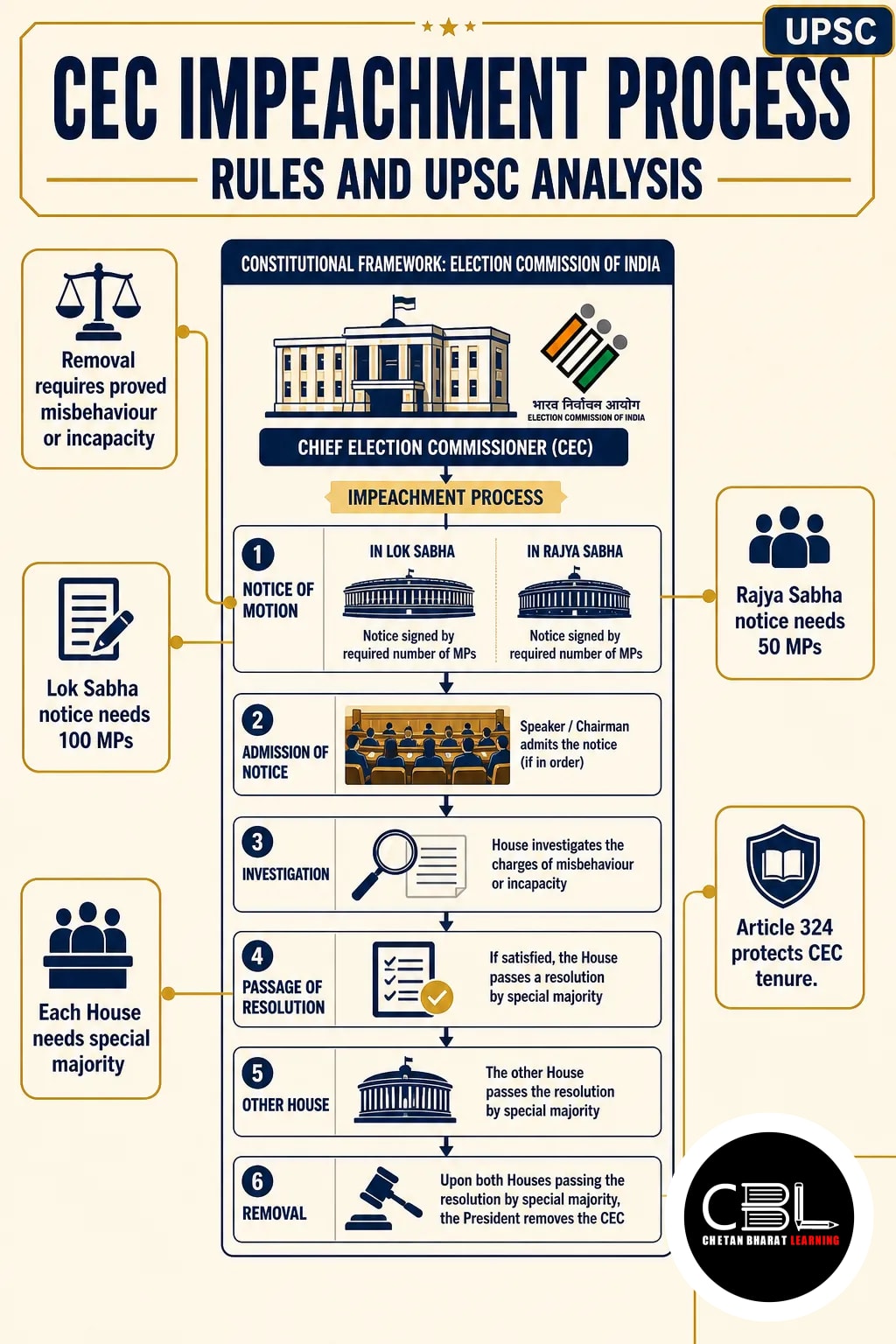
The procedure moves from a signed notice to scrutiny, inquiry, parliamentary voting and a presidential order. Although often called impeachment, the operative constitutional route is removal in the manner applicable to a Supreme Court judge.
- Notice: At least 100 Lok Sabha members or 50 Rajya Sabha members must sign a notice alleging misbehaviour or incapacity.
- Admission: The Speaker or Rajya Sabha Chairman considers the notice and may admit or reject it. Therefore, sufficient signatures do not guarantee an inquiry.
- Inquiry: If the notice is admitted, an inquiry committee examines the charges and evidence. An allegation alone is not a finding of proved misbehaviour.
- Parliamentary vote: Each House must support an address by a majority of its total membership and by at least two-thirds of members present and voting. Both Houses must pass it in the same session.
- Presidential order: Once the constitutional requirements are met, the President orders removal. Thus, the public meeting cannot substitute for these steps.
These thresholds serve different purposes: signatures initiate consideration, while the higher voting requirement protects institutional tenure. Consequently, neither a rejected notice nor a public hearing completes the CEC impeachment process.
How are the CEC and Election Commissioners appointed?
The President appoints the CEC and Election Commissioners on a selection committee’s recommendation under the 2023 Act. The committee comprises the Prime Minister, the Leader of the Opposition in the Lok Sabha and a Union Cabinet minister.
Appointees must have held secretary-level government positions and have integrity and experience relevant to election management. Their term is six years or until age 65, whichever comes first. For more context, see the CEC’s powers and appointment framework.
Why do independence and accountability both matter?
Secure tenure protects election administration, while credible scrutiny helps sustain public confidence. The two objectives need not conflict: independence protects lawful decision-making, not an officeholder from examination of substantiated misconduct.
- Institutional independence: A demanding removal threshold reduces the risk that a temporary political majority can displace the CEC.
- Procedural accountability: Inquiry and parliamentary scrutiny provide a route for examining serious charges. However, rejecting a notice prevents that inquiry from beginning.
- Electoral trust: Allegations about roll revision can affect confidence in the process. Therefore, accessible information and effective avenues to raise electoral grievances matter alongside removal rules.
- Role clarity: Political protest can express public concerns, but it cannot determine legal guilt or replace constitutional procedure.
A constructive approach would emphasise transparent electoral administration and clear responses to substantiated concerns. At the same time, Parliament and constitutional authorities must preserve the safeguards that protect independent decision-making.
Source: Indian Express Explained, 31 October 2026
- CEC Impeachment Protest: Constitutional Rules for UPSC (29 Oct 2026)
- Electoral Roll Revision and Supreme Court Review (28 Oct 2026)
- Chief Election Commissioner: Powers and Appointment (28 Oct 2026)
Asked in UPSC: Previous Year Questions
- UPSC CSE Mains 2026 (GS Paper II): Discuss the Election Commission of India’s position in electoral roll revision. Can it also examine voters’ citizenship?
- UPSC CSE Mains 2018 (GS Paper II): In light of the EVM controversy, what challenges does the Election Commission face in ensuring trustworthy elections?
UPSC links the Commission’s powers to electoral administration and public trust; therefore, revise both institutional safeguards and roll revision.
State PCS examinations can test Article 324, removal safeguards and electoral roll administration in General Studies. Also distinguish the ECI from State Election Commissions, which conduct local-body elections under Articles 243K and 243ZA.
Prelims Practice Corner
Mains Practice Questions
Frequently Asked Questions
Can a public impeachment meeting remove the CEC?
No, because a political meeting has no constitutional power to remove the CEC. Removal requires the prescribed parliamentary procedure and a presidential order.
What are the grounds for removing the CEC?
Proved misbehaviour or incapacity are the grounds. This follows because Article 324(5) applies the same grounds as for a Supreme Court judge.
What majority must Parliament pass for CEC removal?
Each House needs a majority of its total membership and at least two-thirds of members present and voting. Moreover, both Houses must pass the address in the same session.
Does a signed removal notice automatically start an inquiry?
No, because the relevant presiding officer may reject the notice. An inquiry follows only if the notice is admitted.
Related Current Affairs
Preparing for UPSC, PCS or HCS?
Talk to a mentor at Chetan Bharat Learning, Chandigarh. Free guidance on choosing the right exam and building a study plan.
Chat on WhatsAppCall 97793 53345UPSC / IAS / PCS coaching in Chandigarh · Trusted by aspirants across Punjab & Haryana

 Ananya RanaIAS · AIR 60
 Aditya SharmaIAS · AIR 70
 Ria Kaur SethiIPS · AIR 89
 Aman AloonIRS · AIR 295
 Sumer Singh VirkIRS · AIR 335
 Shivani PanchalIAS

Leave a Reply
You must be logged in to post a comment.