
The bank competitiveness committee will examine how Indian banks can compete globally while supporting financial inclusion. Its mandate connects banking reform with the wider Indian economy and financial sector.
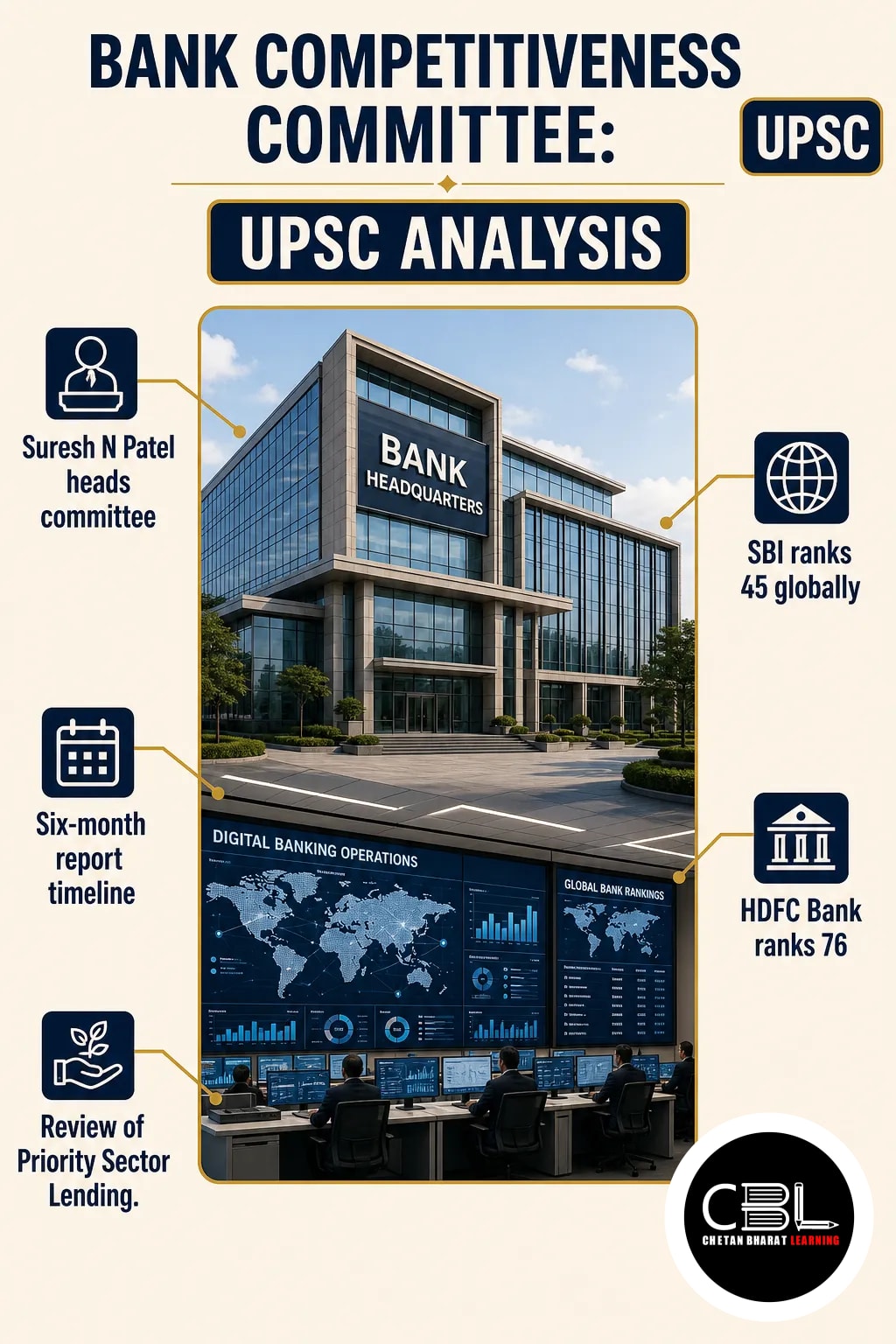
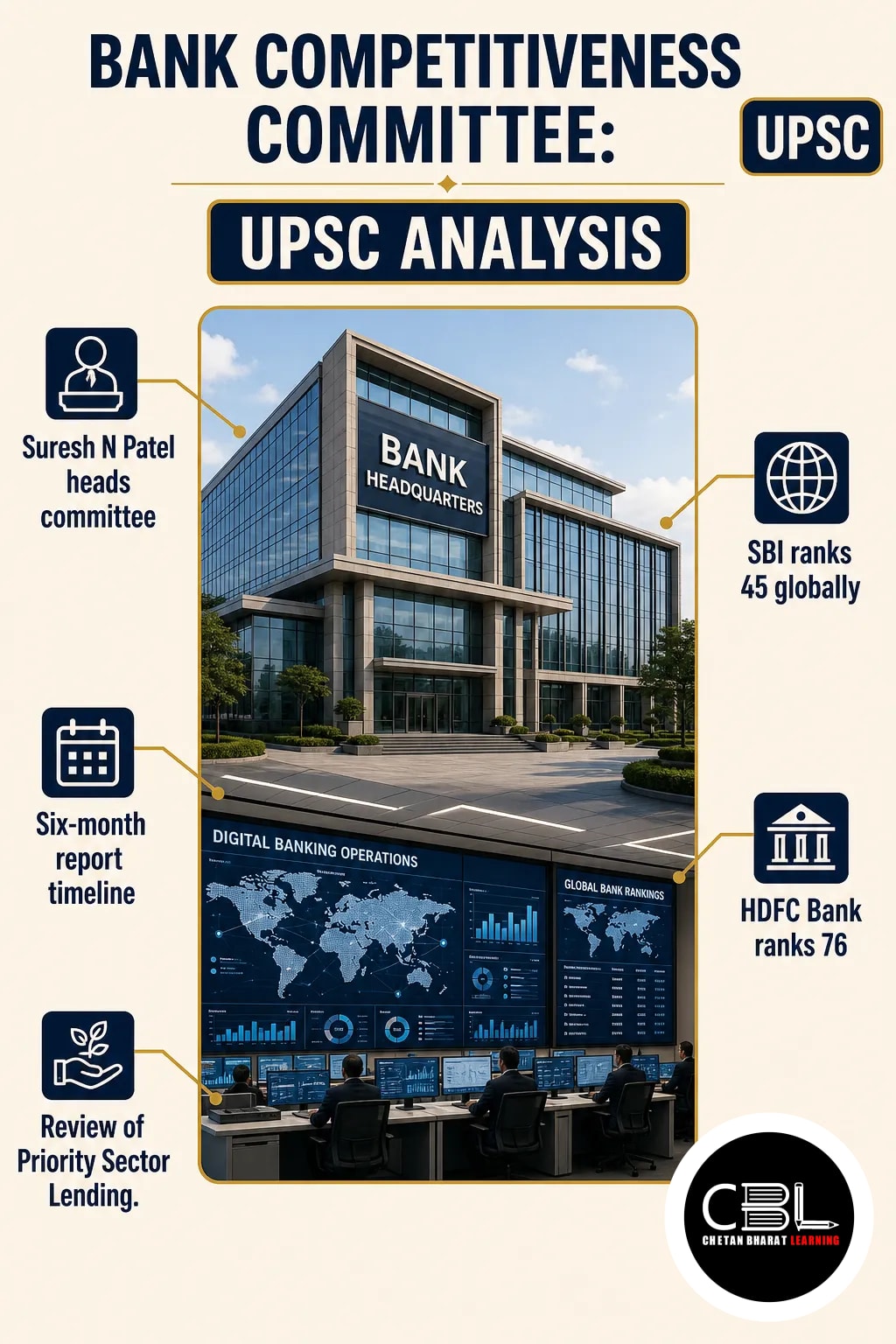
Quick answer: The government has established the bank competitiveness committee, formally called the High-Level Committee on Banking for Viksit Bharat. Former Central Vigilance Commissioner Suresh N Patel heads it. Within six months, it must recommend banking reforms, including roadmaps for global competitiveness and digital innovation with safeguards against cyber risks.
What is the bank competitiveness committee?
The committee is a government-appointed body tasked with a comprehensive review of Indian banking. Finance Minister Nirmala Sitharaman announced it in the Union Budget speech on 1 February 2026.
Its review aims to align banking with India’s next phase of growth. At the same time, its mandate includes financial stability, inclusion and consumer protection. The committee will submit recommendations to the government; its constitution does not itself implement banking reforms.
Besides Patel, its members include Reserve Bank of India (RBI) Deputy Governor Shirish Chandra Murmu, former Deputy Governor NS Vishwanathan and former Indian Bank Managing Director and Chief Executive Officer Padmaja Chunduru. The Department of Financial Services Joint Secretary (Banking) will serve as member secretary. For the broader context, see CBL’s overview of the Viksit Bharat banking committee.
Why is global competitiveness a priority?
The government hopes that one or two Indian banks will rank among the world’s top 20 by 2047. However, the latest S&P Global Market Intelligence list places only two Indian banks in its top 100.
| Bank or group | Position in the cited list |
|---|---|
| State Bank of India (SBI) | 45, down from 43; only Indian public sector bank in the top 100 |
| HDFC Bank | 76, down from 73; the other Indian bank in the top 100 |
| Four largest banks globally | All are from China |
The rankings provide a benchmark for the government’s ambition, but rank alone does not establish financial strength or service quality. Therefore, a competitiveness roadmap must consider capital, governance and risk management alongside scale.
Consolidation has long been considered one route to greater scale. In 2017, the Union Cabinet approved SBI’s acquisition of its five subsidiary banks and Bharatiya Mahila Bank. In 2019, it approved the merger of Vijaya Bank and Dena Bank with Bank of Baroda; a larger public sector bank consolidation followed a year later. There are currently 12 public sector banks.
What will the committee review?
The bank competitiveness committee has a broad mandate covering capital, technology, regulation and inclusive credit. Its main tasks are:
- Global scale: Prepare a roadmap for globally competitive banks and assess their long-term capital requirements.
- Investment: Recommend policy options to encourage private investment for sustainable growth.
- Technology: Develop a roadmap for artificial intelligence (AI) and digital innovation, while providing for cyber-risk safeguards.
- Workforce: Suggest a strategy for talent acquisition and capacity building for a future-ready banking workforce.
- Rules and credit delivery: Review banking laws and regulations, as well as Priority Sector Lending and the Lead Bank Scheme.
Priority Sector Lending directs attention to lending to identified priority sectors. Meanwhile, the Lead Bank Scheme provides a framework for coordinating banking and credit-related activities at district level. The committee will assess their relevance, effectiveness and coordination, rather than presume that either should be discontinued.
What are the opportunities and challenges?
The review can connect global banking ambitions with domestic credit needs, but each reform involves trade-offs.
Capital, scale and investment
Larger banks can potentially support larger financing needs and wider operations. However, mergers require integration of systems and personnel; size by itself cannot guarantee sound lending or effective governance. Similarly, a capital strategy must consider both growth and resilience.
Foreign investment offers another route to capital and expertise. The Cabinet approved the sale of a 60.7% stake in IDBI Bank to Toronto-based Fairfax Financial Holdings for ₹52,878 crore. In addition, the source cites Emirates NBD’s 60% purchase in RBL Bank for nearly $3 billion in June 2026. See the IDBI Bank strategic restructuring analysis for related context.
Yet investment decisions also require attention to ownership, supervision and accountability. The committee’s task is to recommend policy options; the cited transactions do not establish what it will propose.
Digital innovation and inclusion
AI and digital services can help banks process information and reach customers more efficiently. However, cyber incidents, weak controls or inaccessible digital interfaces can undermine trust and consumer protection. Accordingly, innovation and safeguards must advance together.
Inclusive credit poses a related challenge. A bank may expand its balance sheet without necessarily improving access for underserved borrowers or districts. Therefore, the review of priority lending and district-level coordination matters alongside global rankings.
What could a balanced way forward involve?
A balanced roadmap would measure competitiveness through resilience and service delivery as well as size. The following are analytical priorities, not announced recommendations:
- Capital and governance: Assess long-term capital needs alongside risk controls and board accountability.
- Technology safeguards: Pair digital expansion with cyber preparedness, customer grievance handling and accessible services.
- Inclusive lending: Evaluate priority-sector outcomes and district coordination using reliable data, not only aggregate credit growth.
- Workforce and implementation: Build relevant skills and sequence reforms so that institutions can manage the transition.
Ultimately, the committee’s six-month review can help reconcile global ambition with domestic development. However, its impact will depend on the recommendations made and subsequent government and regulatory action.
Source: The Indian Express, 31 October 2026
- Viksit Bharat banking committee: UPSC Analysis (30 Oct 2026)
Punjab PCS and Haryana HCS candidates can connect the review to district-level credit coordination and financial inclusion. In addition, the distinction between bank scale and access to credit is useful for state General Studies answers.
Prelims Practice Corner
Mains Practice Questions
Frequently Asked Questions
Who heads the High-Level Committee on Banking for Viksit Bharat?
Suresh N Patel heads the committee. He previously served as Central Vigilance Commissioner.
Which Indian banks are in the cited global top 100?
SBI and HDFC Bank are the two Indian banks in the cited list. They rank 45 and 76, respectively.
Will the committee review Priority Sector Lending?
Yes, because its terms of reference include a review of Priority Sector Lending. It will also examine the Lead Bank Scheme and coordination for inclusive credit delivery.
Related Current Affairs
Preparing for UPSC, PCS or HCS?
Talk to a mentor at Chetan Bharat Learning, Chandigarh. Free guidance on choosing the right exam and building a study plan.
Chat on WhatsAppCall 97793 53345UPSC / IAS / PCS coaching in Chandigarh · Trusted by aspirants across Punjab & Haryana






Leave a Reply
You must be logged in to post a comment.