
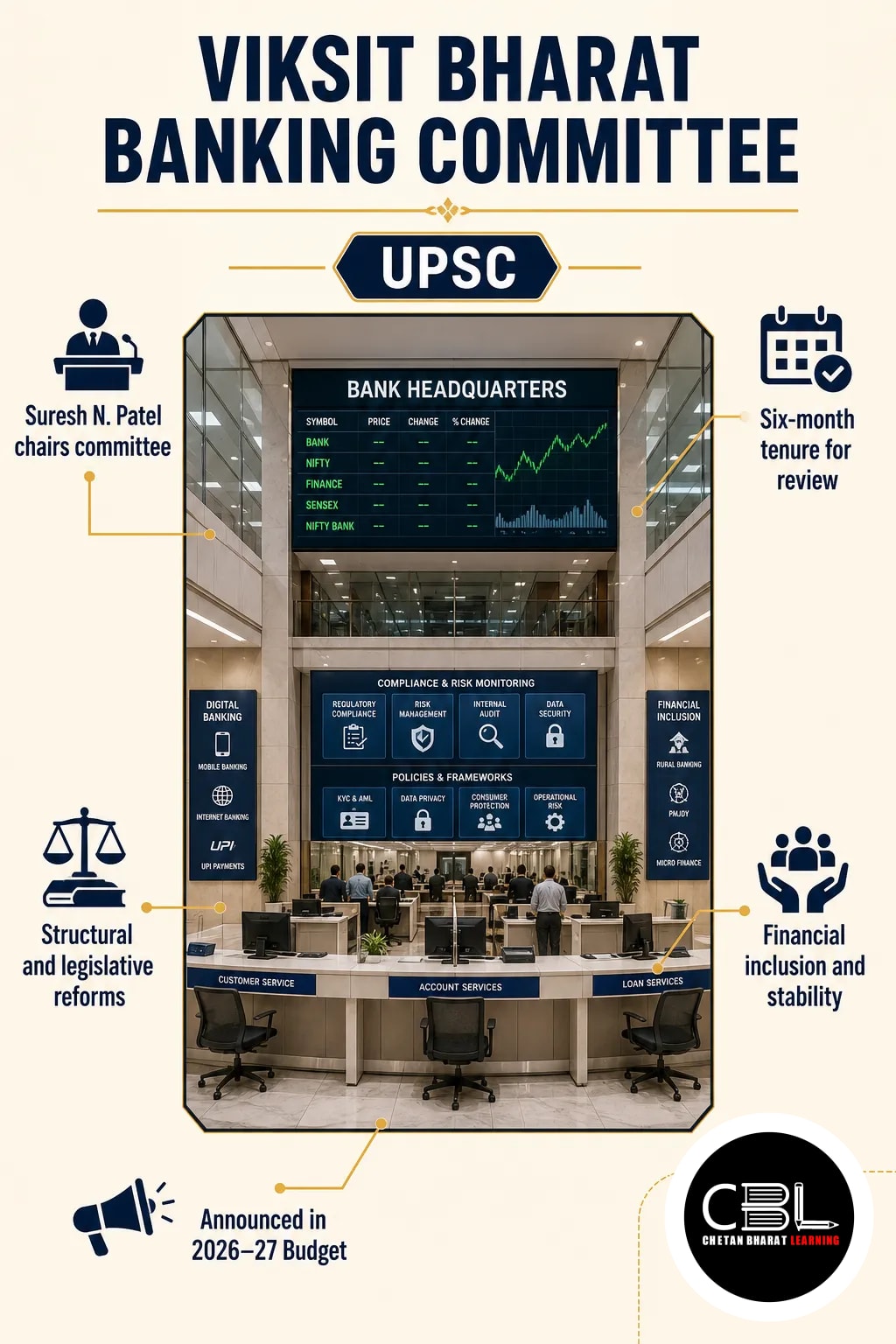

The Viksit Bharat banking committee will review India’s banking sector and recommend reforms for 2047. Its mandate connects global competitiveness with financial inclusion, making it important for economy current affairs.
Quick answer: The Government of India has constituted the Viksit Bharat banking committee under former Central Vigilance Commissioner Suresh N. Patel. Over six months, it will review Indian banking and recommend structural, institutional, regulatory and legislative reforms. The aim is a globally competitive, financially inclusive and robust banking sector for Viksit Bharat 2047.
What is the Viksit Bharat banking committee?
The committee is a government-appointed panel tasked with reviewing the banking sector and recommending reforms. Finance and Corporate Affairs Minister Nirmala Sitharaman announced its formation in the 2026–27 Budget speech.
Its mandate spans structural, institutional, regulatory and legislative changes. However, the announcement establishes a review exercise; it does not itself announce specific reforms or implementation decisions.
The panel’s membership brings together vigilance, banking management and regulatory experience. The Department of Financial Services also provides its member secretary.
| Person or office | Committee role and background |
|---|---|
| Suresh N. Patel | Chair; former Central Vigilance Commissioner |
| Shirish Chandra Murmu | Member; Deputy Governor, Reserve Bank of India (RBI) |
| Padmaja Chunduru | Member; former Managing Director and Chief Executive Officer, Indian Bank |
| N. S. Vishwanathan | Member; former RBI Deputy Governor |
| Joint Secretary, Banking, Department of Financial Services | Member secretary |
Why does banking competitiveness matter?
Competitive banks can support investment and trade while providing reliable services to depositors and borrowers. For India, the policy question is how to improve those capabilities without compromising stability or inclusion.
First, banks mobilise savings and provide credit. Effective credit appraisal and recovery can protect deposits while directing finance to productive activities. Moreover, sound governance helps banks manage decisions across economic cycles.
Second, global competitiveness involves more than the size of a bank. Service quality, risk management, financial strength and the ability to support cross-border business also matter. Consequently, a reform assessment should consider both performance and resilience.
Third, access remains central to the committee’s stated objective. A bank account is useful when customers can operate it, receive payments and obtain suitable services. Therefore, inclusion should be assessed through use and service quality, not access alone.
For a related discussion on bank ownership and structure, see CBL’s analysis of IDBI Bank strategic restructuring. The committee’s mandate, however, covers the banking sector as a whole.
Which reform dimensions could the review address?
The mandate permits examination of the rules, institutions and structures that shape bank performance. The following are analytical possibilities, not announced committee recommendations.
Governance and capital
Clear board responsibilities and professional management can improve accountability for lending and risk decisions. However, governance design must also preserve operational autonomy and permit scrutiny of outcomes.
Capital absorbs losses and supports lending, while inadequate capital can constrain expansion. Therefore, any assessment of competitiveness must consider the relationship between growth, capital strength and the risks banks undertake.
Credit quality and regulation
Weak loan recovery can tie up funds and reduce a bank’s capacity to lend. Hence, credit appraisal, early identification of stress and recovery mechanisms deserve attention alongside new lending.
The discussion of insolvency and recovery risks offers related context. Regulatory or legislative changes would nevertheless require separate consideration after the committee reports.
Inclusion and technology
Digital banking can reduce transaction costs and widen reach. However, customers also need accessible interfaces, safeguards against fraud and effective grievance redress.
Similarly, physical access and assisted services remain relevant for people who cannot easily use digital channels. A competitive system should therefore measure whether its services work for different customer groups.
What challenges must banking reforms balance?
The principal challenge is to pursue efficiency, inclusion and stability together rather than treating them as substitutes.
- Growth versus prudence: Faster lending may support investment, but weak appraisal can increase future losses.
- Scale versus competition: Larger banks may build capabilities; however, scale alone does not guarantee better governance or customer service.
- Commercial viability versus access: Reaching underserved customers can require investment, so service design must address costs without excluding users.
- Innovation versus protection: Digital delivery can improve convenience; nevertheless, fraud prevention and complaint resolution must keep pace.
- Autonomy versus accountability: Banks need room for commercial decisions, while boards, regulators and owners must retain appropriate oversight.
These are policy trade-offs, not findings attributed to the panel. The Viksit Bharat banking committee has been given six months; the supplied announcement does not specify its recommendations or a reform timetable.
What should a banking reform roadmap prioritise?
A useful roadmap would connect measurable banking outcomes with clear institutional responsibilities. It should also distinguish actions banks can take from changes requiring regulation or legislation.
First, reforms could set transparent governance and risk-management standards. Second, they could assess inclusion through active use, customer protection and access to suitable services. Third, benchmarks for competitiveness should include financial soundness as well as efficiency.
Finally, consultation with regulators, banks and customers can help identify implementation costs. Any legislative proposal would then need parliamentary consideration, while regulatory measures would require action by the appropriate authority. Such sequencing would make the review’s recommendations easier to assess and implement.
Source: Press Information Bureau, 30 October 2026
- IDBI Bank Strategic Restructuring: UPSC Analysis (30 Oct 2026)
- IBC Fraud Risks: Haircuts, Section 29A and PMLA (17 Sep 2026)
Asked in UPSC: Previous Year Questions
- UPSC CSE Prelims 2022 (GS Paper I): Which statements about the Banks Board Bureau are correct: the RBI Governor chairs it; it recommends public sector bank heads; it helps banks develop strategies and capital-raising plans?
UPSC tests banking governance through institutional roles; therefore, distinguish a review committee from appointment-related bodies.
Punjab PCS and Haryana HCS may test the committee’s composition and banking reform mandate in General Studies. For descriptive answers, connect financial inclusion with access to banking services and credit in rural areas, without assuming state-specific outcomes.
Prelims Practice Corner
Mains Practice Questions
Frequently Asked Questions
Who chairs the Viksit Bharat banking committee?
Suresh N. Patel chairs it. He is a former Central Vigilance Commissioner and leads the six-month review.
What will the banking committee recommend?
It will recommend structural, institutional, regulatory and legislative reforms. These are intended to support competitiveness, financial inclusion and a robust banking sector.
When was the committee announced and how long is its tenure?
It was announced in the 2026–27 Budget speech and has a six-month tenure. Finance Minister Nirmala Sitharaman made the announcement.
Has the committee announced specific banking reforms?
No; the supplied government announcement sets out its mandate, not specific recommendations. Therefore, potential reform measures should not be presented as committee decisions.
Related Current Affairs
Preparing for UPSC, PCS or HCS?
Talk to a mentor at Chetan Bharat Learning, Chandigarh. Free guidance on choosing the right exam and building a study plan.
Chat on WhatsAppCall 97793 53345UPSC / IAS / PCS coaching in Chandigarh · Trusted by aspirants across Punjab & Haryana

 Ananya RanaIAS · AIR 60
 Aditya SharmaIAS · AIR 70
 Ria Kaur SethiIPS · AIR 89
 Aman AloonIRS · AIR 295
 Sumer Singh VirkIRS · AIR 335
 Shivani PanchalIAS

Leave a Reply
You must be logged in to post a comment.