

UPSC Mapping
| Prelims | Mains |
|---|---|
| Space Missions, AI Applications and Planetary Science | GS Paper III – Space Technology and Emerging Technologies |
Article
What is PRAXIS Mission?
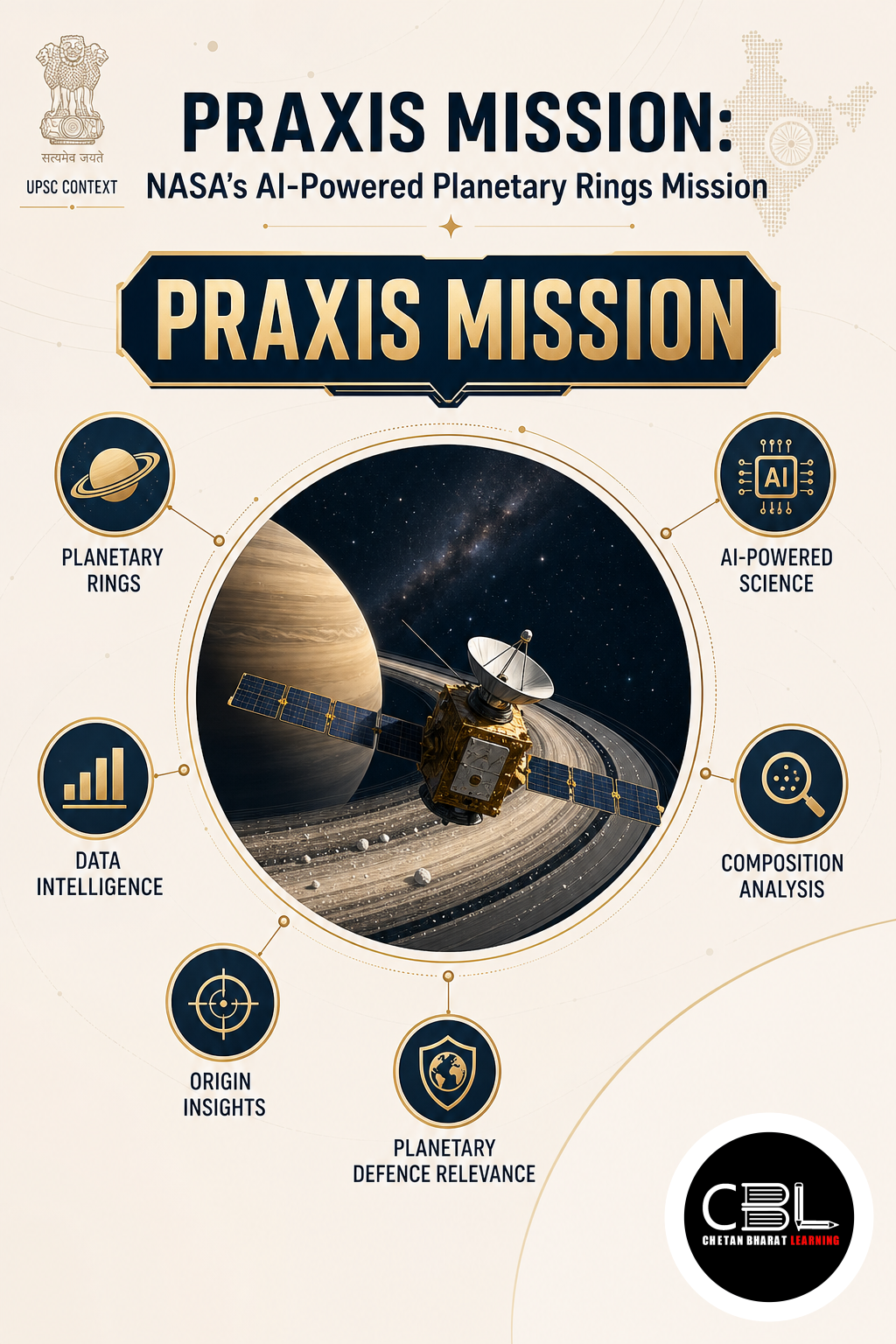
PRAXIS Mission (Planetary Rings Autonomous EXploration with In-situ Sampling) is a proposed NASA mission designed to become the first spacecraft to physically interact with planetary rings by touching, collecting and analysing ring particles directly in space. Unlike conventional sample-return missions, PRAXIS will perform in-situ analysis, examining particles onboard without returning samples to Earth. The mission combines artificial intelligence, autonomous navigation and bio-inspired robotics to operate safely in dynamic ring environments.
Why is PRAXIS Mission in News?
PRAXIS Mission is in the news because NASA selected it for funding under the 2026 NASA Innovative Advanced Concepts (NIAC) programme, which supports visionary technologies for future space exploration. The mission aims to demonstrate autonomous exploration of planetary rings using advanced AI systems and robotic technologies.
Key Features of PRAXIS Mission
- First direct ring exploration: Designed to physically touch and collect particles from planetary rings.
- Artificial Intelligence: AI models will predict particle trajectories and autonomously avoid collisions with moving debris.
- Bio-inspired robotics: Robotic systems inspired by biological mechanisms will enable safe particle collection.
- In-situ analysis: Onboard scientific instruments will examine particle size, porosity and composition without returning samples to Earth.
- Autonomous operations: The spacecraft will independently navigate hazardous ring environments in deep space.
Significance of PRAXIS Mission
- Origin of planetary rings: May explain how ring systems formed and evolved over billions of years.
- Composition studies: Provides direct measurements of ring particle characteristics.
- Advanced autonomous exploration: Demonstrates AI-enabled spacecraft operations in hazardous environments.
- Future deep-space missions: Establishes technologies applicable to challenging planetary exploration missions.
- Exploration of Centaurs: Enables investigation of ring systems surrounding minor planets such as Chariklo and Chiron.
What are Centaurs?
Centaurs are icy minor planets that orbit the Sun between Jupiter and Neptune. They are considered transitional objects because their orbits lie between the asteroid belt and the Kuiper Belt.
- Composition: Primarily composed of ice, dust and rocky material.
- Orbital region: Located in the outer Solar System.
- Examples: Chariklo and Chiron are among the best-known Centaurs.
- Unique feature: Some Centaurs possess their own planetary ring systems.
Challenges
- Dynamic environment: Ring particles move continuously at high speeds.
- Collision risk: Spacecraft must avoid debris while maintaining scientific operations.
- Autonomous decision-making: Large communication delays require onboard AI.
- Precision sampling: Collecting fragile particles without contamination is technically demanding.
- Deep-space reliability: Instruments must function accurately over extended missions.
Way Forward
Future planetary exploration will increasingly depend on autonomous spacecraft capable of making real-time decisions in complex environments. Advances in artificial intelligence, robotics and miniaturised scientific instruments will expand the scope of deep-space exploration. If successful, PRAXIS could establish a new model for studying planetary systems while enhancing understanding of Solar System evolution.
Prelims Practice Corner
Q1. PRAXIS Mission has been selected under which NASA programme?
- (a) Artemis
- (b) Discovery
- (c) NIAC
- (d) Voyager
Answer: (c) NASA Innovative Advanced Concepts (NIAC).
Q2. PRAXIS Mission is designed primarily to study:
- (a) Black holes
- (b) Planetary rings
- (c) Exoplanets
- (d) Comets
Answer: (b) Planetary rings.
Q3. Centaurs primarily orbit between:
- (a) Earth and Mars
- (b) Mars and Jupiter
- (c) Jupiter and Neptune
- (d) Neptune and Pluto
Answer: (c) Jupiter and Neptune.
Q4. Which technologies are central to PRAXIS Mission?
- (a) Nuclear propulsion only
- (b) AI and bio-inspired robotics
- (c) Solar sails only
- (d) Quantum communication only
Answer: (b) AI and bio-inspired robotics.
Q5. Chariklo and Chiron are examples of:
- (a) Dwarf planets
- (b) Centaurs
- (c) Gas giants
- (d) Kuiper Belt Objects only
Answer: (b) Centaurs.
Mains Practice Questions
Q1. Discuss the role of artificial intelligence and autonomous robotics in enabling future deep-space exploration missions. (10 marks)
Answer Structure:
- Intro: Explain the growing role of AI in space exploration.
- Body: Autonomous navigation, robotics, deep-space operations, scientific benefits and challenges.
- Conclusion: Highlight AI as a key enabler of future interplanetary missions.
Q2. Explain the scientific importance of studying planetary rings and Centaurs for understanding the evolution of the Solar System. (15 marks)
Answer Structure:
- Intro: Define planetary rings and Centaurs.
- Body: Ring composition, Solar System evolution, Centaur characteristics and PRAXIS Mission.
- Conclusion: Emphasise the importance of advanced exploration technologies.
FAQs on PRAXIS Mission
What is PRAXIS Mission?
PRAXIS (Planetary Rings Autonomous EXploration with In-situ Sampling) is a proposed NASA mission designed to directly explore and analyse planetary ring particles using AI-enabled autonomous technologies.
What are Centaurs?
Centaurs are icy minor planets orbiting the Sun between Jupiter and Neptune. Some, such as Chariklo and Chiron, possess their own ring systems.
Why is PRAXIS Mission important for UPSC?
The mission is relevant for UPSC under space technology, artificial intelligence, planetary science, autonomous robotics and recent international scientific developments.
Related Current Affairs
Preparing for UPSC, PCS or HCS?
Talk to a mentor at Chetan Bharat Learning, Chandigarh. Free guidance on choosing the right exam and building a study plan.
Chat on WhatsAppCall 97793 53345UPSC / IAS / PCS coaching in Chandigarh · Trusted by aspirants across Punjab & Haryana
Leave a Reply
You must be logged in to post a comment.