
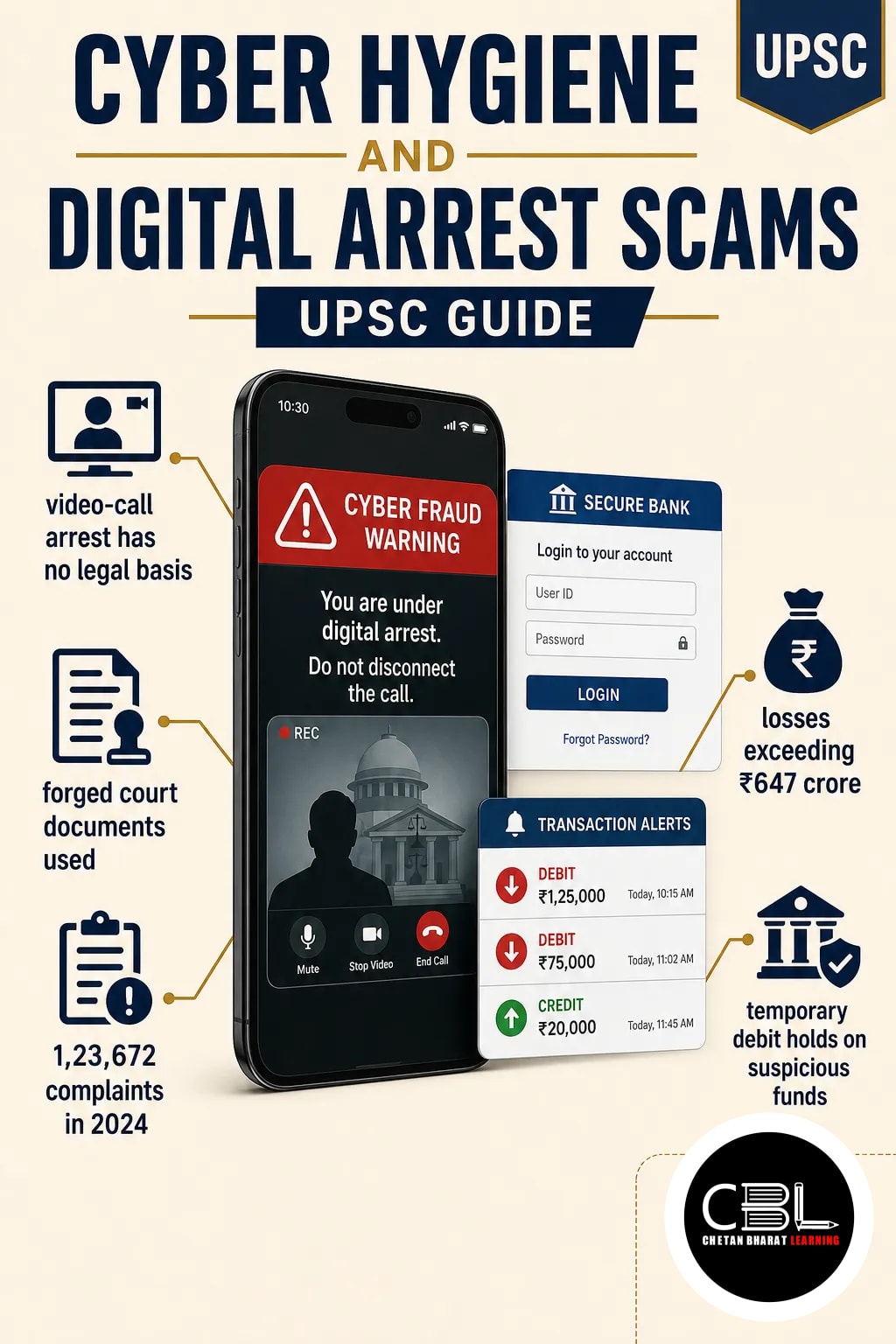

Cyber hygiene has gained attention after the Supreme Court questioned the response to digital arrest scams. The issue connects individual safety with cybersecurity governance and bank accountability.
Quick answer: Cyber hygiene means routine practices that reduce digital security risks. On 29 October 2026, the Supreme Court questioned banks and the Reserve Bank of India over digital arrest frauds. India recorded 21,928 such complaints from January to August 2026, with losses exceeding ₹647 crore. Prevention requires safeguards by both users and institutions.
What is cyber hygiene?
Cyber hygiene is the regular use of practices that protect devices, accounts and information from digital threats. For individuals, it includes updating software, using strong passwords and verifying unexpected requests for money or sensitive information.
For banks and public bodies, it also means monitoring suspicious activity, controlling access to systems and preparing to respond to incidents. However, technical security alone cannot stop a fraudster who persuades a person to authorise a transfer.
Why are digital arrest scams in the news?
The Supreme Court examined digital arrest frauds on 29 October 2026 and questioned both victim awareness and bank scrutiny. The three-judge Bench was headed by Chief Justice of India Surya Kant and included Justices Joymalya Bagchi and V Mohana.
The Court questioned the Reserve Bank of India (RBI) over its response and raised concerns about unusually large transfers, especially from older customers’ accounts. It also proposed bank liability for compensating victims where institutions failed to exercise adequate due diligence. This was a proposal, not a final ruling establishing liability.
The Court took suo motu cognisance in October 2025 after a Haryana senior citizen couple lost more than ₹1 crore. Fraudsters had impersonated investigative agencies and used forged court documents. For the compensation issue, see CBL’s analysis of digital arrest victim compensation.
How does a digital arrest scam work?
A digital arrest scam uses impersonation and fear to pressure a victim into transferring money. Crucially, Indian law provides no mechanism for arrest by video call, and an agency cannot demand money to avoid prosecution.
- Impersonation: Fraudsters pose as police officers, judges or officials of the Central Bureau of Investigation (CBI) or Enforcement Directorate.
- False allegations: They claim that a person’s Aadhaar details, bank account or mobile number is connected to a serious offence.
- Isolation: They may keep the victim on a call and discourage contact with others; meanwhile, fake warrants or police-station backgrounds create apparent authority.
- Transfer: They demand money for purported verification or to avoid arrest; intermediary or mule accounts can then move stolen funds.
Therefore, disconnecting the call and independently verifying the claim can interrupt the pressure. A person who has transferred money should promptly contact the bank and report the fraud to cybercrime authorities.
What do the complaint figures show?
Complaints fell after their 2024 peak, although reported losses remain substantial. The Indian Cybercrime Coordination Centre (I4C) submitted the following figures to the Supreme Court.
| Period | Complaints and reported losses |
|---|---|
| 2022 | 39,925 complaints |
| 2024 | 1,23,672 complaints; approximately ₹1,935 crore lost |
| 2025 | 58,239 complaints; approximately ₹1,211 crore lost |
| January–August 2026 | 21,928 complaints; losses exceeding ₹647 crore |
The 2026 figure covers only eight months, so it is not directly comparable with a full-year total. Moreover, industry executives caution that underreporting may leave some incidents outside official figures.
What safeguards are under consideration?
The RBI’s draft Know Your Customer (KYC) directions and a proposed kill switch address different stages of a suspected fraud. Neither should be treated as an established, universal facility on the basis of the source.
- Transaction monitoring: The September draft would require banks to identify and temporarily block suspicious transactions inconsistent with a customer’s usual banking behaviour.
- Targeted debit holds: Banks could temporarily hold suspicious funds rather than freeze entire accounts, particularly where mule activity is suspected. The draft also provides for verification and safeguards against indefinite freezing.
- Kill switch: The government and RBI are examining an emergency mechanism that could let users stop account transactions when they suspect a scam. One possibility is a button in lenders’ payment applications.
These measures complement user awareness, but each has a trade-off. For example, a broad freeze may prevent further losses while also blocking legitimate payments. The CBL guide to data breaches and security advisories provides related context on institutional preparedness.
What are the governance challenges?
Cyber hygiene policy must address both manipulation of users and weaknesses in the transaction chain. A victim’s decision to transfer money does not by itself settle whether a bank exercised adequate scrutiny.
- Detection: Banks must identify unusual transfers quickly; however, unusual activity alone does not prove fraud.
- Accountability: Compensation depends on establishing what due diligence an institution should have performed and whether it failed to do so.
- Access and safeguards: A hold can protect funds, but an indefinite or excessive restriction can harm legitimate account holders.
- Enforcement: Mule accounts and networks operating overseas can complicate tracing and recovery; consequently, timely coordination matters.
What should be the way forward?
A layered response should combine public awareness, bank controls and accessible remedies. First, campaigns should explain the specific warning signs: isolation on a call, forged authority and demands for transfers.
Second, banks should use risk-based checks and offer customers a clear way to contest mistaken holds. Third, any compensation framework should specify due-diligence standards and a fair process for assessing responsibility. Finally, a well-designed emergency stop should be easy to use while providing a safe route to restore access.
Source: Indian Express Explained, 30 October 2026
- Data Breaches: CERT-In Advisory and UPSC Angle (21 Oct 2026)
- Cyber Terrorism: PM Warning and UPSC Relevance (28 Oct 2026)
The Supreme Court’s suo motu case followed a complaint by a senior citizen couple from Haryana. For Punjab PCS and Haryana HCS, connect the case to cybercrime awareness, policing and coordination with banks.
Prelims Practice Corner
Mains Practice Questions
Frequently Asked Questions
Is digital arrest legal in India?
No, because Indian law has no provision for arrest by video call. Fraudsters use the claim to pressure people into transferring money.
What should someone do after receiving a digital arrest call?
Disconnect the call and independently verify the claim. If money has been transferred, promptly contact the bank and report the fraud to cybercrime authorities.
Has the Supreme Court made banks liable for every digital arrest loss?
No, because the Court proposed liability where banks failed to exercise adequate due diligence. The source does not describe a final ruling imposing liability for every loss.
What is a banking kill switch?
It is a proposed emergency mechanism to stop account transactions when a user suspects fraud. The government and RBI are examining options, including a button in lenders’ payment applications.
Related Current Affairs
Preparing for UPSC, PCS or HCS?
Talk to a mentor at Chetan Bharat Learning, Chandigarh. Free guidance on choosing the right exam and building a study plan.
Chat on WhatsAppCall 97793 53345UPSC / IAS / PCS coaching in Chandigarh · Trusted by aspirants across Punjab & Haryana
Leave a Reply
You must be logged in to post a comment.