
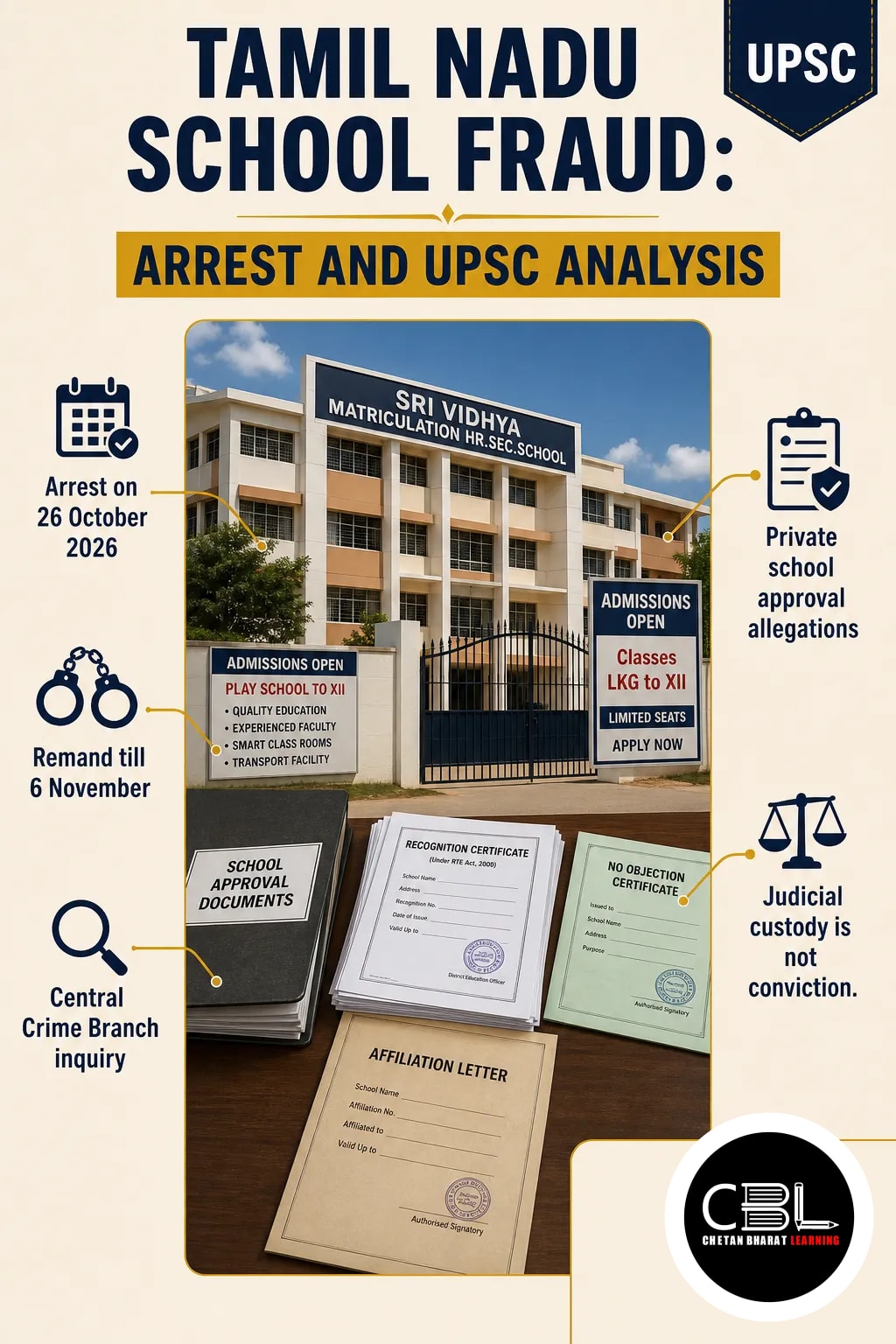
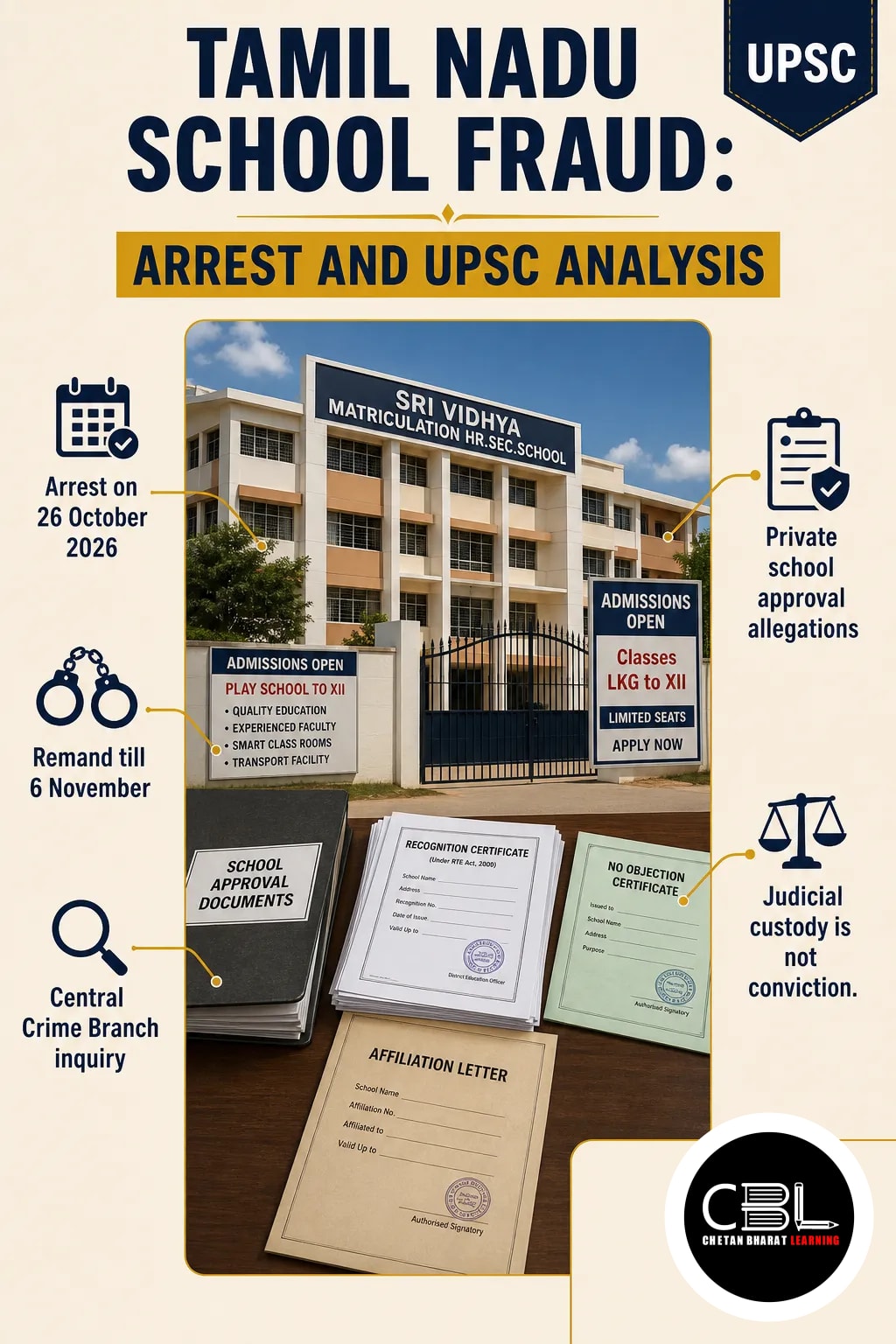
Tamil Nadu school fraud allegations led Chennai Police to arrest former School Education Minister Anbil Mahesh Poyyamozhi on 26 October 2026. The case raises questions about private-school regulation, corruption and due process. Explore related polity and governance current affairs.
Quick answer: In the Tamil Nadu school fraud case, Chennai Police arrested former minister Anbil Mahesh Poyyamozhi on 26 October 2026 after his anticipatory bail plea was rejected. A Chennai special court remanded him to judicial custody till 6 November. The investigation concerns alleged payments collected from private schools for recognition and approvals.
What did the Chennai court order?
The special court remanded Poyyamozhi to judicial custody till 6 November 2026. His anticipatory bail plea had been rejected before the arrest. After a medical check-up at a government hospital, police produced him before the court at 10.10 pm on 26 October.
Judge L. S. Sathiyamurthy heard the defence and prosecution before ordering remand. Remand is not a conviction; the allegations must be examined through the legal process. Moreover, the reported order concerns custody, not a finding that the accused committed the alleged offences.
What are the allegations in the Tamil Nadu school fraud case?
The investigation concerns money allegedly collected from private school managements in exchange for promised recognition and statutory approvals. The Central Crime Branch (CCB) is investigating the allegations. Police sources said several crores were collected as a purported party fund from managements across Tamil Nadu.
The case began with a complaint by C. Elangovan, secretary of the Tamil Nadu Private Schools Federation. He accused B. T. Arasakumar of collecting large sums through an unregistered body called the Tamil Nadu Private Schools Association. According to the complaint, Arasakumar invoked supposed political influence while promising help with approvals.
| Issue | Reported detail |
|---|---|
| Promised services | School upgrades, permanent recognition and building-plan approvals |
| Former minister | Poyyamozhi held the school education portfolio from 2021 to 2026 |
| Another accused | Arasakumar was later detained under the Goondas Act |
| Alleged amount | Associate Muthukumar was allegedly involved in a scam worth about ₹100 crore; police said he was absconding |
The CCB included Poyyamozhi as an accused after its inquiry identified evidence pointing to alleged involvement. Meanwhile, former Chief Minister M. K. Stalin called the arrest political vendetta and said Poyyamozhi would contest the allegations legally. These are competing positions, not judicial findings.
Which constitutional and legal provisions matter?
The case connects criminal procedure and anti-corruption law with constitutional protections and education governance. The following provisions provide a framework for analysis, not a finding that any particular offence is proved.
| Provision | Relevance |
|---|---|
| Article 21 | Protects life and personal liberty except according to procedure established by law. |
| Article 22 | Provides safeguards concerning arrest and detention, subject to constitutional exceptions. |
| Article 21A | Requires free and compulsory education for children aged six to fourteen, as provided by law. |
| Concurrent List, Entry 25 | Places education in the Concurrent List, subject to specified Union List entries. |
| Prevention of Corruption Act, 1988 | Provides a framework for dealing with specified corruption offences; a special court heard the remand matter. |
In judicial custody, an accused is ordinarily held in jail under judicial authority, rather than in a police station. Police interrogation during judicial custody requires court permission. By contrast, anticipatory bail is a direction for release on bail in the event of arrest; rejection does not establish guilt.
Why does the case matter for school governance?
The allegations highlight how approval systems can become vulnerable when applicants depend on informal intermediaries. The case also shows why regulators must protect both public accountability and the rights of accused persons.
- Regulatory integrity: If approvals can be influenced by payments, recognition may cease to reflect compliance with prescribed standards.
- Student welfare: Building and recognition decisions affect the conditions in which children study; therefore, scrutiny matters beyond administrative paperwork.
- Public trust: Alleged political access can weaken confidence in impartial decisions. However, investigators must establish individual responsibility through evidence.
- Cooperation with inquiry: School representatives may have relevant records or testimony. Thus, fair treatment and appropriate safeguards can encourage cooperation.
For a related public-sector accountability theme, see CBL’s analysis of corruption inspection and governance. Also see the witness protection scheme discussion for safeguards relevant to criminal proceedings.
What safeguards can improve approvals and accountability?
Transparent procedures, verifiable records and independent scrutiny can reduce opportunities for influence over approvals. These are policy responses to the risks illustrated by the allegations, not findings about existing Tamil Nadu procedures.
- Publish requirements: Make eligibility criteria, fees, timelines and appeal channels accessible. Consequently, applicants can distinguish official processes from intermediaries’ claims.
- Track decisions: Record applications, inspections, reasons for decisions and authorised payments. In addition, audit trails can help investigators reconstruct decisions.
- Separate functions: Use checks between inspection, approval and review. However, oversight must not displace clear responsibility for each decision.
- Protect due process: Investigate financial records and testimony impartially while respecting bail, custody and fair-trial safeguards. Moreover, provide safe channels for relevant disclosures.
Overall, effective regulation requires both credible enforcement and lawful procedures. Neither public office nor political disagreement should substitute for an evidence-based determination of guilt.
Source: The Hindu, 30 October 2026
Asked in UPSC: Previous Year Questions
- UPSC CSE Prelims 2021 (GS Paper I): With reference to India, consider the statements on where an accused in judicial custody is held and whether police interrogation requires court approval.
UPSC tests the distinction between judicial custody and police custody, as well as safeguards on interrogation.
State PCS General Studies may test education regulation, administrative accountability and custody safeguards. For Punjab PCS and Haryana HCS, connect these principles to state-level service delivery without assuming identical approval procedures.
Prelims Practice Corner
Mains Practice Questions
Frequently Asked Questions
Why was Anbil Mahesh Poyyamozhi arrested?
He was arrested in connection with alleged payments collected from private schools for promised approvals. The CCB is investigating the allegations; however, arrest does not establish guilt.
Until when did the court remand the former minister?
The court remanded him to judicial custody till 6 November 2026. It issued the order after hearing the defence and prosecution on 26 October.
Does judicial custody mean a person has been convicted?
No, because judicial custody is a custody arrangement, not a finding of guilt. The court must determine guilt through the applicable legal process.
Which constitutional list includes education?
Education is in the Concurrent List under Entry 25, subject to specified Union List entries. Therefore, both Parliament and state legislatures have a role in the field.
Related Current Affairs
Preparing for UPSC, PCS or HCS?
Talk to a mentor at Chetan Bharat Learning, Chandigarh. Free guidance on choosing the right exam and building a study plan.
Chat on WhatsAppCall 97793 53345UPSC / IAS / PCS coaching in Chandigarh · Trusted by aspirants across Punjab & Haryana
Leave a Reply
You must be logged in to post a comment.