
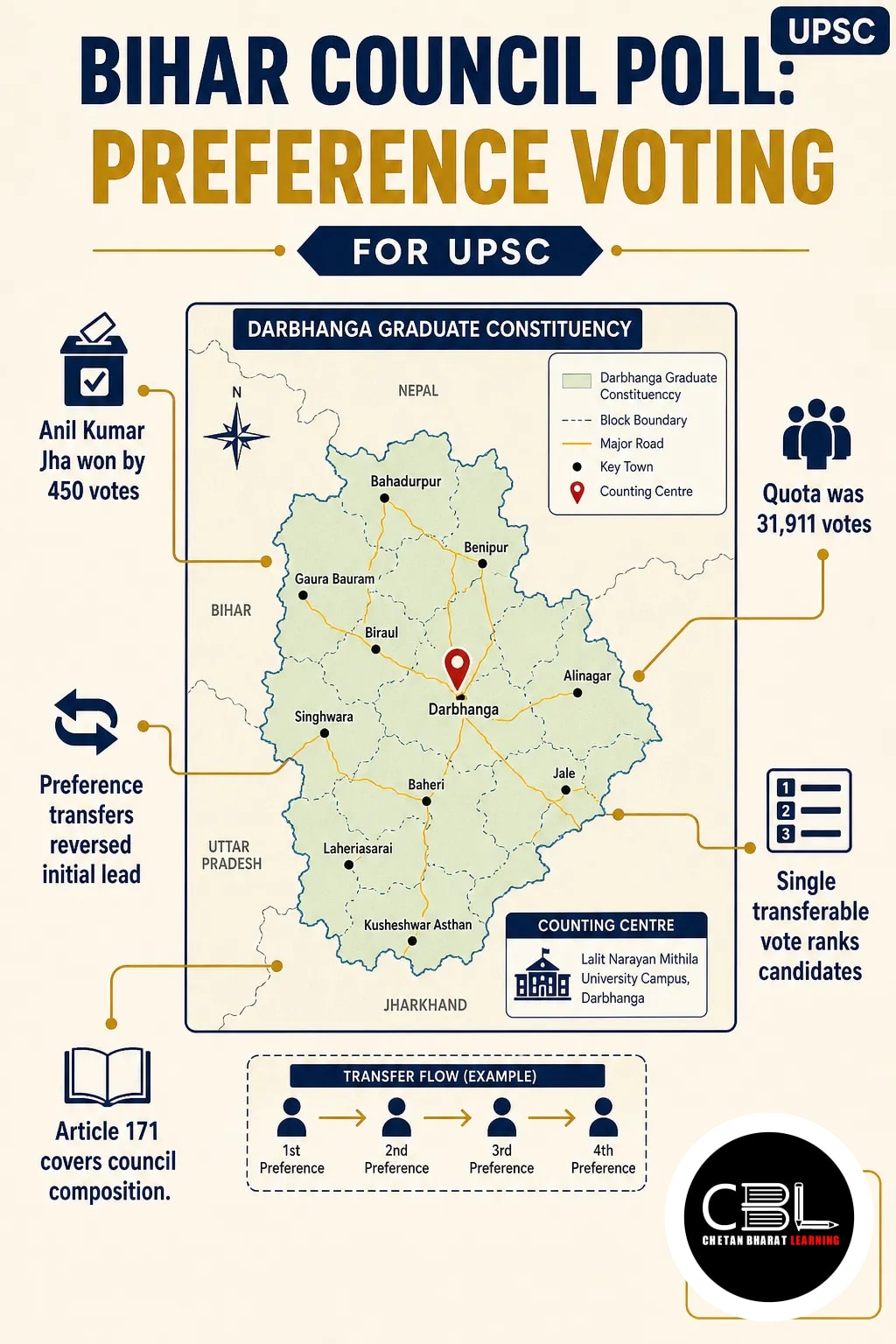

The Bihar council poll turned on preference transfers in the Darbhanga graduate constituency. The result illustrates an electoral system relevant to UPSC polity preparation.
Quick answer: In the Bihar council poll, Rashtriya Janata Dal candidate Anil Kumar Jha defeated Bharatiya Janata Party candidate Sarvesh Kumar in the Darbhanga graduate seat by 450 votes. Neither reached the 31,911-vote quota on first preferences. Consequently, transfers from eliminated candidates reversed Kumar’s initial lead after approximately 60 hours of counting.
What happened in Darbhanga?
Anil Kumar Jha won the graduate seat after trailing Sarvesh Kumar throughout ten rounds of first-preference counting. Neither candidate initially reached the 31,911-vote quota, so the count proceeded to eliminations and transfers.
Congress candidate Rajni Kant Pathak and Jan Suraaj Party candidate Dr Imteyaz Noorani were among those eliminated. Subsequently, Jha received a majority of the transfers from eliminated candidates and won by 450 votes.
Bihar council poll: key results
The result brought the Rashtriya Janata Dal (RJD) level with the Bharatiya Janata Party (BJP), with two seats each. The reported tally also included the following winners:
| Party or group | Seats won |
|---|---|
| RJD | 2 |
| BJP | 2 |
| Janata Dal (United) | 1 |
| Jan Suraaj Party | 1 |
| Independents | 2 |
The BJP did not win either of the two Darbhanga seats. Meanwhile, its state president Sanjay Saraogi represents Darbhanga in the Assembly.
How does preference voting work?
Voters rank candidates in order under the single transferable vote (STV) system. They mark 1 for their first choice, 2 for their second and so on.
If no candidate reaches the required quota, the count can eliminate lower-ranked candidates and transfer their ballots according to available preferences. Thus, a candidate who initially trails can overtake the first-preference leader.
The Constitution prescribes proportional representation by STV for elected Legislative Council seats. It also uses STV for presidential and Rajya Sabha elections, although the electoral colleges and counting contexts differ.
Why does the result matter for UPSC?
The result links preference counting with the constitutional composition of state Legislative Councils. Under Article 171, approximately one-twelfth of council members come from graduate constituencies and one-twelfth from teachers’ constituencies.
In addition, approximately one-third are elected by local authorities and one-third by Assembly members from persons outside the Assembly. The Governor nominates the remainder from specified fields. For broader context, revise the constitutional status of voting rights.
Source: The Indian Express, 29 October 2026
State PCS General Studies can test Legislative Council composition and preference voting through this result. Therefore, distinguish council electoral colleges from direct Assembly elections.
Prelims Practice Corner
Mains Practice Questions
Frequently Asked Questions
Who won the Darbhanga graduate seat?
RJD candidate Anil Kumar Jha won by 450 votes. He overtook BJP candidate Sarvesh Kumar after preference transfers.
What was the winning quota in Darbhanga?
The quota was 31,911 votes. Since neither leading candidate reached it initially, the count proceeded to eliminations and transfers.
Which constitutional article covers Legislative Council composition?
Article 171 covers Legislative Council composition. It also specifies the broad proportions elected by different constituencies and nominated by the Governor.
Related Current Affairs
Preparing for UPSC, PCS or HCS?
Talk to a mentor at Chetan Bharat Learning, Chandigarh. Free guidance on choosing the right exam and building a study plan.
Chat on WhatsAppCall 97793 53345UPSC / IAS / PCS coaching in Chandigarh · Trusted by aspirants across Punjab & Haryana
Leave a Reply
You must be logged in to post a comment.