
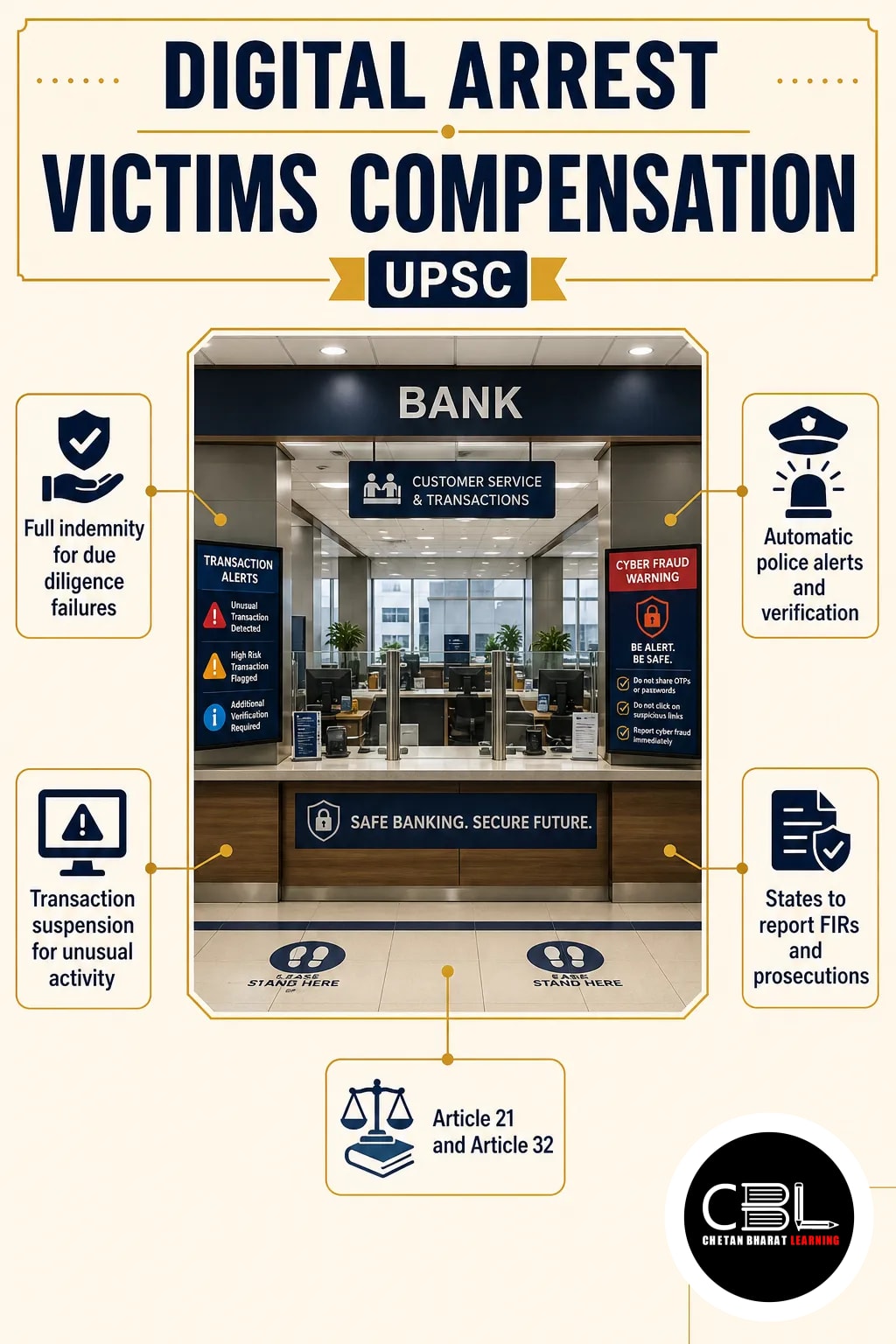

Digital arrest victims compensation is under Supreme Court scrutiny after the Bench called for financial institutions to bear losses linked to their own due diligence failures. The issue connects constitutional governance with banking regulation and cybercrime response.
Quick answer: On 29 October 2026, the Supreme Court asked the Reserve Bank of India to mandate full indemnity for digital arrest victims where institutional negligence enabled the fraud. The Bench also sought transaction safeguards and state investigation data. The proposed rules were not yet notified; the government gave a 30 November notification target.
What did the Supreme Court say?
The Bench called for full indemnity when a financial institution’s lack of due diligence enables digital arrest fraud. In effect, digital arrest victims compensation would depend on an institutional lapse linked to the crime, rather than on fraud alone.
However, the court’s comments should not be confused with a final, notified compensation scheme. It wanted to examine the proposed Reserve Bank of India (Know Your Customer) Amendment Directions, 2026, and agreed to schedule the matter again before 30 November.
The court also sought systems to temporarily suspend transactions that depart from an account’s usual activity. Furthermore, it envisaged automatic police alerts, followed by physical verification to establish whether transactions were genuine.
What is digital arrest and why is the case significant?
Digital arrest is a fraud in which criminals impersonate law-enforcement officials and use a supposed arrest to pressure victims into transferring money. Chief Justice of India Surya Kant questioned the belief that someone could be arrested over a mobile phone call.
The Chief Justice cited losses of over ₹800 crore and said around ₹3,000 crore had been lost to digital arrests in the previous year. Meanwhile, Attorney-General R. Venkataramani said digital arrest instances had fallen by 50% this year compared with the previous year.
The Attorney-General also said money had been restored in over 11 lakh cases. Separately, he cited over seven lakh restoration requests and orders in more than 5.5 lakh cases; these figures should not be assumed to describe the same group of cases.
The Bench directed states to provide information on first information reports (FIRs), investigations and prosecutions. For broader context, see CBL’s coverage of the Supreme Court’s digital dacoity ruling.
Which legal provisions and institutions matter?
The case involves constitutional protection, banking supervision and criminal investigation, but the proposed compensation rules remain under examination.
| Provision or institution | Relevance |
|---|---|
| Article 21 | Protects life and personal liberty; privacy forms part of this protection. |
| Article 32 | Provides a remedy to approach the Supreme Court for enforcement of fundamental rights. |
| Reserve Bank of India (RBI) | The central bank whose proposed Know Your Customer (KYC) amendments the court wants to examine. |
| State police | Investigate offences; states must provide the Bench with case-status information. |
For constitutional analysis, distinguish the general rights framework from the court’s specific proposal. Article 21 does not, by itself, establish the compensation mechanism discussed at this hearing.
What are the implications for digital arrest victims compensation?
The proposal would connect victim relief with the duties of institutions that handle transactions.
- Accountability: Compensation can encourage financial institutions to invest in customer verification and transaction monitoring.
- Early intervention: Temporary suspension may limit losses before funds move further, provided institutions verify alerts quickly.
- Victim relief: A clear claim process could reduce uncertainty for victims. However, a claim would still require an assessment of institutional failure and its connection with the loss.
- Coordination: Police alerts and state case information can connect financial safeguards with investigation and prosecution.
Furthermore, digital arrest victims compensation would address only one part of cybercrime control. CBL’s analysis of critical infrastructure cybersecurity provides a wider institutional perspective.
What challenges must the framework address?
The main challenge is to prevent fraud without blocking legitimate payments or creating open-ended surveillance.
- Proof of lapse: Investigators must distinguish an institution’s due diligence failure from fraud that occurred despite reasonable controls.
- False alerts: An unusual transaction is not necessarily fraudulent. Therefore, prolonged or unnecessary suspension could harm legitimate account holders.
- Privacy: Monitoring and police alerts require safeguards over access, retention and use of personal financial information.
- Shared responsibility: Banks, investigators and platforms have different roles. Consequently, unclear responsibilities can delay relief and investigation.
- Insider risk: The court raised concern about bank employees’ involvement. Internal checks therefore matter alongside customer awareness.
WhatsApp’s counsel told the court that the platform had banned 9,400 suspicious accounts and was developing identification software. The court allowed the platform to intervene and respond; meanwhile, the Attorney-General said intermediary responsibilities would form part of instructions from the relevant government departments.
What should a victim-centred response include?
A workable response should combine prompt prevention, fair compensation and accountable investigation.
First, the final rules could define due diligence duties, evidence standards and a time-bound process for deciding claims. They should also provide reasons and review when an institution rejects a claim.
Second, transaction alerts need proportionate thresholds, quick human verification and a clear route to restore genuine payments. In addition, restricted data access and audit trails can protect privacy.
Finally, banks, police and platforms should share relevant information through defined channels. Public communication should explain impersonation tactics without blaming victims; stronger safeguards and informed customers are complementary, not substitutes.
Source: The Hindu, 29 October 2026
- Digital Dacoity Ruling: Supreme Court on Cybercrime (28 Oct 2026)
Punjab PCS and Haryana HCS can test the roles of state police in cybercrime investigation and victim assistance. Additionally, revise coordination between state agencies, banks and the central regulator without assuming state-specific figures.
Prelims Practice Corner
Mains Practice Questions
Frequently Asked Questions
What compensation did the Supreme Court seek for digital arrest victims?
Full indemnity, where institutional lack of due diligence enabled the fraud. However, the proposed regulatory framework was yet to be notified.
Can someone be arrested over a mobile phone call?
No, a mobile phone call does not itself constitute an arrest. Fraudsters nevertheless impersonate officials and use such claims to pressure victims.
When are the proposed RBI KYC directions expected?
The Attorney-General gave 30 November 2026 as the notification target. Additionally, he gave 31 December 2026 as the target for operationalisation.
Did the court ask states for digital arrest case data?
Yes, the Bench directed states to provide details of registered FIRs. It also sought the status of investigations and prosecutions.
Related Current Affairs
Preparing for UPSC, PCS or HCS?
Talk to a mentor at Chetan Bharat Learning, Chandigarh. Free guidance on choosing the right exam and building a study plan.
Chat on WhatsAppCall 97793 53345UPSC / IAS / PCS coaching in Chandigarh · Trusted by aspirants across Punjab & Haryana
Leave a Reply
You must be logged in to post a comment.